
How to Use Chlorine Dioxide Tablets for Cleaning: Concentration, Contact Time & Best Practices
⏱️Article At a Glance
🏠 Best For: Homeowners, cleaning professionals and anyone learning how to use Envirotab® chlorine dioxide tablets correctly
🔑 Key Takeaways
- Chlorine dioxide tablets must be activated in the correct amount of water. Tablet size and water volume determine the resulting concentration.
- PPM matters. Cleaning, deodorizing and other labeled applications should not automatically use the same chlorine dioxide concentration.
- Pre-cleaning matters. Visible dirt, grease and organic material should generally be removed before an antimicrobial treatment because soil can interfere with disinfectant performance. CDC similarly recommends cleaning surfaces before sanitizing or disinfecting.
- Contact time matters. For disinfectant applications, the treated surface needs to remain wet for the time specified by the applicable product directions.
- Coverage matters. A correctly prepared solution cannot work effectively on areas it never reaches.
- More ClO₂ isn't automatically better. Excessively strong solution can waste product and may increase exposure or material-compatibility concerns.
- Never casually mix cleaning chemicals. Follow the Envirotab® instructions for the specific application.
- The best cleaning process is: Identify → Pre-Clean → Prepare → Apply → Allow Contact Time → Verify.
Continue Reading
⏱️Reading Time: About 10–12 Minutes
⬇️⬇️⬇️⬇️
How Do You Use Chlorine Dioxide Tablets for Effective Cleaning?
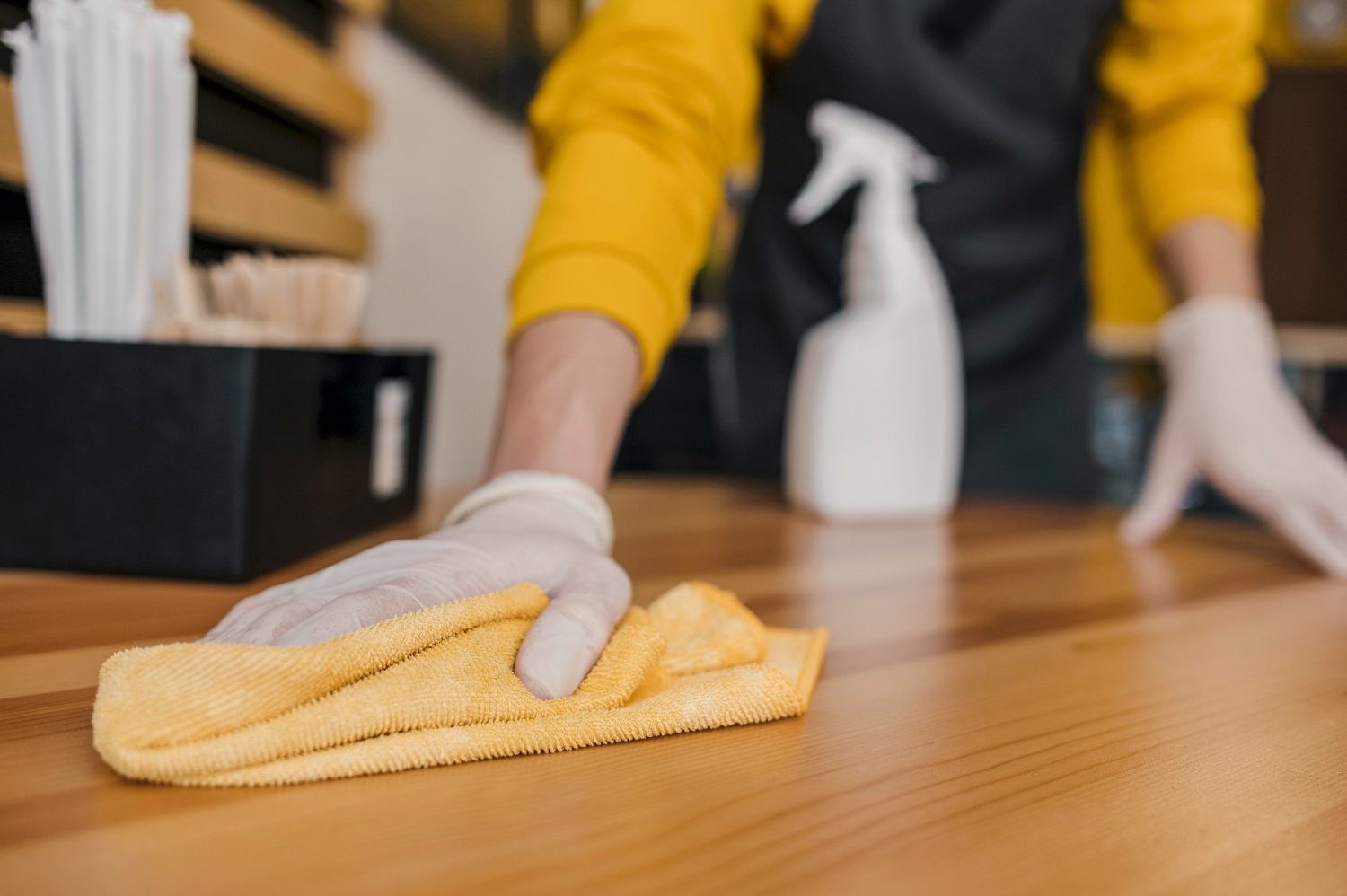
Chlorine dioxide tablets are activated in water according to product-specific directions to generate an aqueous chlorine dioxide (ClO₂) solution. For effective use, first identify the cleaning problem, choose the appropriate tablet and concentration, remove heavy visible soil, activate the tablet in the specified volume of water, apply the solution evenly, and follow the required contact-time and rinse instructions for that application.
The most important principle is simple:
Effective ClO₂ cleaning isn't about making the strongest solution. It's about creating the right solution for the job.
That means understanding four variables:
Concentration + Coverage + Contact Time + Surface Condition
Get those right, and chlorine dioxide becomes a remarkably versatile cleaning chemistry.
Get them wrong, and adding more chemical isn't necessarily going to fix the problem.
Also Read 📖Benefits Of Using Chlorine Dioxide Tablets For Home Environment
Cleaning Has a Chemistry Problem
Walk through the average cleaning aisle and you'll find a product for practically everything.
Kitchen cleaner.
Bathroom cleaner.
Odor eliminator.
Disinfectant.
Glass cleaner.
Pet-odor spray.
Mold-and-mildew cleaner.
Fabric refresher.
And underneath all those brightly colored bottles is a much more interesting question:
What exactly are you trying to accomplish?
Sometimes you're removing soil.
Sometimes you're trying to reduce microorganisms.
Sometimes you're dealing with odor molecules.
Sometimes you're trying to break down organic contamination.
And sometimes you're dealing with a physical problem—like moisture or damaged material—that chemistry alone cannot solve.
This is where chlorine dioxide becomes interesting.
Instead of starting with the name on the front of a spray bottle, ClO₂ encourages us to start with the problem.
Also Read 📖What Makes Some Residues Harder to Reach Than Others?
What Happens When an Envirotab® Tablet Goes Into Water?

Chlorine dioxide is represented by the chemical formula ClO₂.
Envirotab® tablets are designed to generate chlorine dioxide in water. The company's product literature describes its tablets as producing a sediment-free aqueous chlorine dioxide solution within minutes or less, depending upon the tablet/product configuration.
This on-demand preparation matters because chlorine dioxide is reactive chemistry.
EPA technical information notes that chlorine dioxide is generally produced at or near the point where it will be used, although aqueous chlorine dioxide solution can have greater stability when appropriately protected and stored.
In practical household terms:
Tablet + Correct Water Volume → Activated ClO₂ Solution
But that equation has one enormously important variable:
How much water?
That's where PPM enters the picture.
Also Read 📖Safe Use of Chlorine Dioxide Tablets | Guidelines, PPE & Mixing Instructions
Understanding PPM: The Number Every ClO₂ User Should Know
PPM means parts per million.
It describes concentration.
You don't need a chemistry degree to understand the basic principle.
Imagine dropping a small amount of food coloring into:
- one cup of water,
- one gallon of water,
- or a swimming pool.
Same amount of material.
Very different concentration.
Chlorine dioxide follows the same fundamental concept.
Tablet size alone does NOT tell you the final concentration.
The amount of water matters.
This means:
Same Tablet + Less Water = Higher Concentration
Same Tablet + More Water = Lower Concentration
And that's exactly why someone shouldn't simply drop any Envirotab® into whatever spray bottle happens to be nearby.
Also Read📖What to Do If You Mixed Chlorine Dioxide at the Wrong PPM | CLO2 Tablets
Why Isn't One PPM Right for Everything?
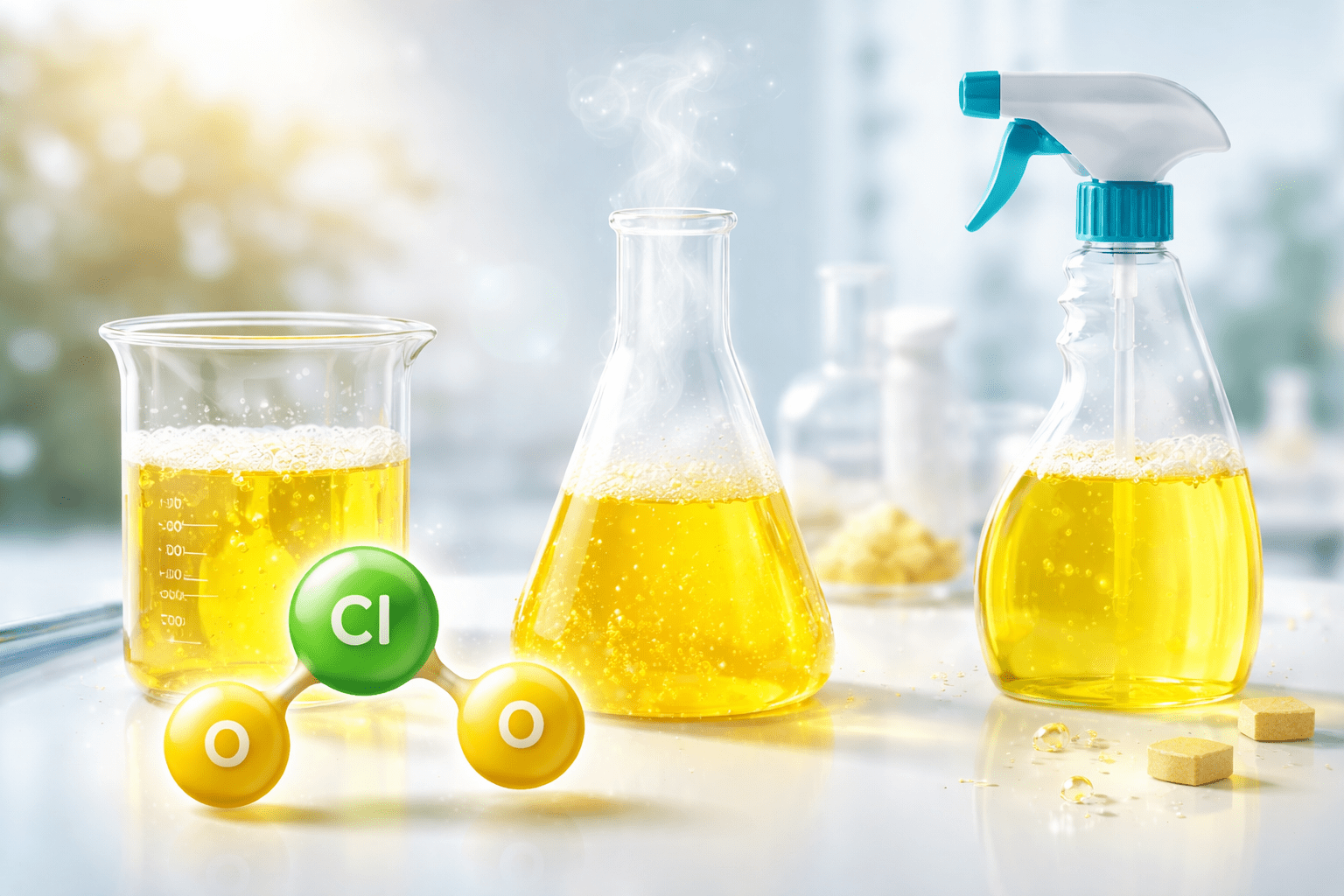
Because cleaning problems aren't identical.
Think about the difference between:
routine surface cleaning
and
a persistent odor problem
and
a heavily contaminated surface.
Those aren't necessarily the same chemical challenge.
Different applications can involve different:
- concentrations,
- contact times,
- application methods,
- surface preparation,
- PPE considerations,
- and rinse requirements.
The correct approach is therefore not:
“What's the strongest solution I can make?”
It is:
“What concentration is specified for this application?”
That single change in thinking makes chlorine dioxide use far more precise.
The Envirotab® Cleaning Method: 6 Steps to Smarter ClO₂ Use
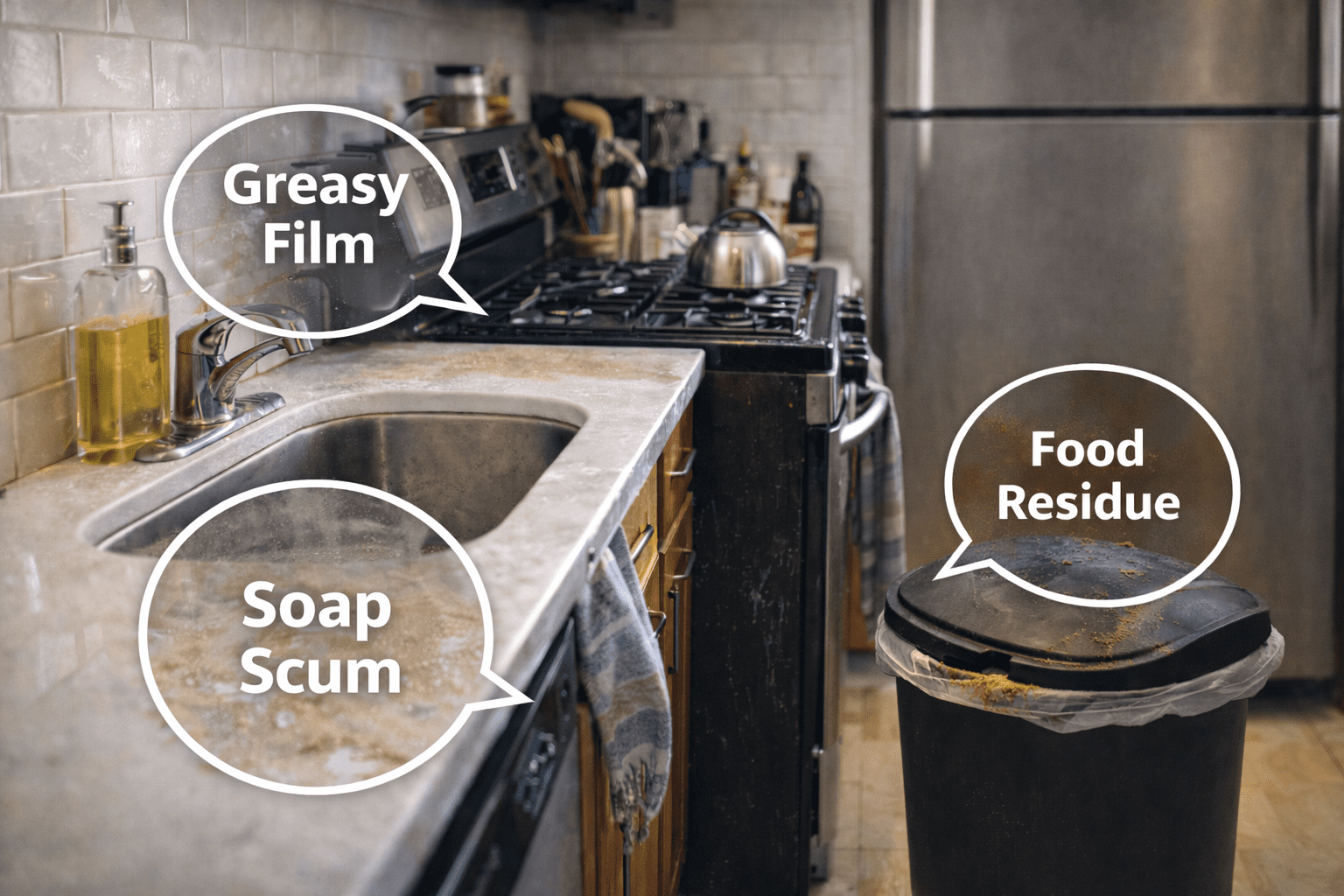
Let's turn the chemistry into something practical.
STEP 1 — IDENTIFY THE PROBLEM
Before touching a tablet, determine what you're actually trying to accomplish.
Is the problem visible dirt?
Physical cleaning is probably required first.
Is it grease?
ClO₂ should not automatically be treated as a replacement for an appropriate degreasing process.
Is it odor?
Find the source before treating the smell.
Is it microbial contamination?
Determine whether you're cleaning, sanitizing or disinfecting and follow the applicable product directions.
Is it moisture?
Fix the moisture problem.
This step prevents a very common mistake:
Using more chemistry to compensate for an unidentified problem.
STEP 2 — PRE-CLEAN WHEN NECESSARY
This may be one of the most overlooked parts of effective disinfection.
If a countertop has dried food, grease and dirt on it, spraying disinfectant over everything doesn't magically make physical contamination disappear.
CDC distinguishes cleaning from disinfecting and recommends cleaning surfaces before sanitizing or disinfecting because dirt and impurities can interfere with the disinfectant's ability to reach and act on microorganisms.
So:
Remove the physical soil first.
Wipe away:
- crumbs,
- food residue,
- grease,
- mud,
- hair,
- organic debris,
- and other visible contamination.
Then use the appropriate chemistry.
CLEANING SCIENCE RULE:
You cannot disinfect dirt. Remove the dirt so the chemistry can reach the surface.
Also Read 📖Chlorine Dioxide Tablets for House Cleaning | Complete FAQ & Safety Guide
STEP 3 — CHOOSE THE CORRECT ENVIROTAB® TABLET AND CONCENTRATION

Now we're ready for the chemistry.
Envirotab® is available in different tablet sizes because one concentration and one solution volume aren't ideal for every application.
The company's current product literature includes tablet sizes ranging from 1 gram through substantially larger formats, with different solution capacities and suggested applications.
For many household cleaning applications, the 1g Envirotab® format provides a convenient option for preparing smaller quantities.
But don't choose a tablet based purely on size.
Choose based on:
Application → Required Concentration → Water Volume → Tablet
That's the correct order.
Don't reverse it.
Buying a large tablet and guessing how much water to add is not precision cleaning.
STEP 4 — ACTIVATE THE TABLET CORRECTLY
Once you've selected the correct product and water volume:
- Use the water volume specified by the Envirotab® directions.
- Add the appropriate tablet.
- Allow it to activate according to the instructions.
- Do not improvise by adding other cleaning chemicals.
- Apply the prepared solution according to its intended use.
The existing ClO2Tablets hard-surface guide describes tablet activation as occurring rapidly and notes the characteristic amber-yellow appearance of prepared solution.
And remember:
More tablets ≠ better cleaning.
Adding another tablet changes the concentration.
That's chemistry—not a cleaning hack.
STEP 5 — APPLY FOR COMPLETE COVERAGE

Now we arrive at another variable that people often underestimate.
Coverage.
Imagine spraying a large countertop three times.
Maybe 20% of the surface is visibly wet.
Even if the solution concentration is correct, the chemistry cannot effectively treat an area it never contacts.
Depending upon the application and product directions, ClO₂ solution may be applied using appropriate tools such as:
- spray equipment,
- microfiber,
- cloths,
- mops,
- or sponges.
EPA technical guidance also describes aqueous chlorine dioxide being applied to hard surfaces through methods such as sponging, mopping or coarse spraying within applicable treatment systems.
The goal is appropriate, even coverage—not simply creating a cloud of spray.
STEP 6 — RESPECT CONTACT TIME
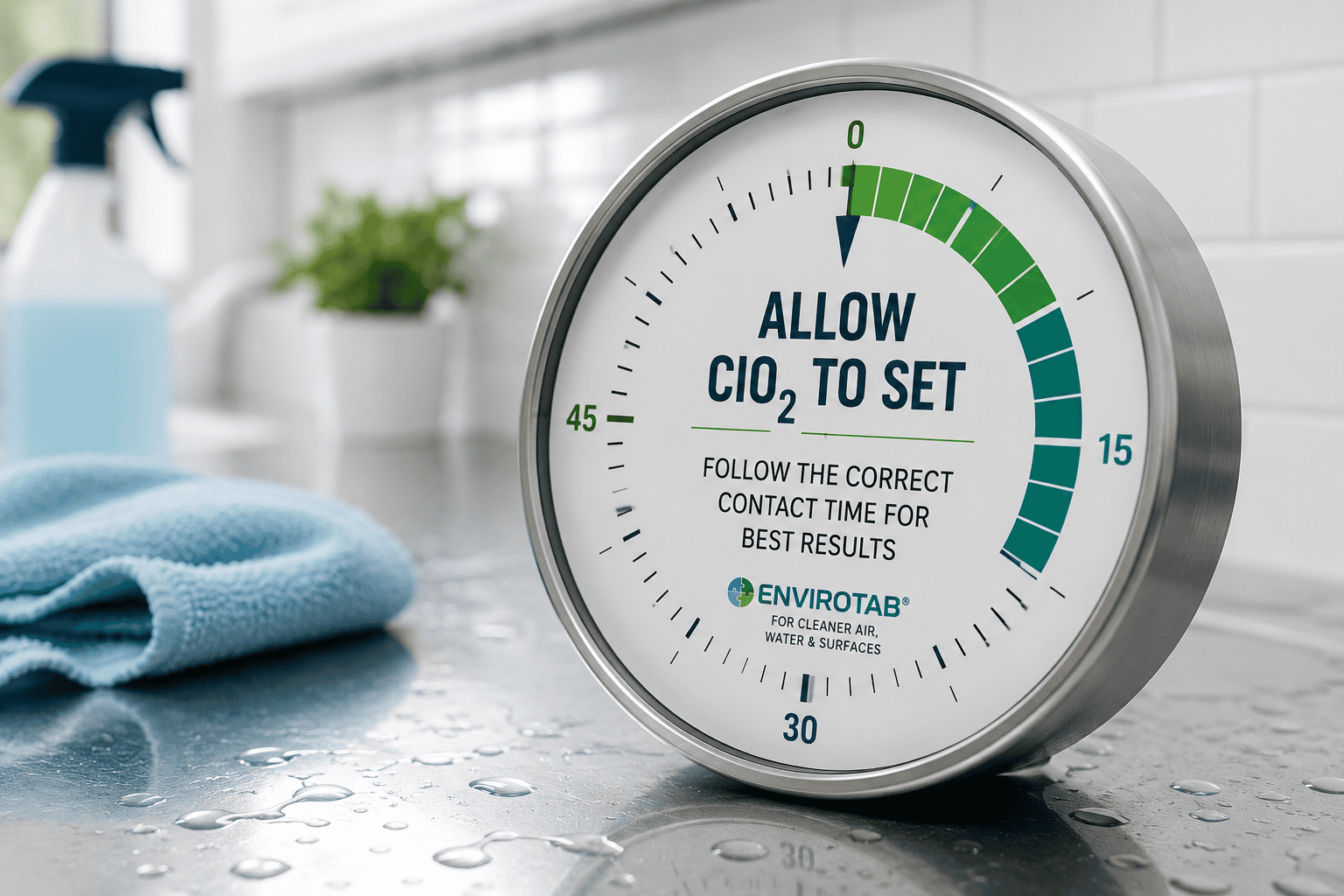
This is where cleaning gets surprisingly scientific.
Many people spray a surface and immediately wipe it dry.
Spray.
Swipe.
Done.
But if you're using a product for a labeled antimicrobial application, contact time matters.
Contact time—or dwell time—is the amount of time the product needs to remain in contact with the surface according to its directions.
CDC explains that when disinfecting, the surface should remain wet for the specified contact time.
That means:
Correct PPM + Insufficient Contact Time ≠ Correct Process
Just as:
Wrong PPM + Long Contact Time ≠ Automatically Correct
The variables work together.
The Four-Part ClO₂ Cleaning Equation
Here's the idea I want every ClO2Tablets.com reader to remember:
CONCENTRATION × COVERAGE × CONTACT TIME × CLEAN SURFACE
Each variable matters.
You can have the perfect concentration and poor coverage.
You can have perfect coverage and inadequate contact time.
You can have both—but spray over heavy grease.
And you may not get the result you expected.
Effective cleaning is a process, not just a chemical.
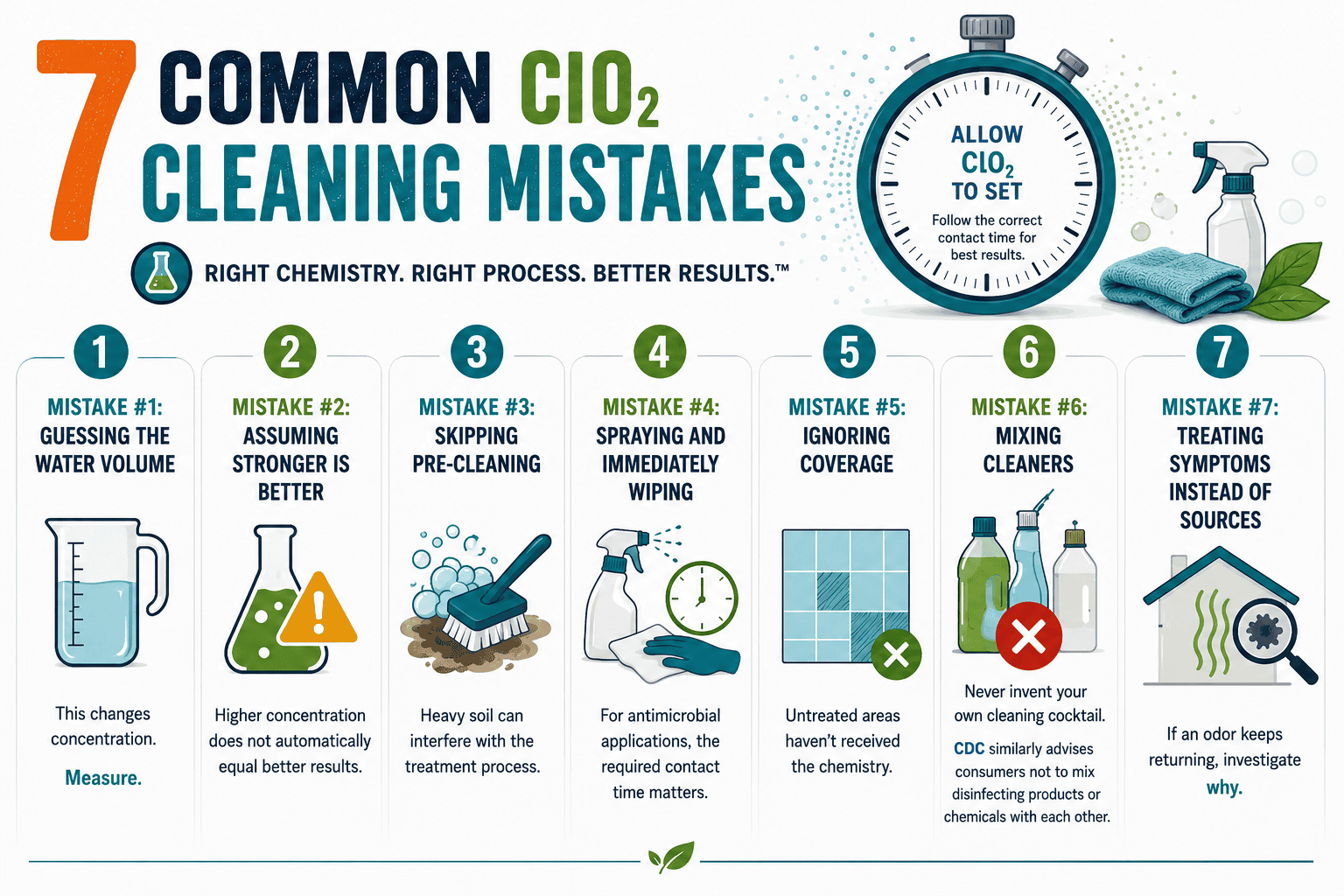
This section deserves an infographic.
I'd make this one of the primary visual assets of the article.
Proper ClO₂ PPM Levels for Industrial Applications
Cleaning, Sanitizing and Disinfecting Are Not Interchangeable Words
This distinction is important both scientifically and from a product-claims standpoint.
CDC defines these concepts differently:
Cleaning removes dirt, impurities and germs from surfaces through cleaning action.
Sanitizing reduces germs to levels considered safe under applicable public-health standards.
Disinfecting uses chemicals to kill remaining germs on surfaces.
So we shouldn't casually use all three words as though they mean the same thing.
When making an antimicrobial claim, the applicable product label and directions control the use.
That's especially important with ClO₂ because the chemistry has many applications—but that doesn't mean every ClO₂ product is automatically approved for every possible application.
Also Read 📖How Can Chlorine Dioxide Tablets Sanitize & Deodorize Carpets Safely?
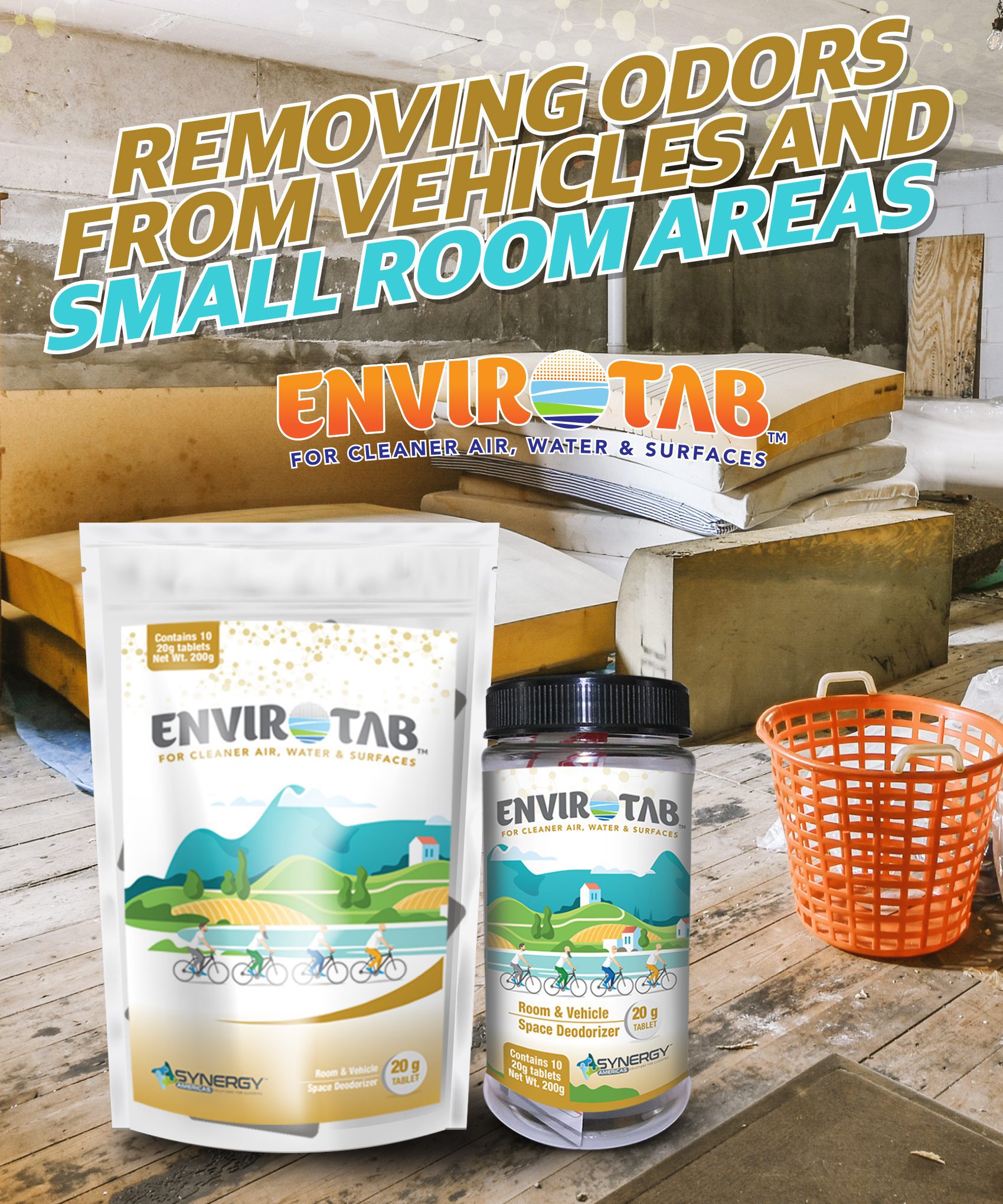
What About Odor Control?
This is where chlorine dioxide becomes especially interesting.
Traditional odor products often rely heavily on fragrance.
That may make an environment smell different.
But different and eliminated are not necessarily the same thing.
Chlorine dioxide is an oxidizing chemistry capable of reacting with susceptible odor-causing compounds.
But here's the rule:
Find the source first.
If the kitchen trash can smells because liquid leaked underneath the liner, clean the container.
If a pet repeatedly contaminated carpet padding, investigate the padding.
If a bathroom smells musty because water is leaking behind a wall, find the moisture source.
If spoiled food fell behind the refrigerator, remove it.
Then treat the remaining problem appropriately.
ClO₂ can be an odor-control tool. It should never become an excuse to ignore the odor source.
Also Read 📖How do I Use CLO₂ Tablets for Cleaning, Odor Removal & Mold?
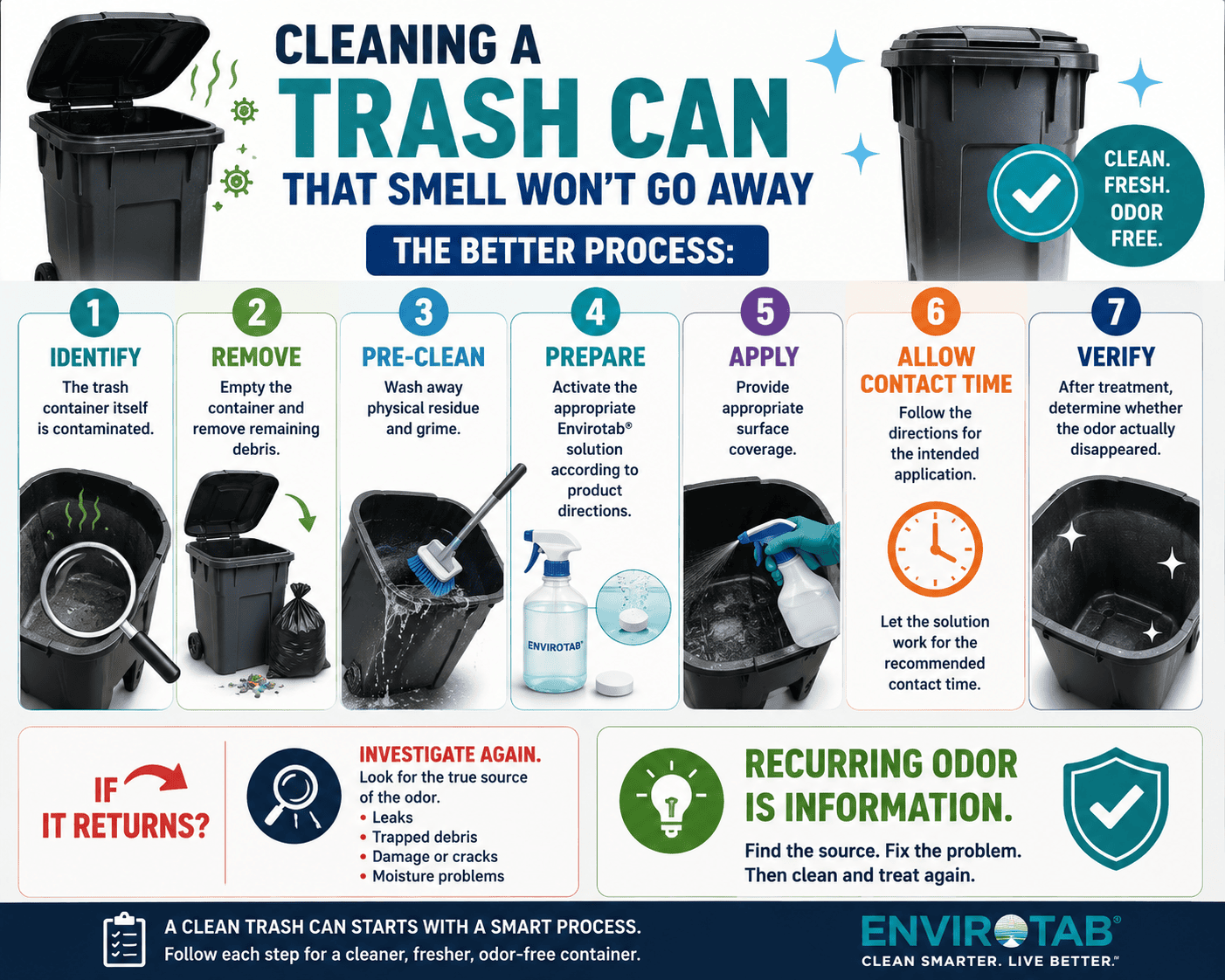
REAL-WORLD EXAMPLE: THE KITCHEN TRASH CAN

Imagine a household trash container that smells terrible every summer.
The homeowner empties it.
Sprays air freshener.
The smell comes back.
Sprays more.
Still comes back.
Here Is a Good Example of a Proper Technique
Also Read 📖What Are Biofilms, and Why Do They Form on Everyday Surfaces?
What Surfaces Can Be Cleaned With Chlorine Dioxide?
This is another area where we should avoid sweeping claims.
ClO₂ can be useful across many hard-surface cleaning applications when used according to appropriate product directions.
However:
Don't assume every material is compatible with every concentration.
Be particularly thoughtful around:
- natural stone,
- unfinished wood,
- specialty coatings,
- delicate metals,
- dyed materials,
- fabrics,
- electronics,
- and other sensitive surfaces.
When uncertain, consult the product guidance and consider testing an inconspicuous area where appropriate.
Also Read 📖ClO₂ Tablets Uses: Water, Mold, Surface Cleaning, Odor & More | Full Guide
Which Envirotab® Product Is Right for Your Cleaning Job?
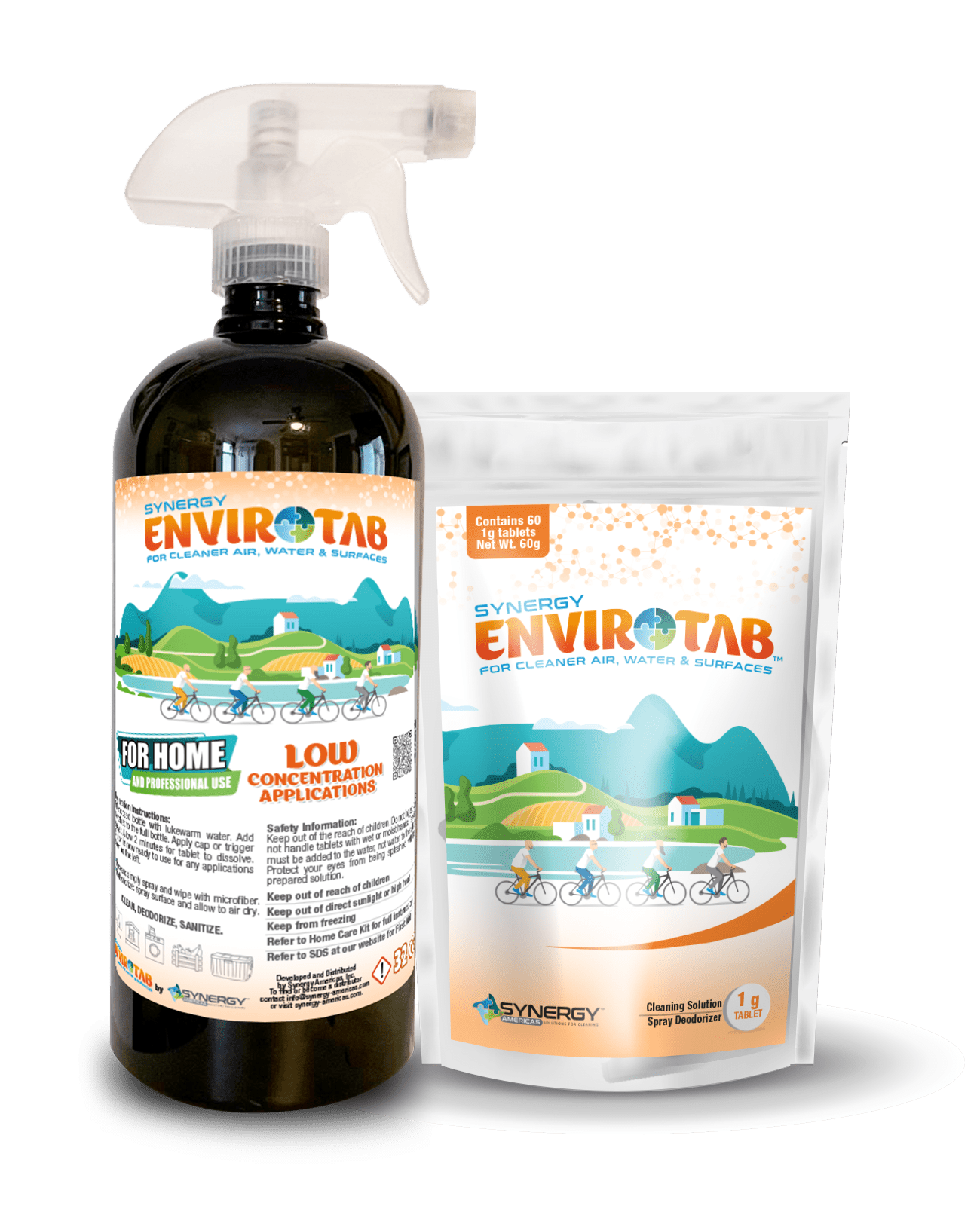
This is where the article should transition naturally from education into product selection.
For Smaller Household Cleaning & Spray Applications
The Envirotab® 1g tablet format is particularly convenient for smaller-volume preparation when its specified concentration and application match the task.
It's a logical option for homeowners who want a manageable tablet format rather than bulk preparation.
Consider:
Envirotab® 1g Chlorine Dioxide Tablets
Best for users who already have appropriate preparation and application equipment.
New to ClO₂?
Consider the:
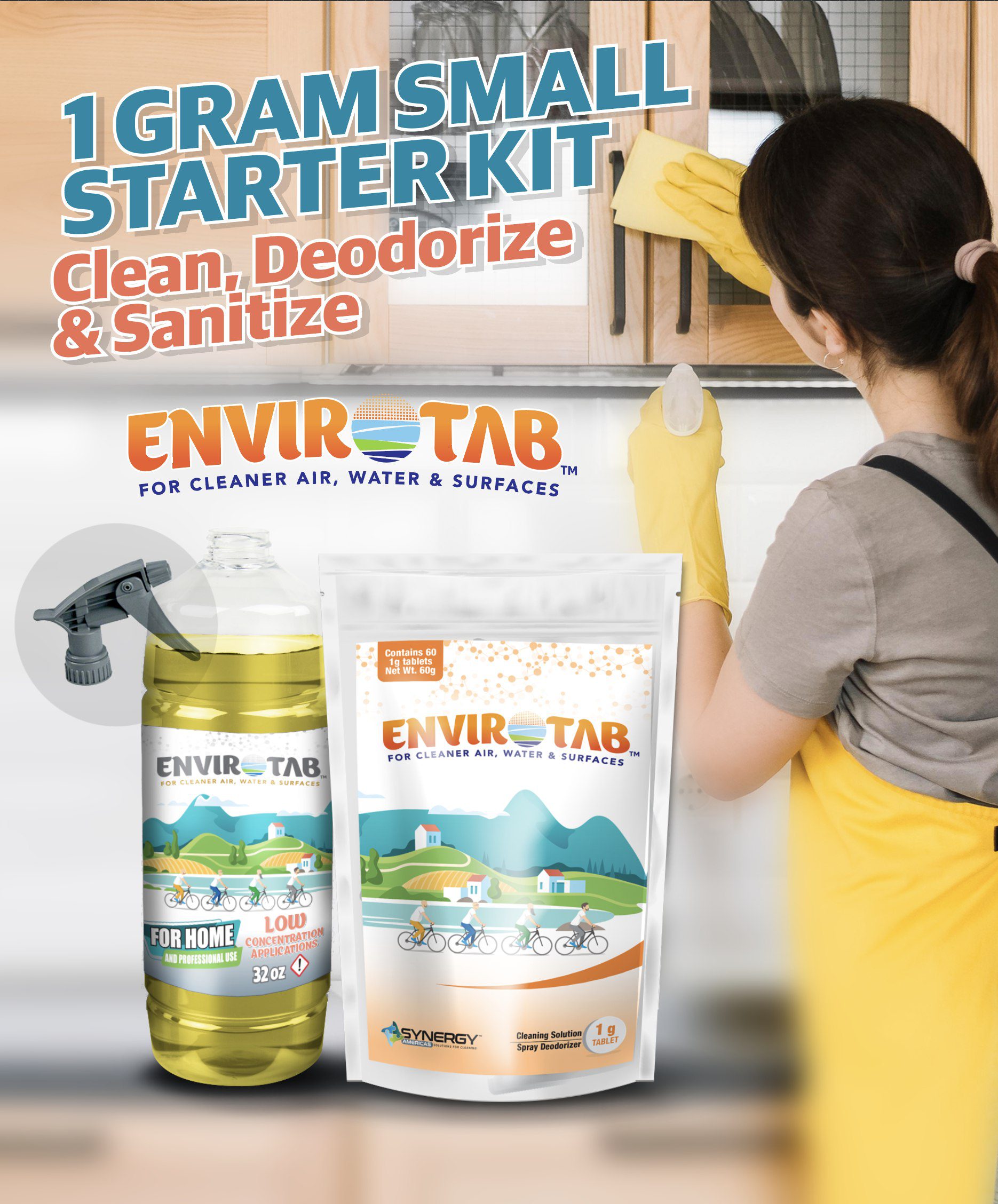
Envirotab® 1 Gram Small Starter Kit
This gives a first-time user a more complete introduction to the system instead of purchasing tablets without the basic application tools.
This should have a prominent:
SHOP THE 1G STARTER KIT →
Need More Capacity?
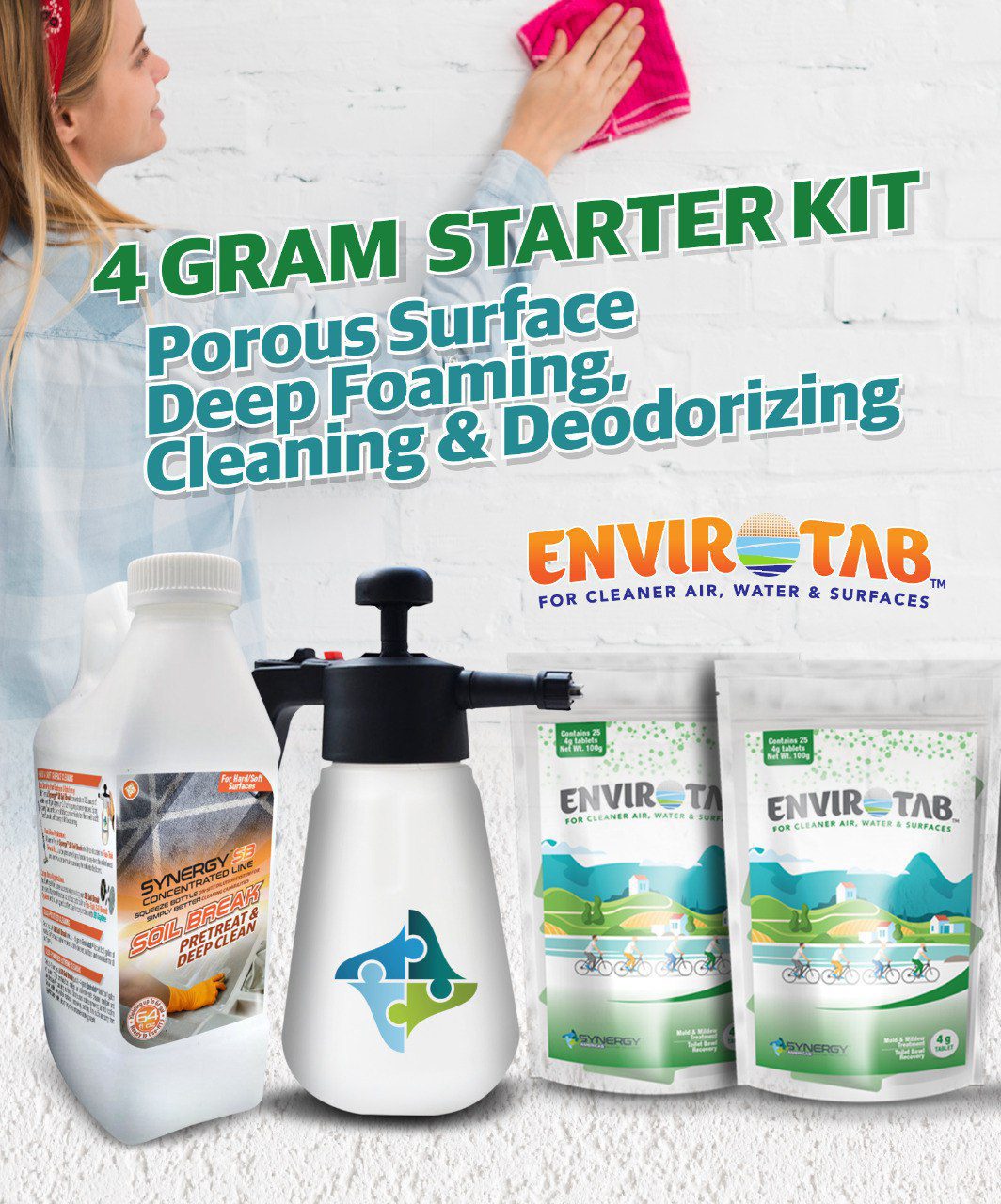
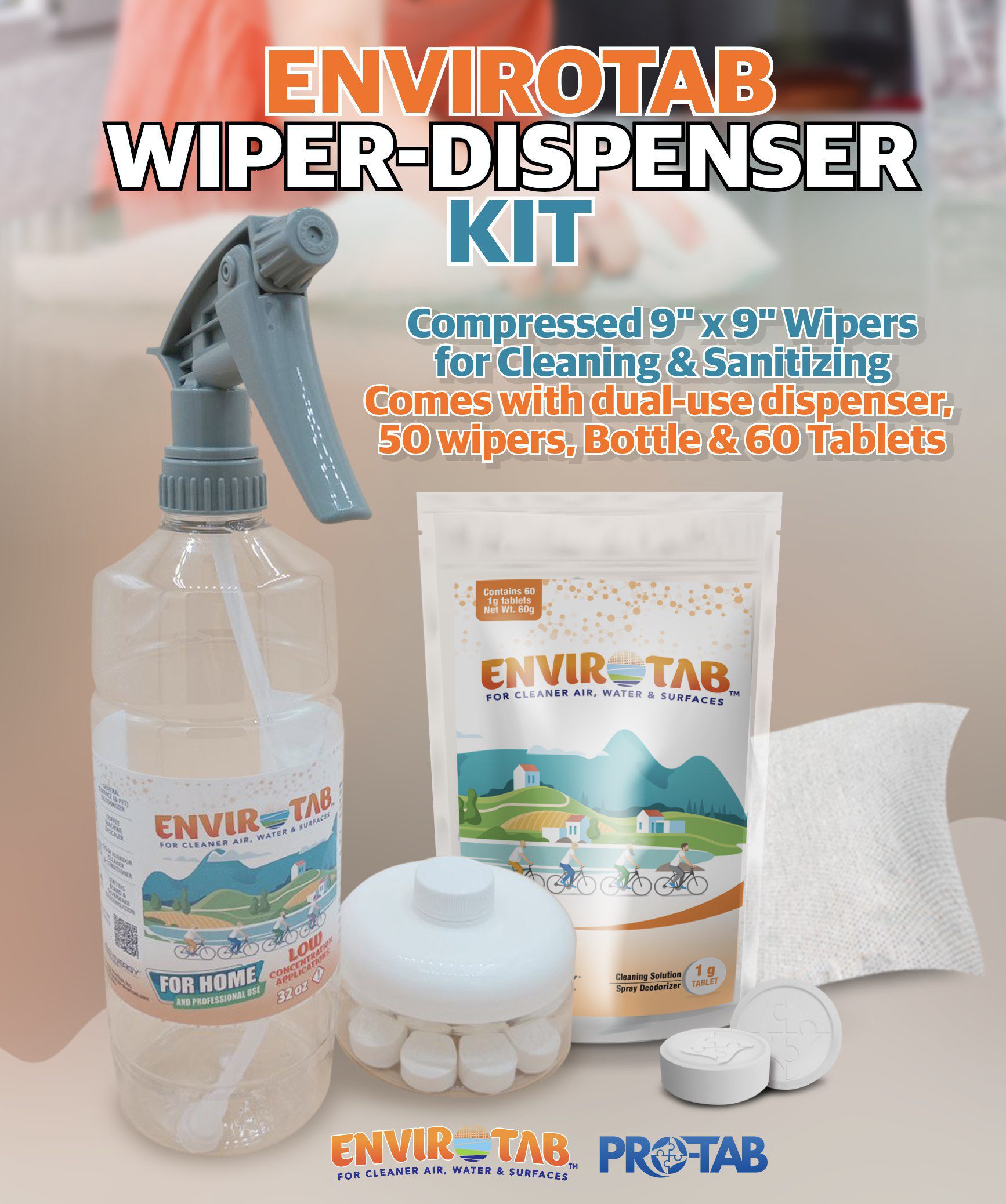
For larger cleaning or odor-control requirements, ClO2Tablets.com offers additional Envirotab® tablet sizes and systems.
But again:
Don't choose based on “strongest.”
Choose based on the application and required solution volume.
SHOP ALL ENVIROTAB® PRODUCTS →

Why Envirotab® Makes ClO₂ Easier to Use
The tablet format solves an important practical problem.
Most homeowners don't want to become amateur chemists.
Envirotab® allows chlorine dioxide-generating chemistry to be packaged into predetermined tablet formats that can be paired with specified water volumes.
That creates a much more understandable workflow:
Choose → Measure → Activate → Apply
rather than:
Pour → Guess → Hope.
And that may ultimately be one of the biggest advantages of tablet-based ClO₂.
Proper CLO2 PPM Ranges for Institutions
Responsible ClO₂ Use: Respect the Chemistry
Chlorine dioxide is powerful oxidizing chemistry.
Treat it accordingly.
General best practices include:
- Read and follow the applicable product directions.
- Measure water rather than estimating.
- Use the specified tablet size.
- Maintain appropriate ventilation.
- Follow applicable PPE recommendations.
- Don't mix ClO₂ products with other cleaners unless specifically directed.
- Keep tablets and prepared products away from children and pets.
- Don't ingest cleaning or disinfecting products.
- Don't use disinfectants directly on people or pets.
- Follow rinse instructions where required.
- Store tablets according to product instructions.
CDC similarly recommends ventilation, following label dilution and contact-time directions, avoiding chemical mixing, and keeping cleaning and disinfecting chemicals away from children and pets.
Proper CLO2 PPM Ranges for Commercial Sanitation
Frequently Asked Questions About Using Chlorine Dioxide Tablets
1. How do you use a chlorine dioxide tablet for cleaning?
Activate the appropriate chlorine dioxide tablet in the water volume specified by the product directions. Pre-clean visibly dirty surfaces when necessary, apply the prepared solution evenly, and follow the required contact-time and rinse directions for the intended application.
2. How much water should I use with an Envirotab® tablet?
The correct water volume depends on the tablet size and desired concentration. Follow the current Envirotab® instructions or concentration guide rather than estimating the amount of water.
3. What does PPM mean with chlorine dioxide?
PPM means parts per million and describes the concentration of chlorine dioxide in the prepared solution. The tablet size and volume of water both influence the resulting concentration.
4. Is stronger chlorine dioxide better for cleaning?
Not necessarily. Effective cleaning depends on the correct concentration, coverage, contact time, surface condition and application method. Excessively strong solution may waste product and may not be appropriate for the material or application.
5. Do I need to clean a surface before applying ClO₂?
If a surface is visibly dirty or heavily soiled, pre-cleaning is generally important. Physical soil can interfere with the ability of an antimicrobial product to contact the surface effectively.
6. How long should chlorine dioxide remain on a surface?
Use the contact time specified by the applicable product directions for the intended application. For antimicrobial treatment, sufficient wet contact time is an important part of correct use.
7. Can chlorine dioxide be mixed with other cleaners?
Do not casually mix chlorine dioxide products with other cleaning chemicals. Follow the Envirotab® product directions and never create unapproved chemical mixtures.
8. Can chlorine dioxide be used for household odors?
Chlorine dioxide can react through oxidation with susceptible odor-causing compounds. However, the physical source of an odor should first be identified and removed whenever possible.
9. Can I use chlorine dioxide on every household surface?
Do not assume every material is compatible with every chlorine dioxide concentration. Follow product guidance and evaluate surface compatibility, especially with delicate, dyed, coated or specialty materials.
10. Which Envirotab® product should a beginner use?
For smaller-volume household applications, the Envirotab® 1g format can be a practical starting point when it matches the intended application. A 1 Gram Small Starter Kit may be particularly convenient for first-time users who also need application equipment.

Clean Smarter: The Right Chemistry Is Only Half the Solution
Effective cleaning isn't about reaching for the strongest chemical on the shelf. It is about understanding what you're trying to remove, choosing the appropriate chemistry, and using it correctly.
That's especially true with chlorine dioxide.
ClO₂ gives homeowners and cleaning professionals access to powerful oxidation chemistry, but the chemistry is only one part of the equation. Concentration, surface preparation, coverage and contact time all matter.
That's why the smarter ClO₂ process is simple:
Identify → Pre-Clean → Prepare → Apply → Allow Contact Time → Verify
Start by identifying the real problem. Remove visible dirt, debris and contamination. Prepare the appropriate chlorine dioxide concentration according to product directions. Apply it thoroughly. Give the chemistry the required time to work. Then verify that you actually solved the problem.
And if an odor or cleaning problem keeps returning?
Investigate again.
A recurring problem is often telling you something. There may be hidden contamination, trapped organic material, moisture, damaged material or another source that chemistry alone cannot correct.
Make ClO₂ Easier With Envirotab®
Envirotab® chlorine dioxide tablets take much of the complexity out of preparing ClO₂ by providing convenient, premeasured tablet formats that generate chlorine dioxide solution when activated according to product directions.
For homeowners and first-time users, the Envirotab® 1g tablet is a practical option for many smaller-volume applications when it matches the intended use. And if you're completely new to chlorine dioxide, the Envirotab® 1 Gram Small Starter Kit provides an easy way to begin with tablets and basic application equipment together.
The goal isn't to fill your cleaning cabinet with more bottles.
It's to understand what you're cleaning, why you're cleaning it and which chemistry makes sense for the job.
Ready to Clean Smarter?
Explore Envirotab® Chlorine Dioxide Tablets and Starter Kits at ClO2Tablets.com and choose the solution that matches your cleaning or odor-control application.
→ Shop Envirotab® Chlorine Dioxide Tablets
→ Start With the Envirotab® 1 Gram Small Starter Kit
→ Explore All Envirotab® Products
Not sure which tablet, concentration or system is right for your application? Contact the ClO2Tablets.com team before you buy. Getting the right product and understanding how to use it is always better than simply choosing the strongest option.
Right chemistry. Right concentration. Right process. Better cleaning.™