
The Chlorine Dioxide Cleaning Guide
Introducing The 2-Wipe System That Improves on Surface Sanitation
Why Chlorine Dioxide Tablets Are the Foundation of a Modern Cleaning System
Chlorine dioxide (ClO₂) tablets represent a fundamental upgrade over liquid disinfectants, concentrates, and ready-to-use sprays. Rather than transporting water and unstable chemistry, tablets allow cleaning professionals and homeowners to create fresh, on-demand solutions at the exact concentration required for the task.
Why Chlorine Dioxide Tablets Are the Foundation of a Modern Cleaning System

Portability: Without Compromise
Tablets are lightweight, compact, and easy to store. This makes them ideal for:
- Janitorial carts
- Mobile cleaning crews
- Facilities with limited storage
- Emergency or remediation scenarios
- No leaking containers. No degradation in transit. No guessing.
Stability: Until the Moment of Use
Unlike liquid chlorine, hydrogen peroxide, or pre-mixed disinfectants, chlorine dioxide tablets remain chemically stable until activated in water. This ensures:
- Predictable performance
- Full oxidative strength at time of use
- No loss of efficacy due to age or heat
Accuracy: Exact ppm, Every Time
Tablet dosing removes one of the biggest variables in cleaning: human error in dilution.
With tablets, you can reliably create:
- 100 ppm solutions for routine cleaning
- 200–400 ppm solutions for deodorizing and sanitizing
- Higher concentrations for specialized applications
This accuracy is essential when pairing chemistry with microfiber, where controlled moisture and residue-free performance matter.
Why Our Yellow Microfiber Is Essential When Using 100–400 ppm ClO₂ Solutions
ClO₂'s Perfect Partner: Microfiber Instead of Surfactancy
Chlorine dioxide performs best when it can contact soils, microbes, and odor molecules directly — and microfiber is the most efficient delivery and removal tool available. Many of the ingredients in traditional cleaners and disinfectants are all geared to attracting soil to water - with residue then attracting soil to the surfaces. We don't play that game. Instead, we let the cleaning cloth draw the soil and get out of the way of the chlorine dioxide. The two partners in our cleaning system have uniquely different characteristics and roles that perfectly complement one another.
Yellow microfiber cloths are widely adopted for general and non-critical cleaning zones, providing:
- High soil capture without the requirement of chemistry
- Low lint & extremely long life. Our cloths will last a full year of daily cleaning and laundering (with our detergent)
- Visual differentiation from critical-care colors - yellow cloths for semi-critical cleaning with the yellow ClO₂ solution.
Microfiber’s 96% Soil Removal Efficiency
Independent and reliable testing has repeatedly shown that quality microfiber removes approximately 96% of microbial soil per wipe, without relying on chemical kill alone.
This is mechanical removal — not just disinfection.
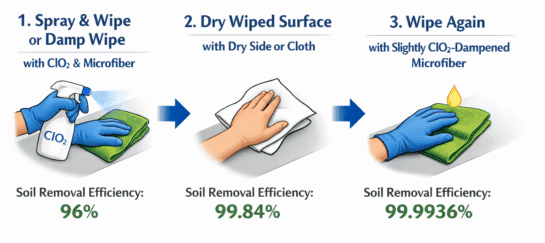
Why This Method is Worth the Time...
To begin with, it takes no more time, if cleaning with 2 hands. But...
The entire point of cleaning is soil and bioburden removal - removing the contaminates that spread disease. It does no good to leave any residue behind on any surface you clean, and give soil, bacteria and other parasites to hide and anchor themselves to environmental surfaces - touchpoints that transfer infections from one person to another. Disinfection without soil removal is useless.
The Math Tells the Whole Story
If one microfiber wipe removes 96% of soil and bioburden:
- 1st wipe → 96% removed
- 2nd wipe → removes 96% of what remains
- Result → ~99% total cleaning efficiency
- 3rd wipe → approaches virtual 100% bioburden removal
This is not theoretical — it is cumulative reduction.
Chlorine dioxide enhances this system by:
- Oxidizing remaining microbes and odor molecules
- Leaving no residue that could interfere with microfiber performance
- Eliminating sticky surfactants that trap soil
Residue-Free Chemistry: Why ClO₂ and Microfiber Work So Well Together
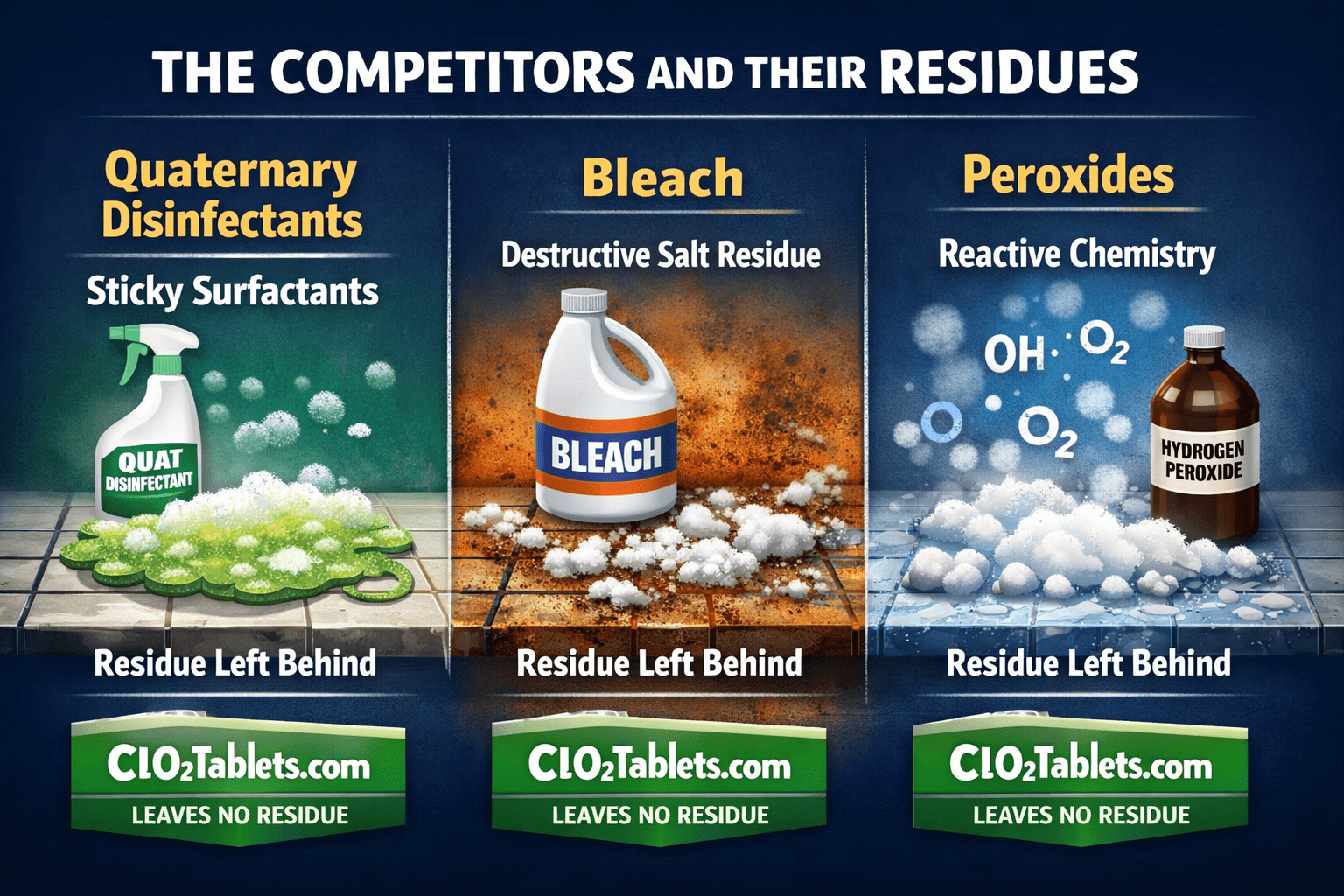
What “Tradition Solutions” Offer
Most disinfectants leave behind residues:
- Quats leave films that attract soil
- Bleach leaves salts
- Peroxides leave reactive byproducts
Chlorine dioxide is different.
What “Residue-Free” Really Means
After reacting, chlorine dioxide:
- Converts into benign salts at extremely low levels
- Does not form sticky or oily residues
- Does not interfere with microfiber fibers
This allows microfiber to:
- Absorb moisture efficiently
- Release soils cleanly during laundering
- Maintain performance over repeated use
Two Levels of Application: Non-Critical vs. Semi-Critical Cleaning
The 2-Wipe System adapts easily to different risk environments.
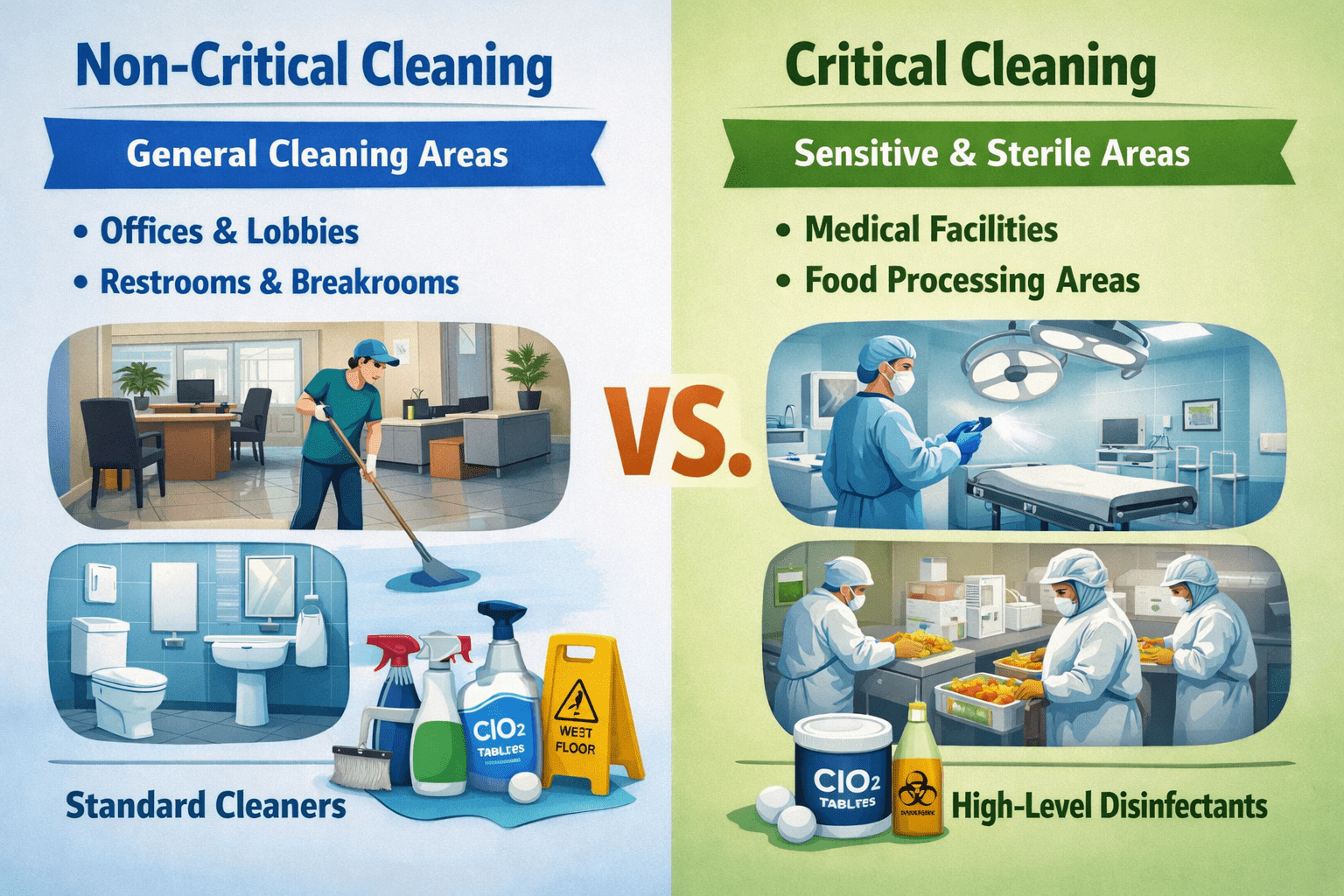
Non-Critical Cleaning Applications
Non-critical cleaning applies to:
- Offices
- Homes
- Retail spaces
- Classrooms
- Hospitality environments
Non-Critical 2-Wipe Method
- Spray a 100ppm ClO₂ solution onto the surface
- Wipe using one side of a yellow microfiber cloth
- Flip the cloth and dry with the second side
Semi-Critical Cleaning Applications
Critical cleaning applies to:
- Medical and clinical environments
- Restrooms and high-risk touchpoints
- Post-incident sanitation
- Areas requiring increased dwell-time
Semi-Critical Cleaning Method
- Microfiber cloths are pre-soaked and dampened in 200-400ppm chlorine dioxide solution
- The surface is wiped, allowing increased dwell time
- A second, clean microfiber cloth is used to dry
- Both cloths are immediately retired to laundry
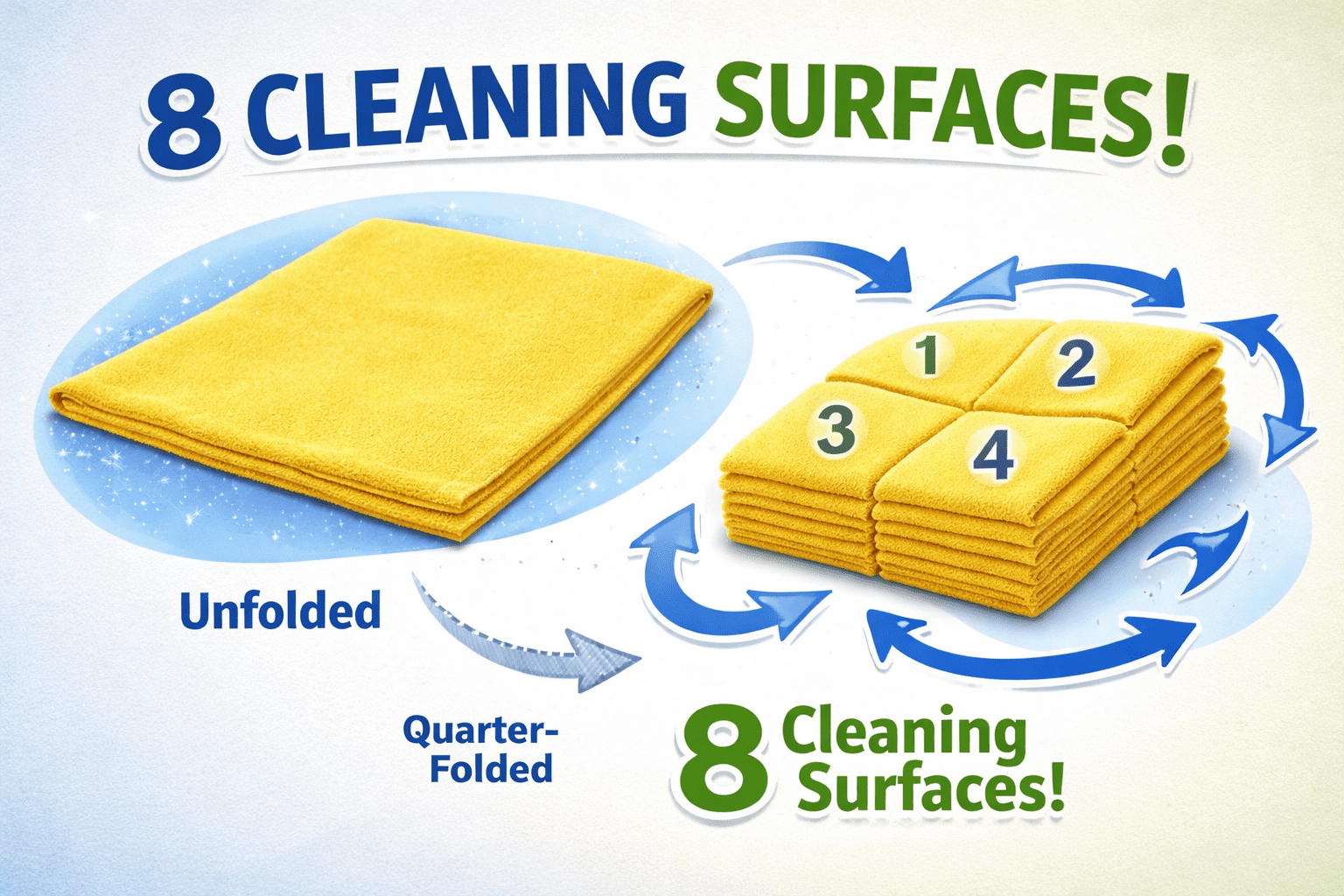
Quarter-Folding for Maximum Efficiency
Quarter-folding a microfiber cloth creates four distinct cleaning surfaces, allowing:
- Controlled soil management
- Reduced cross-contamination
- Fewer cloths per task
Once all sides are used, the cloth is retired to laundry.
Why This System Outperforms Traditional Spray-and-Wipe Cleaning
Traditional cleaning relies heavily on chemical kill claims while often:
- Spreading contamination
- Leaving residues
- Ignoring mechanical removal
The Chlorine Dioxide + Microfiber 2-Wipe System:
- Prioritizes physical soil removal
- Uses chemistry to support, not replace, cleaning
- Delivers measurable, repeatable results
A Practical, Scalable Cleaning System
This guide is not about one product — it’s about a system:
- Tablets provide accuracy and stability
- Chlorine dioxide provides selective oxidation without residue
- Microfiber provides unmatched mechanical removal
- The 2-Wipe System ensures predictable outcomes
Together, they form a modern cleaning approach built for health, efficiency, and real-world use.
A Practical, Scalable Cleaning System
- Use tablets to control ppm precisely and avoid dilution errors
- Pair 100–400 ppm ClO₂ solutions with yellow microfiber for routine cleaning
- Follow the 2-Wipe System to reach ~99% cleaning efficiency, 3-Wipes for 100% soil removal.
- Use pre-soaked microfiber and separate drying cloths for critical areas
- Retire cloths promptly and rely on laundering, not over-spraying

Our Social Media Links:
P.O. Box 34 Winterport, Maine 04496
If you need more information, or are a commercial buyer, please visit this parent site.