
What Should You Do If You Mixed the Wrong PPM of Chlorine Dioxide?
Chlorine dioxide (ClO₂) is a precision oxidizing disinfectant. Its performance depends on one critical variable: correct concentration, measured in parts per million (PPM).
If you mix too weak, you compromise effectiveness.
If you mix too strong, you waste product and may exceed recommended application levels.
The solution isn’t guesswork. It’s math — and using the correct yield data for your tablet formulation.
Understanding PPM in Real-World Tablet Use
PPM means “parts per million,” which in water applications is equivalent to milligrams per liter (mg/L).
However, with tablet systems, you must account for actual available chlorine dioxide yield, not just raw tablet weight.
A 1-gram CLO2 tablet (for instance) does not translate directly into 1,000 mg of free chlorine dioxide in solution. The concentration produced depends on formulation chemistry and conversion efficiency.
That is why using manufacturer concentration charts is essential.
Below is the correct working output for 1 gram of activated CLO2 tablet.
Accurate Mixing Chart – 1 Gram CLO2 Tablet
| Water Volume | Approximate PPM |
|---|---|
| 8 oz | 460 PPM |
| 16 oz | 230 PPM |
| 32 oz | 115 PPM |
| 64 oz | 57 PPM |
| 128 oz (1 gallon) | 26 PPM |
These values reflect the actual available chlorine dioxide produced when the tablet is properly activated and dissolved.
How to Use These Ratios Properly

Now let’s apply this practically.
If You Need ~100–120 PPM
Ideal for general hard-surface disinfection.
→ Mix 1 gram into 32 oz of water (115 PPM).
If You Need ~50–60 PPM
Common for odor control, light sanitation, and maintenance cleaning.
→ Mix 1 gram into 64 oz of water (57 PPM).
If You Need ~25 PPM
Appropriate for low-level maintenance or specific water applications (verify regulatory requirements).
→ Mix 1 gram into 1 gallon (26 PPM).
If You Need a Stronger Concentrate
For shock treatment or dilution into larger systems:
→ 8 oz yields 460 PPM
→ 16 oz yields 230 PPM
These higher strengths are typically used as controlled concentrates and diluted down to working levels.
Also Read 👉🏼Chlorine Dioxide Cleaning Guide
What to Do If You Mixed the Wrong PPM
Scenario 1: You Mixed It Too Weak
If your concentration is below target:
- Add additional tablet proportionally based on final desired PPM.
- Or discard and re-mix using the chart above.
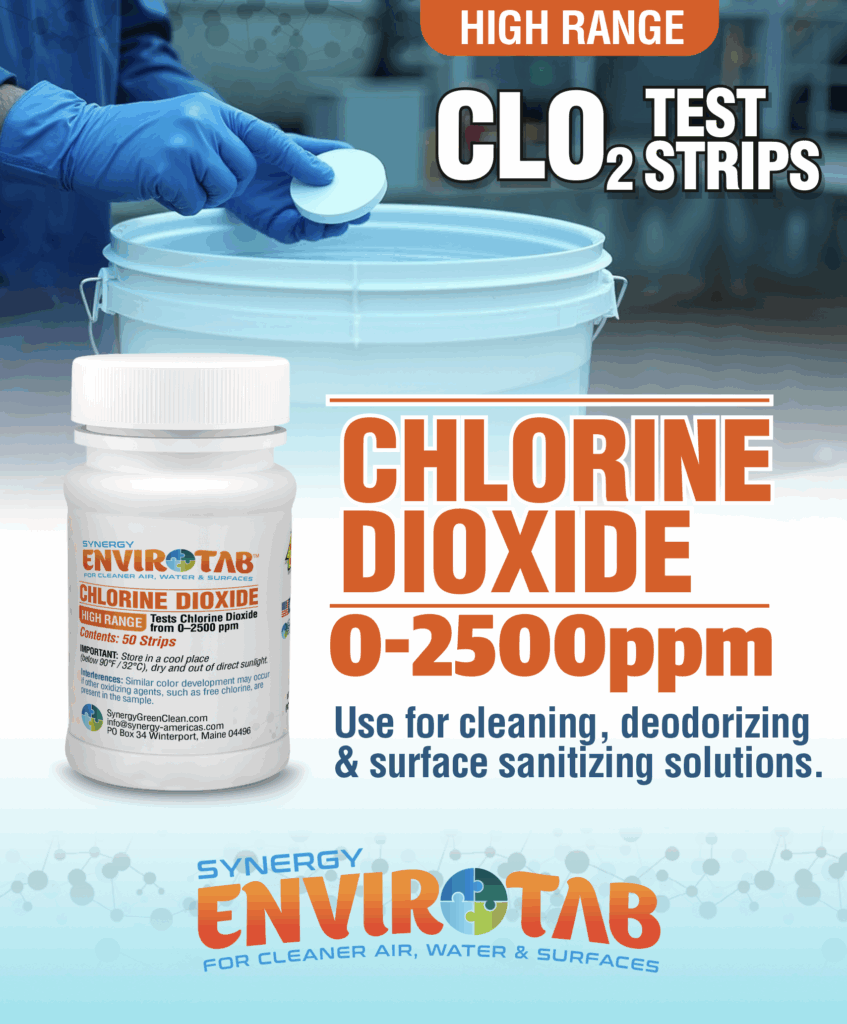
- Verify concentration when possible using chlorine dioxide test strips.
Under-concentration affects performance but does not increase material risk.
Scenario 2: You Mixed It Too Strong

If your concentration exceeds recommended guidelines:
- Dilute with clean water.
- Use proportional dilution.
Example:
If you mixed 1 gram into 16 oz (230 PPM)
But you only need ~115 PPM
Simply double the water volume to 32 oz total.
230 PPM diluted 1:1 becomes approximately 115 PPM.
Another example:
If you made 8 oz at 460 PPM
And need ~115 PPM
460 ÷ 115 ≈ 4
You would dilute 1 part concentrate with 3 parts water.
Always mix thoroughly after dilution.
What To Do If You Notice It's to Strong.
Recommended PPM Guidelines by Application
While regulations vary by industry, typical professional use ranges include:
General Surface Disinfection
100–200 PPM
Food Contact Surface Sanitization
50–100 PPM (follow applicable food safety regulations)
Odor Neutralization
50–150 PPM
Biofilm and Water System Maintenance
5–50 PPM depending on system design
Potable Water Applications
Typically below 5 PPM and subject to EPA and local regulation
Always confirm compliance requirements specific to your industry.
Why Precision Matters
Chlorine dioxide works by oxidative disruption of microbial cell structures. Its effectiveness follows concentration-time (CT) principles.
More is not automatically better.
Excess concentration does not proportionally increase kill rate. Instead, it can:
- Stress sensitive materials
- Increase off-gassing in enclosed environments
- Waste product
- Complicate regulatory documentation
Professional disinfection is controlled chemistry — not aggressive dosing.
Best Practices to Prevent Future Mixing Errors
- Measure water volume before adding tablets.
- Use graduated mixing containers.
- Post this dilution chart at mixing stations.
- Label all mixed batches with date and PPM.
- Use test strips when precision verification is required.
- Train staff on standardized mixing procedures.
Consistency builds safety.
Precision builds trust.
For detailed product instructions and technical guidance, visit:
https://clo2tablets.com
Conclusion
Incorrect PPM mixing is correctable — but only when addressed with proper chemistry and accurate ratios.
Using verified tablet yield data ensures:
- Effective microbial reduction
- Material compatibility
- Regulatory compliance
- Cost efficiency
When concentration is controlled, chlorine dioxide performs exactly as engineered.
Precision is not optional in professional sanitation.
It is the difference between treatment and guessing.
CLO2 Tablets provide consistent, measurable output when mixed according to labeled guidelines — giving professionals reliable chlorine dioxide performance every time.
Also See 👉🏼Chlorine Dioxide Cleaning Guide
(FAQS)
1. I accidentally mixed chlorine dioxide too strong — did I just make my home unsafe?
No. A 600 PPM liquid solution is strong, but the risk depends on how it’s being used. If it’s sitting in an open container or heavily sprayed, it can off-gas and create an irritating odor. The fix is simple: increase ventilation immediately and dilute the solution to the correct working strength.
2. If I mixed it around 600 PPM, should I leave the house?
If you detect a strong odor or experience throat, eye, or lung irritation, step outside into fresh air immediately. For high concentrations like 600 PPM used indoors, it is best practice to vacate the treated area until ventilation reduces the odor completely. In most residential environments with good airflow, this can take 30 minutes to several hours depending on ventilation.
3. How long should I air out the house after using a high concentration?
Ventilate until there is no noticeable chlorine dioxide odor remaining. Open windows, run exhaust fans, and use HVAC circulation if available. With cross-ventilation, most indoor spaces clear within 1–4 hours. Poor airflow may require longer.
Air exchange is the solution. Fresh air reduces concentration rapidly.
4. Is it dangerous to breathe chlorine dioxide if it’s too strong?
High airborne levels can irritate the eyes, nose, and respiratory tract. That irritation is your body’s warning system. If you feel burning, coughing, or discomfort, leave the area immediately and allow it to ventilate fully before returning.
Short exposure with prompt ventilation is unlikely to cause long-term harm in healthy individuals, but prolonged exposure to strong vapor should always be avoided.
5. What should I do immediately if I realize I mixed it too strong?
Follow these steps:
- Stop applying the solution.
- Open windows and doors.
- Turn on fans or HVAC ventilation.
- Leave the area if odor is strong.
- Dilute the remaining liquid to proper PPM before future use.
- Simple airflow and dilution resolve the issue.
6. Is it safe to sleep in the house if I used a 600 PPM or greater solution earlier?
Only if the odor is completely gone and the area has been thoroughly ventilated. If any noticeable chlorine dioxide smell remains, continue airing out the space before occupying it for extended periods like sleeping.
Your nose is a useful guide — if you can smell it strongly, more ventilation is needed.
7. How can I tell if off-gassing levels are too high?
Warning signs include:
• Strong bleach-like or chlorine-type odor
• Eye irritation
• Throat scratchiness
• Coughing
If any of these occur, leave the area and ventilate immediately. Properly diluted working solutions at recommended PPM ranges should not create overwhelming indoor vapor when used correctly.
8. Can high PPM damage surfaces in my home?
Concentrations around 600 PPM are typically considered shock-level strength. While chlorine dioxide is gentler on many materials than traditional bleach, prolonged exposure at high concentration may stress delicate finishes or certain metals. Diluting to 100–200 PPM for general disinfection significantly reduces this risk.
9. Should I dispose of the solution if it’s too strong?
If you cannot accurately dilute it to the intended concentration, it is safer to discard according to local regulations and prepare a properly measured batch. In many cases, controlled dilution is sufficient and avoids waste.
10. How can I prevent this from happening again?
Use a printed dilution chart and measure water volume before adding tablets. For example:
• 1 gram in 32 oz = 115 PPM
• 1 gram in 64 oz = 57 PPM
• 1 gram in 1 gallon = 26 PPM
Clear measurement prevents over-concentration and eliminates fear.