

Why Pre-Season Greenhouse Sanitation Matters More Than Most Growers Realize
Early spring brings rising humidity, increased irrigation cycles, and enclosed warmth — ideal conditions for seedlings and for microbial buildup. During winter downtime, organic debris, algae films, dormant spores, and biofilm residues quietly accumulate on benches, walls, trays, and irrigation lines.
When temperatures rise, those residues become active.
Greenhouse sanitation is not simply cosmetic cleaning. It is environmental load management. Every enclosed growing structure — high tunnels, poly greenhouses, grow rooms, propagation houses — creates a controlled microclimate. That control works both ways. Moisture stays in. Air stagnation zones form. Condensation develops on poly film and structural framing.
Without a pre-season reset, growers start the year with elevated microbial pressure already present.
Understanding Mold Pressure in Enclosed Growing Environments
“Mold pressure” refers to the overall concentration of mold spores and organic substrates that allow fungal growth to establish quickly. It is not about one visible outbreak. It is about environmental readiness for microbial expansion.
Greenhouses create three ideal conditions for mold development:
- Persistent moisture
- Organic debris accumulation
- Limited air exchange zones
Overwintered plant residue under benches, algae buildup on floors, and residue in irrigation lines create nutrient sources. When seedlings are introduced, the microbial ecosystem is already active.
Sanitation before seedling season lowers that baseline pressure.
Also Read 🌱Proper CLO2 PPM for Safe & Effective Use In Agriculture
Step 1: Remove Organic Residue Before Disinfection
Disinfection without cleaning is ineffective. Organic matter neutralizes many sanitizing agents and shields microorganisms.
Before applying any sanitizing solution:
- Remove old plant material and growing media debris
- Sweep and vacuum benches and structural ledges
- Scrub algae from floors and low walls
- Flush out sediment from drainage areas
Mechanical cleaning reduces the organic load. Sanitation solutions work best on physically clean surfaces.
This is infrastructure maintenance, not just hygiene.
Step 2: Sanitize Benches, Walls, and Structural Surfaces

Benches and work surfaces are high-contact zones for trays and tools. Poly film walls and framing collect condensation droplets that can harbor spores.
Key areas to address:
- Propagation benches
- Tool staging areas
- Door handles and carts
- Structural supports where condensation forms
An oxidizing sanitation approach can help reduce residual biofilm and organic buildup without leaving heavy chemical residues. Chlorine dioxide, when properly diluted and applied, functions as a selective oxidizer that disrupts microbial cell walls while breaking down organic odor-causing compounds.
Unlike traditional chlorine bleach, chlorine dioxide does not rely primarily on hypochlorous acid chemistry and does not form the same chlorinated byproducts. For enclosed spaces, residue control and ventilation considerations matter.
Step 3: Address Seed Trays and Propagation Equipment
Reusable seed trays are common sources of cross-cycle contamination.
Plug trays and humidity domes often retain:
- Root fragments
- Biofilm residues
- Mineral scale
- Fungal spores embedded in plastic pores
Proper seed tray cleaning involves:
- Physical washing to remove media debris
- Soaking or spraying with a properly diluted sanitizing solution
- Complete drying before reuse
Drying is often overlooked. Residual moisture allows microbial rebound before seeds are even planted.
For small farmers and homesteaders, tray sanitation can significantly reduce early-stage losses linked to damping-off organisms.
Step 4: Sanitize Irrigation Components and Reservoirs
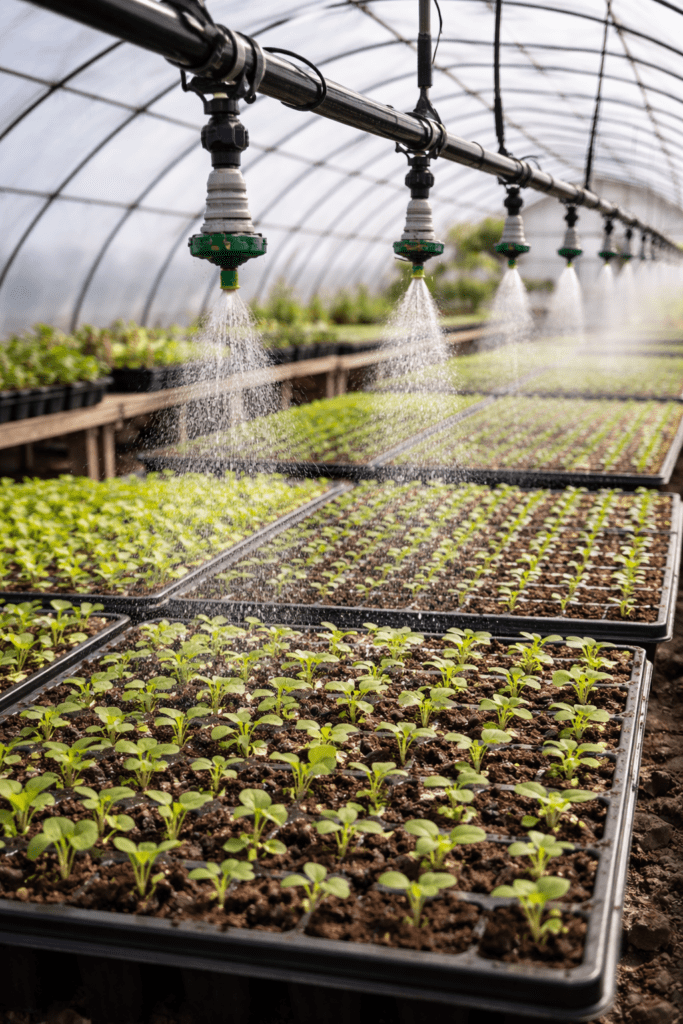
Irrigation systems are frequently ignored during pre-season cleaning. Drip emitters, misting lines, reservoirs, and hydroponic channels can accumulate biofilm — a structured microbial community embedded in a protective matrix.
Biofilm:
- Reduces flow efficiency
- Harbors bacteria and fungi
- Contributes to odor formation
- Interferes with nutrient delivery consistency
Flushing irrigation lines with an appropriate oxidizing solution before nutrient introduction can help remove organic buildup and reduce biofilm mass.
This step supports long-term system performance, not just sanitation.
Also Read 🌱Hydroponics with ClO₂ — Cleaner Water, Healthier Crops
The Role of Chlorine Dioxide in Greenhouse Sanitation
Chlorine dioxide (ClO₂) is a dissolved gas used globally for water treatment, food processing sanitation, and infrastructure hygiene. As an oxidizer, it disrupts microbial cells without functioning as a traditional chlorinating agent.
For greenhouse applications, chlorine dioxide tablets allow controlled mixing for:
- Surface sanitation
- Tray soaking
- Irrigation line flushing
- Odor management in enclosed grow rooms
When used according to proper dilution guidelines, chlorine dioxide breaks down into inert salts and does not leave heavy residues on treated surfaces.
In 2026 and beyond, growers are increasingly prioritizing sanitation solutions that balance microbial control with residue awareness and environmental compatibility.
Future-Proofing Greenhouse Sanitation Practices
Controlled environment agriculture is expanding rapidly. Indoor farming, hydroponic systems, and high-efficiency greenhouse operations require consistent infrastructure hygiene.
Emerging trends include:
- Increased regulatory attention to water quality in produce operations
- Greater scrutiny of sanitation documentation in commercial farms
- Adoption of oxidizing technologies that reduce byproduct formation
- Integrated hygiene planning between crop cycles
Pre-season sanitation will continue shifting from “optional cleaning” to standardized operational protocol.
Small growers who adopt structured sanitation routines now build more consistent growing systems over time.
Conclusion: Start Clean, Grow Consistent
Greenhouses are designed to amplify plant growth. They also amplify moisture and microbial activity.
A structured sanitation reset before seedling season reduces mold pressure, removes organic residue, and supports cleaner infrastructure. From benches and trays to irrigation lines and reservoirs, every surface contributes to the microbial baseline of the growing environment.
Starting the season clean does not guarantee perfect crops — agriculture is never that simple. But it improves environmental consistency and reduces avoidable pressure points.
Greenhouse sanitation is not about reacting to outbreaks. It is about building a more manageable growing space from the beginning of the season.
(FAQs)
1. What is greenhouse sanitation?
Greenhouse sanitation is the process of cleaning and disinfecting surfaces, tools, trays, and irrigation systems to reduce microbial buildup and organic residue before and during crop cycles.
2. Why is pre-season greenhouse cleaning important?
Pre-season cleaning lowers mold pressure and removes overwintered debris that can contribute to early crop losses.
3. How often should a greenhouse be sanitized?
A full sanitation reset is recommended between crop cycles, with ongoing maintenance cleaning during active growing periods.
4. What causes mold pressure in greenhouses?
Persistent humidity, organic debris, and limited airflow create conditions that allow mold spores to multiply rapidly.
5. Can irrigation lines harbor bacteria and fungi?
Yes. Biofilm can form inside irrigation lines and reservoirs, reducing efficiency and increasing microbial load.
6. Is chlorine dioxide safe for greenhouse sanitation?
When properly diluted and applied according to guidelines, chlorine dioxide is used globally for water and surface sanitation in agricultural settings.
7. Do seed trays need to be sanitized every season?
Reusable trays should be cleaned and sanitized between crop cycles to reduce cross-contamination.
8. Does bleach work for greenhouse sanitation?
Bleach can disinfect surfaces but may leave residues and form byproducts. Some growers prefer oxidizing alternatives that reduce residue concerns.
9. What is biofilm in irrigation systems?
Biofilm is a structured microbial community that adheres to surfaces and protects microorganisms from environmental stress.
10. Can sanitation improve crop consistency?
Reducing microbial load and organic residue supports more consistent growing conditions, though sanitation alone does not eliminate all crop risks.