Tag: IAQ solutions

  • How Chlorine Dioxide Improves HVAC Air Quality and Indoor Environments

    How Chlorine Dioxide Improves HVAC Air Quality and Indoor Environments

    Indoor Air Quality Starts Inside Your HVAC System

    Most people focus on surfaces when they think about cleanliness.

    But the real story?
    👉 Your air system is what defines your environment.

    Every time your HVAC system runs, it moves air through:

    • Ductwork
    • Coils
    • Filters
    • Vents

    If that system contains odor or contamination,
    👉 it distributes it—room by room, breath by breath.


    The Overlooked Source of Poor IAQ

    Indoor air quality (IAQ) issues often don’t come from what you can see.

    They come from what’s circulating.

    Inside HVAC systems, you’ll commonly find:

    • Dust and organic buildup
    • Moisture-prone areas
    • Residual odor compounds
    • Airborne particles that re-circulate continuously

    This creates a cycle:

    1. Contaminants build up inside the system
    2. Air moves through it
    3. Odors and particles spread
    4. The problem repeats

    Why Traditional Cleaning Isn’t Enough

    Fighting Allergens

    Standard HVAC maintenance is important—but incomplete.

    What it typically does:

    ✔ Removes visible debris
    ✔ Improves mechanical performance

    What it often misses:

    ❌ Embedded odor molecules
    ❌ Airborne contamination
    ❌ System-wide environmental issues

    Because IAQ problems aren’t just mechanical—
    👉 they’re environmental and molecular

    Also Read What Is Oxidation, and Why Does It Change Smells and Residue?


    How Chlorine Dioxide Changes the Approach

    Chlorine dioxide (ClO₂) isn’t a surface cleaner.

    It’s an environmental treatment technology.

    Here’s what makes it different:

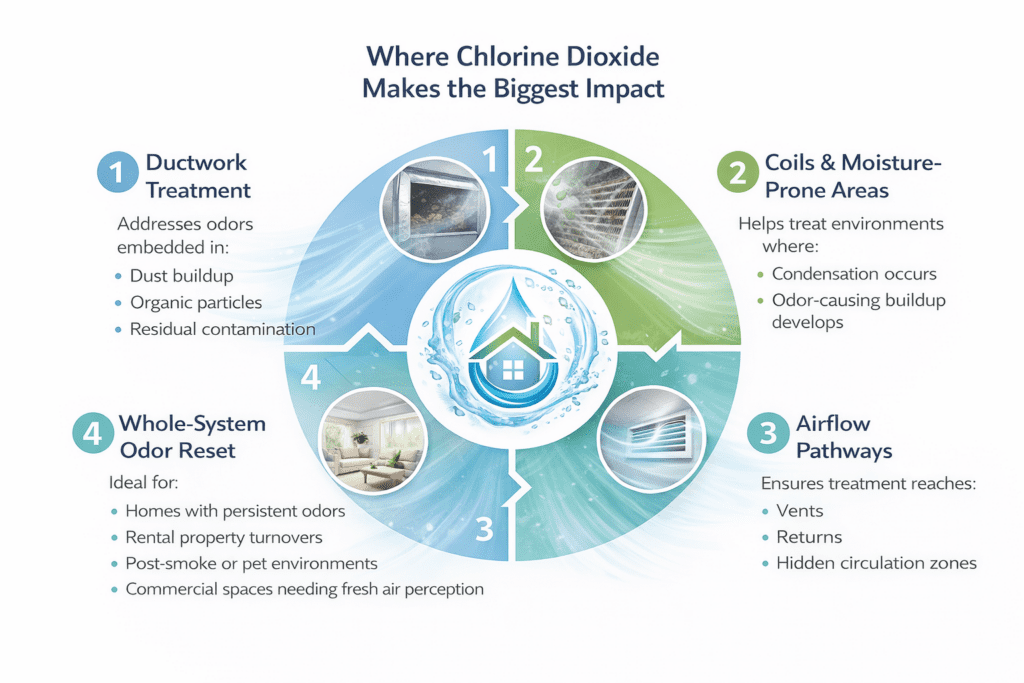
    ✔ Moves Through the Entire HVAC System

    As a gas, it follows airflow pathways—reaching:

    • Ductwork
    • Coils
    • Hidden zones

    ✔ Targets Odor at the Source

    Instead of masking smells, it:

    • Interacts with odor-causing molecules
    • Breaks them down chemically
    • Eliminates the source of the problem

    ✔ Treats the Air, Not Just the Equipment

    It works within:

    • The airspace
    • The system
    • The environment as a whole


    Health, Comfort, and the Air You Breathe

    Let’s talk real-world impact.

    Poor IAQ isn’t just unpleasant—it affects:

    • Comfort
    • Perception of cleanliness
    • Breathing experience
    • Overall indoor environment quality

    When air carries odor or contamination:
    👉 people notice immediately—even if they can’t explain why

    Cleaner air means:
    ✔ More comfortable spaces
    ✔ Better perceived cleanliness
    ✔ Improved indoor experience


    Why IAQ Matters More Than Ever

    Modern buildings are:

    • More sealed
    • More energy-efficient
    • Less naturally ventilated

    That means:
    👉 Air stays inside longer—and so do contaminants

    At the same time:

    • Occupants are more aware of air quality
    • Property standards are rising
    • First impressions are instant

    A Smarter Approach to Indoor Air Quality
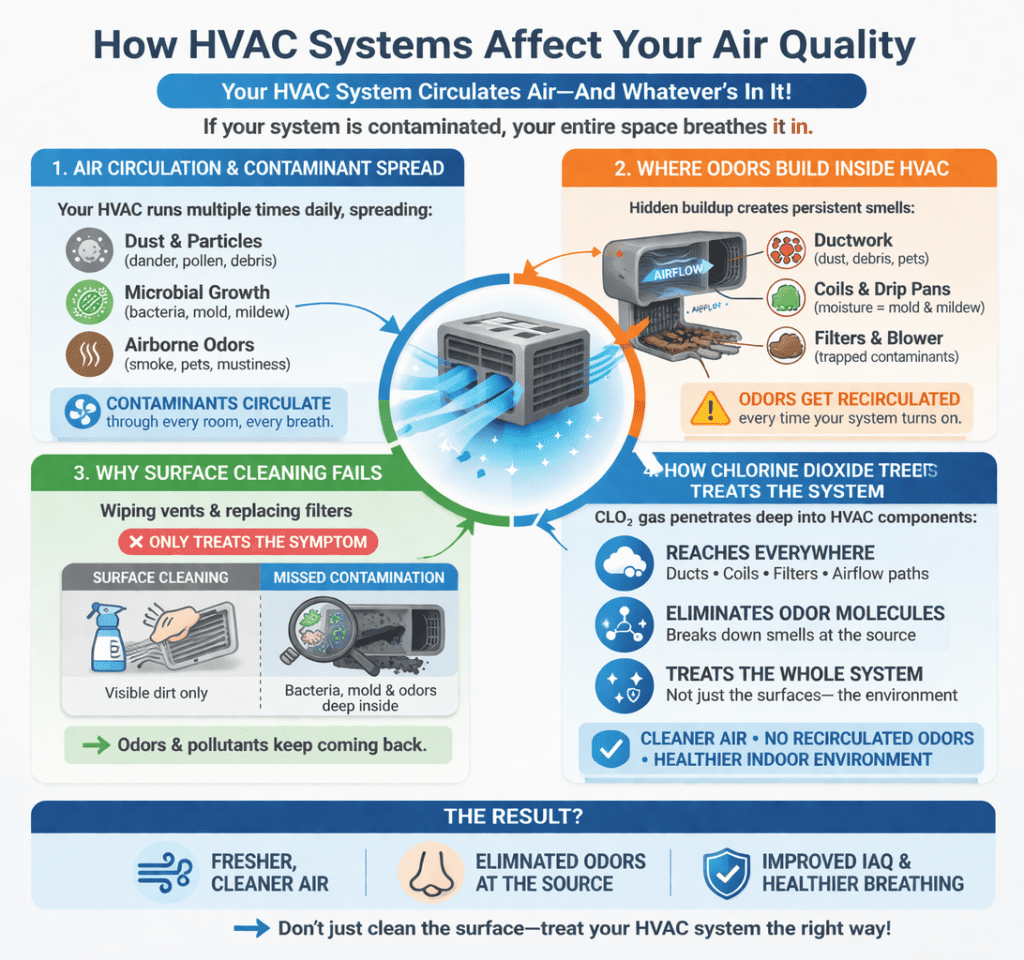
    infograph of how HVAC systems impact IAQ

    Instead of relying only on:

    • Surface cleaning
    • Filters
    • Fragrance-based solutions

    The shift is toward:
    👉 system-level environmental treatment

    Because if the system is clean,
    the air becomes clean.


    Use-Case Scenario

    A homeowner notices:

    • A musty smell every time the AC turns on
    • Air feels “stale” despite cleaning

    The issue isn’t the room—it’s the system.

    After a chlorine dioxide treatment:

    • Odor source is neutralized
    • Air feels clean and neutral
    • The HVAC system stops reintroducing the problem

    Safe and Controlled Use

    Chlorine dioxide is highly effective—but must be used properly.

    Key considerations:

    • Follow product instructions carefully
    • Use correct dosage for space/system size
    • Ensure proper ventilation guidance is followed

    👉 Results come from controlled, intentional use—not overuse

    Also Read Clean Air Cure™ 90 – HVAC Air Distribution Sanitizing System (Up to 90 Days)


    Final Thoughts: Fix the System, Fix the Air

    If your indoor environment doesn’t feel clean,
    the issue may not be what you’re cleaning…

    👉 It’s what you’re breathing.

    Chlorine dioxide offers a way to:

    • Treat the HVAC system
    • Eliminate odor at the source
    • Support a cleaner indoor air environment

    Call to Action

    If you’re dealing with recurring odors or inconsistent indoor air quality, it may be time to move beyond surface-level solutions.

    Discover how chlorine dioxide tablets can help restore your air system and improve the environment you live and work in.

     (FAQs)

    1. How does chlorine dioxide improve indoor air quality?

    It works by breaking down odor-causing molecules within the air system, helping create a cleaner and more neutral indoor environment.


    2. Can chlorine dioxide be used in HVAC systems?

    Yes, it can be used as part of a controlled treatment process to address odors and environmental buildup within HVAC systems.


    3. Why does my HVAC system make my home smell?

    Odors often originate from buildup inside ductwork, coils, or airflow pathways and are distributed throughout the home when the system runs.


    4. Does chlorine dioxide replace HVAC cleaning?

    No, it complements traditional maintenance by addressing odor and environmental factors that cleaning alone may not eliminate.


    5. Can chlorine dioxide reach inside air ducts?

    Yes, as a gas, it travels through the system and reaches areas that are difficult to access with physical cleaning.


    6. Will this help with musty or stale air?

    Yes, it is commonly used to neutralize musty odors and improve the overall freshness of indoor air.


    7. Is chlorine dioxide safe for indoor use?

    When used according to product instructions and guidelines, it is designed for controlled environmental treatment.


    8. How long does it take to improve air quality?

    Results vary depending on the severity of the issue, but improvements are often noticeable within hours to days.


    9. Can it help with pet or smoke odors in HVAC systems?

    Yes, it can address odors from pets, smoke, and other organic sources embedded within the system.


    10. Why do indoor air problems keep coming back?

    Because the source of the issue often remains inside the HVAC system, continuing to circulate through the air.

  • Ways to Prevent Persistent Odors From Returning for Good In 2026

    Ways to Prevent Persistent Odors From Returning for Good In 2026

    Making Sure Odors Stay Away In 2026

    Your home is your sanctuary. It should smell clean, calm, and unmistakably healthy.
    Yet nothing breaks that illusion faster than conquering an odor—only to have it creep back days later like it never got the memo.

    Here’s the truth that still holds in 2026:

    The presence of an odor is the presence of a problem.

    Odor behaves like the check engine light of your home. You can ignore it. You can cover it up. But it will not turn off until the underlying issue is addressed. And just like your car, homes now require preventative maintenance, not emergency reactions.

    The good news? With modern IAQ (Indoor Air Quality) strategies, advanced chlorine dioxide technology, and smarter household habits, odors don’t have to be recurring guests.

    Below are the 2026-aligned, science-supported ways to stop odors from returning—permanently.


    1. Prioritize Continuous Air Circulation, Not Just “Fresh Scents”

    Fresh air is not a luxury—it’s a necessity for odor prevention.

    Opening windows and doors regularly allows stale, odor-laden air to escape and brings in oxygen-rich outdoor air. This simple habit dramatically reduces the concentration of airborne odor-causing compounds.

    For days when outdoor airflow isn’t practical, fans and modern air circulation systems keep air moving so odor molecules don’t stagnate and settle into fabrics, walls, and soft surfaces.

    Scented candles and air fresheners may provide temporary relief, but in 2026 they are widely recognized as masking agents—not solutions. Overuse can actually worsen indoor air quality by adding VOCs (volatile organic compounds) into the environment.

    Rule of thumb:
    If something needs to be covered up, it hasn’t been resolved.

    Also Read 👉🏼Winter IAQ Solutions: Stop Wood Smoke, Dry Air & Stale Indoor Odors

    a woman opening curtains with a smiling face.


    2. Build Daily Cleaning Into Your Odor-Prevention Strategy

    Odors don’t start as smells.
    They start as bacteria, mold spores, and organic residue.

    Daily cleaning routines—wiping surfaces, removing food debris, managing laundry—interrupt odor formation before it begins. Consistency matters more than intensity.

    Modern chlorine dioxide (ClO₂) cleaning solutions are particularly effective because they neutralize odor-causing microbes at the molecular level instead of simply disinfecting surfaces.

    Using microfiber cloths enhances this process by reaching microscopic surface imperfections where bacteria and mold love to hide.

    In 2026, the goal is no longer “clean enough to look good.”
    It’s clean enough to disrupt microbial ecosystems.


    3. Control Moisture to Eliminate Mold and Mildew Odors at the Source

    Moisture is the silent enabler of persistent odor problems.

    Mold and mildew thrive in damp environments—bathrooms, kitchens, basements, crawl spaces—and once established, they continuously emit musty odors even after visible growth is removed.

    Dehumidifiers help maintain optimal humidity levels, while prompt repairs of leaks, drips, and condensation prevent moisture accumulation in the first place.

    Targeted chlorine dioxide mold-remediation products go a step further by destroying mold spores and preventing regrowth, rather than simply cleaning visible residue.

    Dry air is hostile air—to mold.

    Also Read 👉🏼Mold Remediation in Crawl Spaces | Identify, Remediate & Protect with ClO₂


    4. Manage Pet Hygiene as an IAQ Issue, Not a Cosmetic One

    Pet odors are not “just part of having animals.”
    They are biological odors caused by bacteria, dander, oils, and moisture.

    Regular pet bathing, brushing, and bedding sanitation dramatically reduce odor load. In controlled concentrations, chlorine dioxide solutions (such as 100 ppm formulations) are safe and effective for neutralizing pet-related odors without masking or irritation.

    Cleaning pet bedding and toys with fragrance-free, biodegradable detergents prevents odor buildup while protecting sensitive respiratory systems—both human and animal.

    In 2026, pet-friendly homes are defined by odor neutrality, not perfume.


    5. Dispose of Garbage Strategically—Not Passively

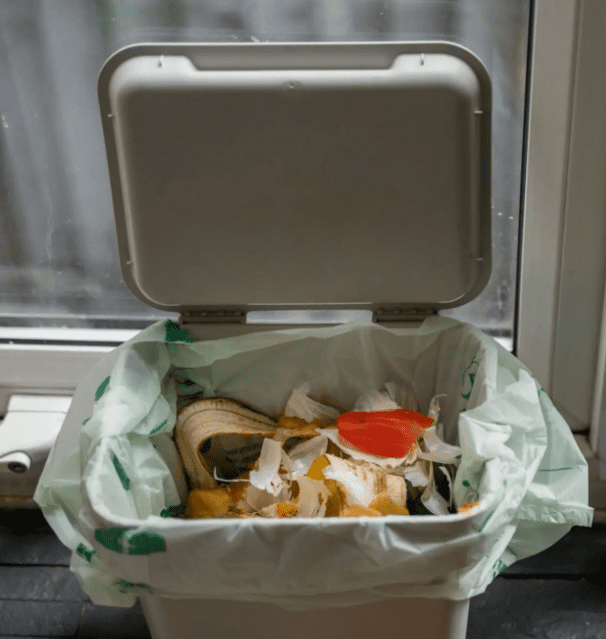
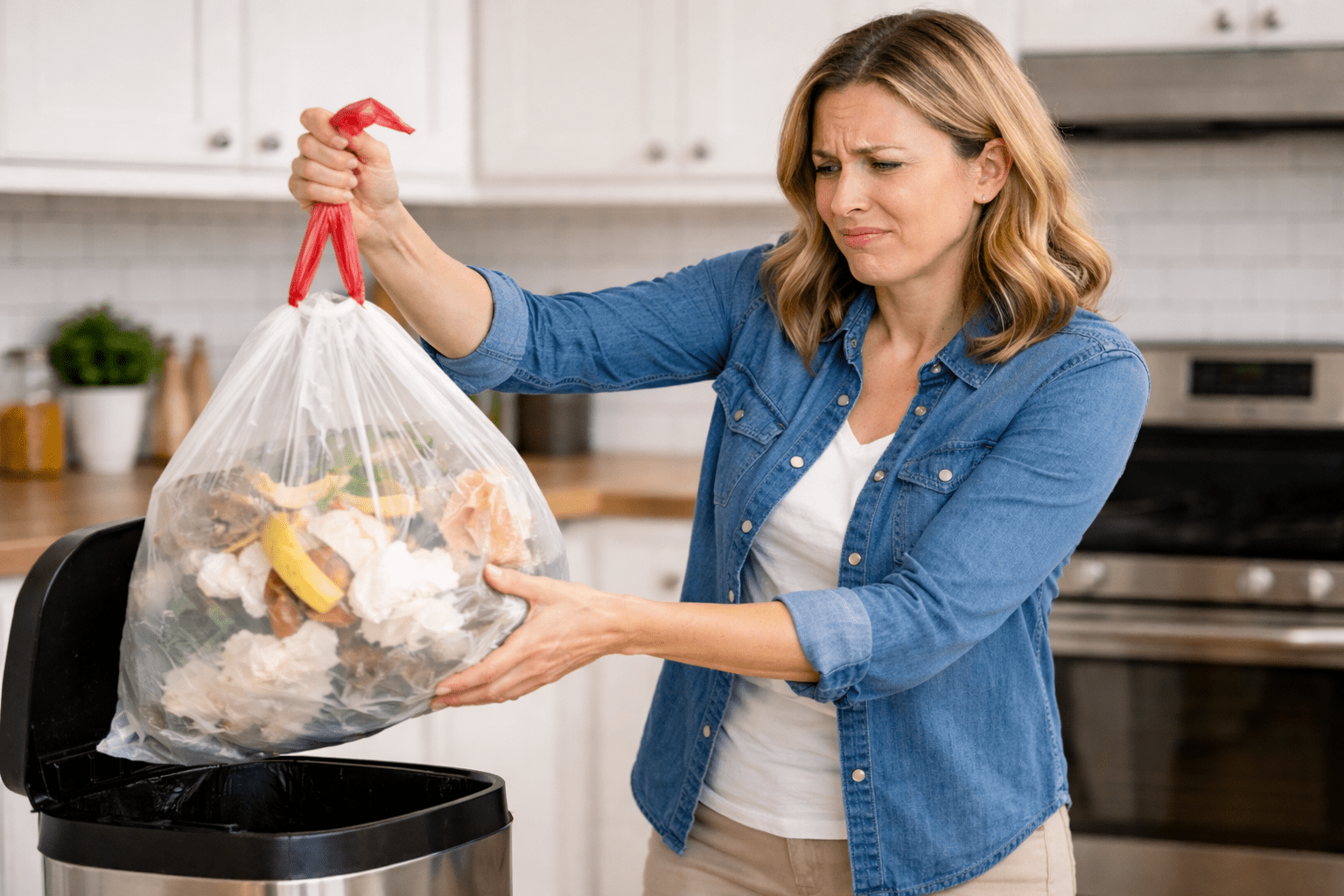
    Using CLO2 on your trash can can not only kill the odor but also break down the biome that is creating the odor.

    Trash odors escalate quickly because decomposing organic matter produces sulfur compounds and microbial gases.

    Best practices include:

    • Prompt disposal after meals
    • Sealing trash bags before removal
    • Routine cleaning of trash cans and surrounding areas

    Chlorine dioxide tablets are especially effective here, as they eliminate odor-causing microbes rather than layering fragrance on top of decay.

    Odors ignored in waste areas rarely stay contained.


    6. Designate and Maintain Smoking Areas With Intentional Remediation

    Smoke and nicotine residues are notoriously persistent. They bond to walls, fabrics, ceilings, and ventilation systems.

    Designated smoking areas reduce cross-contamination, but only if those areas are actively cleaned and remediated. Chlorine dioxide products are uniquely effective at breaking down nicotine residues and smoke-related soils at the molecular level.

    In 2026, smoke odor management is about containment, neutralization, and prevention—not ventilation alone.

    Also Read 👉🏼Why Does My Leather Sofa Smell & How Do I Get Rid of It for Good?


    7. Use ClO₂ Tablets and Granules in High-Risk Odor Zones

    Certain areas act as odor reservoirs: closets, basements, storage rooms, trash areas, and utility spaces.

    Dissolving a 1-gram Envirotab tablet in water and allowing it to off-gas safely creates a powerful, residue-free deodorization environment that works without introducing new fragrances.

    Chlorine dioxide is effective precisely because it does not smell like a “cover-up.”
    It eliminates the problem rather than announcing its presence.


    8. Improve Whole-Home Air Quality With Modern Air Purification

    Air purifiers are no longer optional accessories—they are foundational IAQ tools.

    High-quality systems remove airborne particulates, allergens, microbial fragments, and odor molecules before they settle. Granule and powder deodorization technologies add another layer by absorbing persistent odors in larger spaces.

    Clean air smells like…nothing.
    That’s the goal.


    9. Schedule Periodic Inspections to Catch Hidden Odor Sources Early

    Some odor problems are invisible.

    Leaks behind walls, microbial growth in HVAC systems, or organic buildup in rarely accessed spaces can quietly sabotage your efforts. Periodic professional inspections—often using tools like UV or black-light detection—identify problems before odors become entrenched.

    Addressing issues early is always easier, healthier, and less expensive than reactive remediation.


    Take Back Your Home—And Keep It That Way

    A consistently fresh-smelling home isn’t achieved through one-time fixes.
    It’s built through systems, habits, and preventative strategies that work together to maintain healthy indoor air.

    In 2026, odor control is no longer about fighting smells.
    It’s about engineering an environment where odors can’t survive.

    When the source is addressed, the smell doesn’t return—and your sanctuary stays exactly that.

    FAQS

    1. Why do household odors keep coming back after cleaning?
    Household odors return when the underlying source—such as bacteria, mold, moisture, or trapped organic residue—was not fully eliminated. Cleaning alone removes surface soil but may not neutralize odor-causing microbes.

    2. What is the most effective way to prevent persistent odors?
    The most effective approach is source control combined with airflow management, moisture regulation, and microbial neutralization using technologies like chlorine dioxide.

    3. Are air fresheners effective for long-term odor control?
    No. Air fresheners only mask odors temporarily and can add VOCs to indoor air. Long-term odor control requires eliminating the odor source rather than covering it.

    4. How does moisture contribute to recurring odors?
    Excess moisture allows mold and bacteria to grow, which continuously release odor-causing compounds. Controlling humidity prevents these organisms from thriving.

    5. Can chlorine dioxide permanently remove odors?
    Yes. Chlorine dioxide neutralizes odor-causing microbes and organic compounds at the molecular level, preventing odors from returning when used correctly.

    6. Are pet odors preventable without strong fragrances?
    Yes. Regular pet hygiene, bedding sanitation, and microbial odor control eliminate pet odors without relying on perfumes or masking agents.

    7. How often should air purifiers be used to control odors?
    Air purifiers should run daily, especially in high-traffic or enclosed spaces, to continuously remove airborne odor particles before they settle.

    8. Why do trash areas smell even after the garbage is removed?
    Odors linger because bacteria and residue remain on trash cans and surrounding surfaces. These areas require cleaning and microbial neutralization, not just emptying.

    9. Do smoking odors require professional treatment?
    Often, yes. Smoke residues bond to surfaces and require targeted remediation using advanced deodorization methods such as chlorine dioxide for full removal.

    10. When should a professional odor inspection be considered?
    Professional inspections are recommended when odors persist despite cleaning, as hidden sources like leaks, HVAC contamination, or microbial growth may be present.