Tag: odor neutralization

  • Why Musty Odors Come Back Every Spring?

    Why Musty Odors Come Back Every Spring?

    Every spring, the same thing happens.

    You open a storage bin, step into the garage, or pull out seasonal items—and that unmistakable musty smell hits you instantly.

    It’s not just unpleasant.
    It’s persistent.
    And no matter how many times you try to “freshen it up,” it keeps coming back.

    That’s because musty odors aren’t random—they’re predictable, seasonal, and driven by environmental conditions that reactivate odor at the source.


    What Actually Causes Musty Odors?

    Musty odors are not just “stale air.”

    They are the result of active microbial processes, primarily:

    • Bacteria
    • Mold and mildew
    • Organic residue breakdown

    These microorganisms feed on microscopic organic material and release volatile organic compounds (VOCs)—the compounds your nose detects as odor.

    👉 If you can smell it, something is actively producing it.


    Why Spring Triggers Odor Problems

    Spring creates the perfect conditions for odor to return:

    🌡️ Temperature Increase

    Warmer environments accelerate microbial activity

    💧 Rising Humidity

    Moisture fuels bacterial and mold growth

    🔒 Enclosed Storage Conditions

    Limited airflow traps odor compounds and allows buildup

    💤 Dormant-to-Active Shift

    Microorganisms that slowed during winter reactivate rapidly


    Where Musty Odors Commonly Develop

    This is why you notice odors in:

    • Storage bins and containers
    • Closets and basements
    • Vehicles and enclosed cabins
    • Upholstery and cushions
    • Seasonal gear and fabrics

    These environments combine moisture + limited airflow + porous materials, creating ideal conditions for odor formation.


    Why Most Odor Solutions Fail

    Most people try to fix the problem with:

    • Air fresheners
    • Fragrance sprays
    • Surface cleaners

    These approaches only address the symptom, not the source.

    ❌ They mask odor

    ❌ They don’t penetrate materials

    ❌ They don’t neutralize odor-causing compounds

    That’s why the smell returns—often stronger than before.
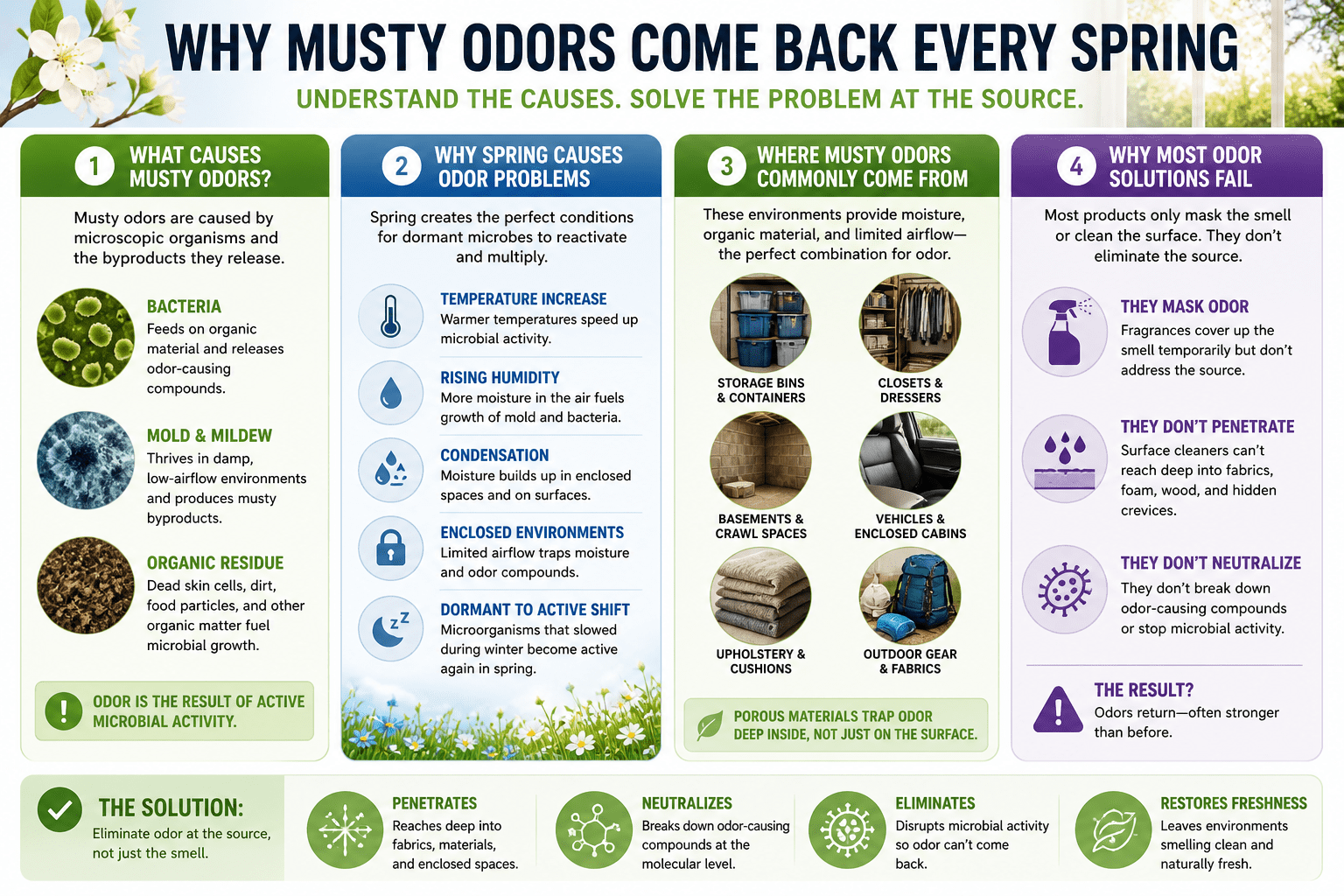
    infograph exolaining what causes musty odors and why they are worse in the spring.


    Why Odor Means Active Contamination

    This is where most people underestimate the problem.

    Odor is not just a nuisance—it’s a signal.

    It indicates:

    • Ongoing microbial activity
    • Active breakdown of organic material
    • Continued release of odor compounds

    👉 In other words, the problem isn’t gone—it’s growing.


    What It Takes to Actually Eliminate Odor

    To solve musty odors at the source, a solution must:

    ✔ Reach into porous materials (fabric, foam, wood)
    ✔ Neutralize odor-causing compounds at the molecular level
    ✔ Penetrate enclosed and hard-to-reach areas
    ✔ Address both air and surface contamination

    This is where chlorine dioxide (ClO₂) technology stands apart.

    Also Read 📖The Science of Safe Air | How ClO₂ Purifies Without Harm


    How Chlorine Dioxide Technology Works

    Chlorine dioxide works through a true neutralization process, not masking.

    It:

    • Breaks down odor-causing compounds
    • Disrupts microbial activity responsible for odor production
    • Penetrates areas that sprays and liquids cannot reach

    Because it can exist in a gas form, it moves through:

    • Airspace
    • Fabric fibers
    • Hidden crevices
    • Enclosed environments

    👉 This allows for whole-environment odor treatment, not just surface cleaning.
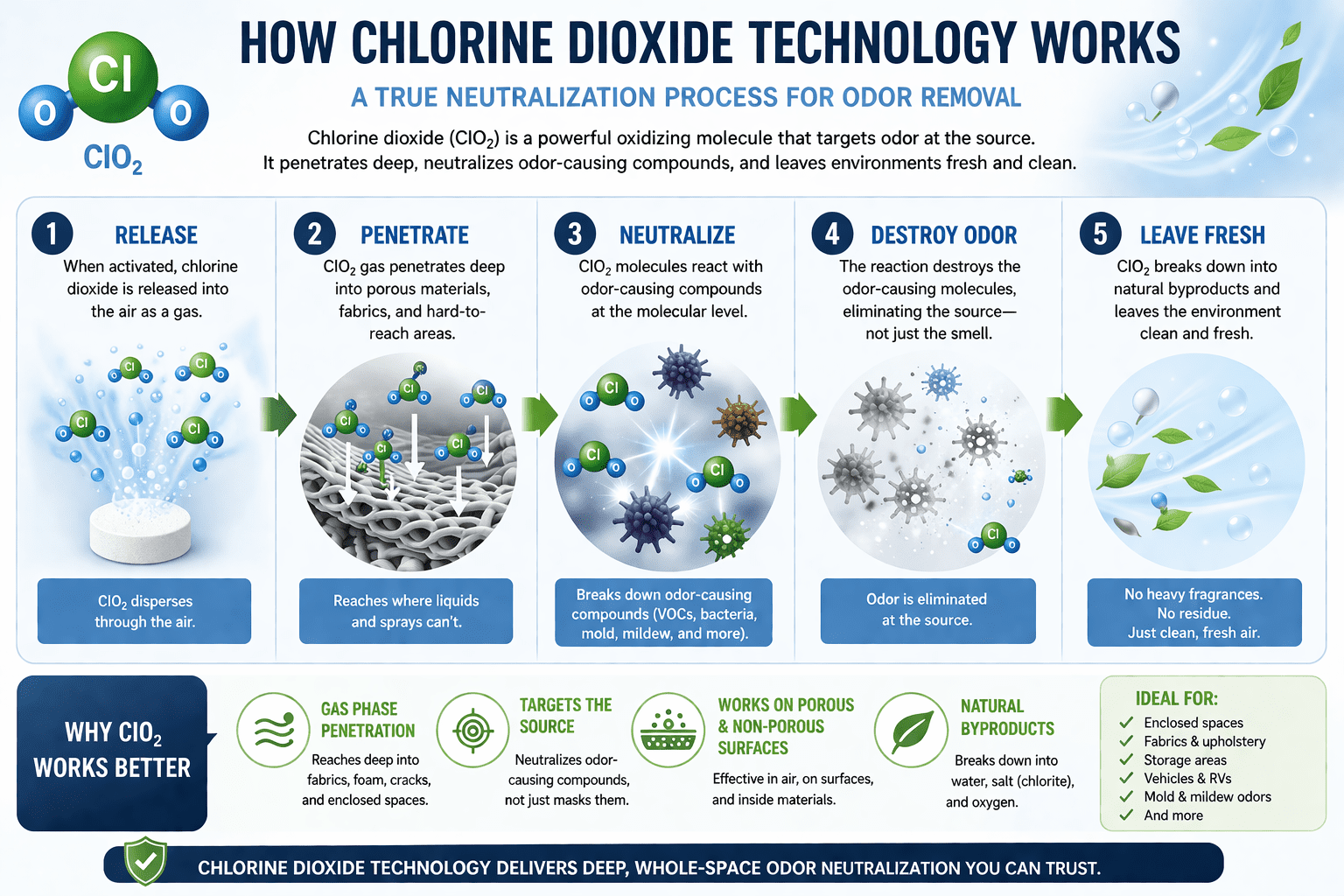
    Infographic explaining chlorine dioxide odor removal process, including gas penetration, molecular neutralization, and elimination of odor-causing bacteria and compounds


    Real-World Application Example

    Consider a storage bin sealed over winter.

    Even if items were “clean,” small amounts of moisture and organic residue remain.

    Over time:

    • Microbial activity continues slowly
    • Odor compounds build up
    • Enclosed space traps those compounds

    When spring arrives, conditions accelerate the process—and the odor becomes noticeable immediately.

    For a real-world example of how this affects outdoor gear specifically, see how this applies in camping environments here:


    👉 How to remove musty smell from camping gear (FreshTent Solutions)

    Why Does Camping Gear Smell Musty Every Year?


    How to Prevent Musty Odors from Returning

    Prevention is just as important as treatment.

    Before Storage:

    • Ensure items are completely dry
    • Avoid sealing in moisture
    • Treat enclosed environments before long-term storage

    After Storage:

    • Use a full odor-neutralizing treatment
    • Allow time for deep penetration
    • Avoid relying on fragrance-based solutions

    Why This Matters More Than Ever

    As awareness around indoor air quality and environmental conditions continues to grow, people are recognizing that odor is not just cosmetic—it’s environmental.

    Persistent odors can affect:

    • Comfort
    • Perceived cleanliness
    • Air quality
    • Long-term material condition

    👉 Eliminating odor at the source is no longer optional—it’s essential.

    Also read 📖Ways to Prevent Persistent Odors From Returning for Good In 2026


    Conclusion 

    Musty odors don’t just “come back”—they were never fully eliminated.

    They persist because the source remains active beneath the surface.

    If you want to break the cycle, the solution isn’t stronger fragrance—it’s true odor neutralization at the molecular level.

    👉 If you can smell it, it’s still there.
    👉 And if it’s still there, it can be eliminated the right way.


    ❓ FAQs
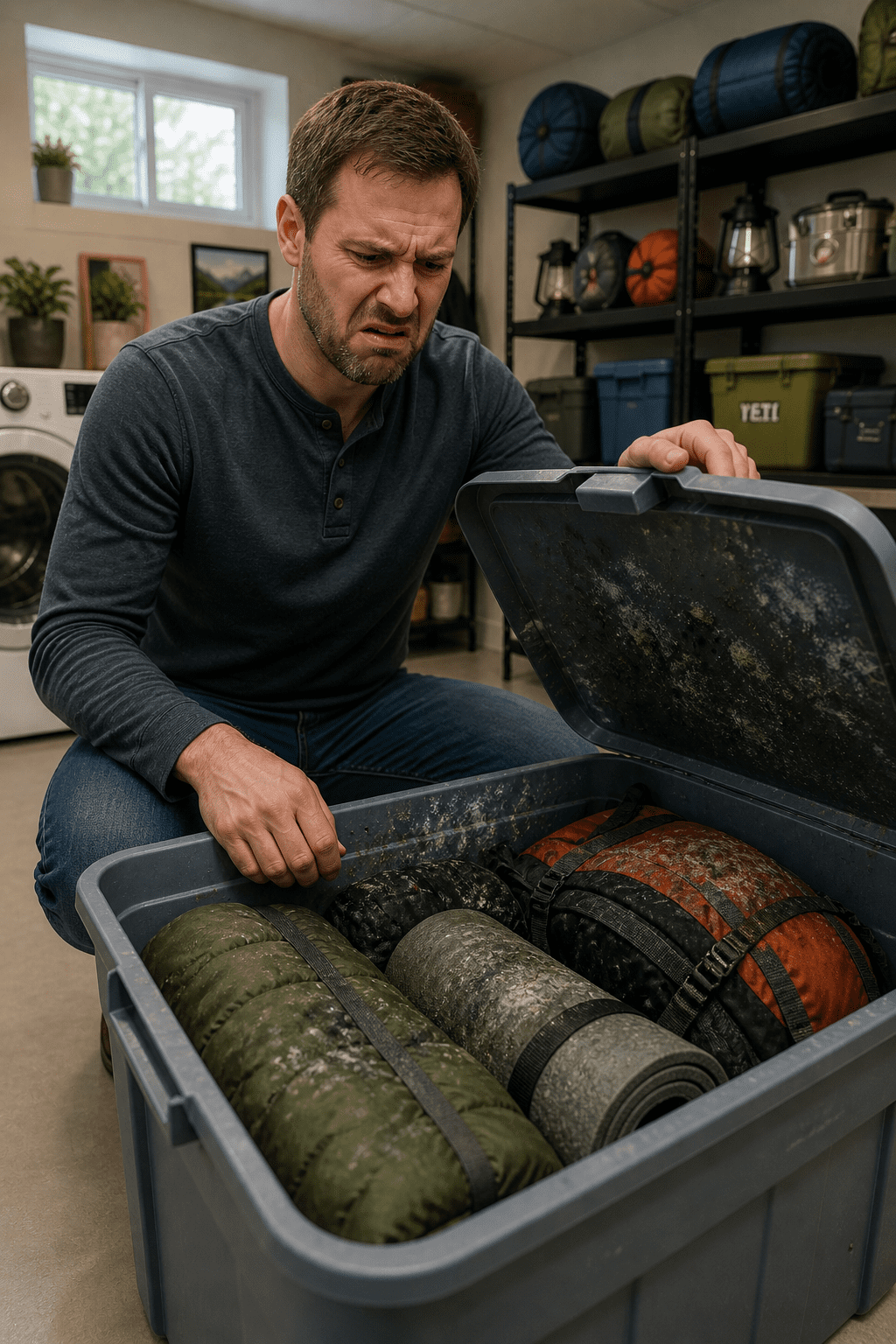
    Man opening a storage tote of camping gear and reacting to moldy, musty equipment in a basement storage area

    1. Why do things smell musty after winter?

    Because moisture and dormant bacteria reactivate in warmer, humid spring conditions.

    2. What causes musty odors?

    Microbial activity such as bacteria and mildew breaking down organic material.

    3. Why do odors come back after cleaning?

    Because most cleaning methods do not eliminate the source of odor.

    4. Is musty smell a sign of contamination?

    Yes, it indicates active odor-producing processes.

    5. Can odors live in fabric?

    Yes, porous materials trap odor-causing compounds deeply.

    6. Why don’t air fresheners work long-term?

    They mask odor instead of neutralizing it.

    7. What eliminates odor at the source?

    Treatments that break down odor-causing compounds at the molecular level.

    8. Does humidity make odors worse?

    Yes, moisture accelerates microbial activity.

    9. Can enclosed spaces trap odor?

    Yes, lack of airflow allows buildup of odor compounds.

    10. How do you prevent musty smells?

    Control moisture, treat enclosed areas, and eliminate odor sources before storage.

  • How Can Chlorine Dioxide Tablets Sanitize & Deodorize Carpets Safely?

    How Can Chlorine Dioxide Tablets Sanitize & Deodorize Carpets Safely?

    The Hidden Reality Inside Carpets and Upholstery

    Carpets and upholstered furnishings are comfort features, acoustic buffers, and design anchors—but from a microbial perspective, they are also high-surface-area reservoirs. Every footstep, pet nap, spill, and airborne particle embeds itself into fibers where conventional cleaners often fail to reach.

    Independent indoor air quality studies consistently show that carpets can harbor:

    • Bacteria and viruses tracked in from shoes
    • Mold spores and mildew in humid environments
    • Dust mites and allergens bound to fibers
    • Organic odor compounds from pets, food, and smoke

    By 2026, cleaning standards are shifting away from appearance-only metrics toward microbial load reduction and air quality outcomes. This is where chlorine dioxide becomes uniquely relevant.


    Why Traditional Carpet Deodorizers Fall Short

    Most carpet cleaning products rely on one of three outdated strategies:

    1. Fragrance masking, which adds volatile compounds without removing odor sources
    2. Surfactant cleaning, which lifts soil but does not neutralize microbes
    3. Quaternary disinfectants, which struggle to penetrate dense fibers and may leave residues

    These approaches often improve appearance temporarily while leaving odor-causing chemistry intact. As consumer expectations evolve and regulatory scrutiny increases, these methods are increasingly viewed as insufficient.


    The Chemistry Behind Chlorine Dioxide (ClO₂)

    Chlorine dioxide is not chlorine. It is a selective oxidizing gas with a well-documented history in water treatment, healthcare sanitation, food processing, and industrial hygiene.

    When chlorine dioxide tablets are activated in water:

    • They release ClO₂ gas in controlled, low-concentration levels
    • The gas penetrates porous materials, including carpet fibers and upholstery foam
    • It oxidizes microorganisms and odor molecules at the molecular level

    Unlike bleach or fragrances, chlorine dioxide destroys odor sources instead of covering them.

    Also Read 👉🏼Why Use Chlorine Dioxide Tablets for Cleaning | ClO₂ Benefits & Uses Guide


    How Chlorine Dioxide Sanitizes Carpet Fibers

    Sanitization occurs through oxidative disruption. Chlorine dioxide breaks down:

    • Bacterial cell walls
    • Viral protein coats
    • Mold and mildew structures
    • Biofilms that protect odor-producing microbes

    Because ClO₂ is a gas in solution, it reaches areas that liquid disinfectants cannot, making it particularly effective for thick pile carpets and upholstered cushions.

    This mechanism aligns with emerging 2026 cleaning frameworks emphasizing true sanitization over cosmetic cleaning.


    Deodorization Without Fragrance or Residue


    Odors persist because organic compounds remain chemically intact. Chlorine dioxide neutralizes odors by altering their molecular structure, rendering them non-odorous.

    This makes it exceptionally effective for:

    • Pet urine and dander odors
    • Smoke and cooking smells
    • Musty or mildew-related odors
    • Commercial spaces with heavy foot traffic

    The result is a clean-neutral scent, not a perfumed one—an increasingly preferred outcome in healthcare, hospitality, and eco-conscious environments.


    Step-by-Step: Using Chlorine Dioxide Tablets on Carpets & Upholstery

    1. Thoroughly vacuum to remove loose debris and particulate matter
    2. Activate chlorine dioxide tablets according to manufacturer specifications
    3. Apply the solution evenly using a fine mist sprayer
    4. Allow proper dwell time for oxidation to occur
    5. Extract or blot excess moisture as needed

    This process supports both sanitization and odor neutralization without damaging fibers when used as directed.


    Safety, Compliance, and Best Practices

    Think your home is clean? Think again! Remote controls, light switches, fridge interiors, and door handles are germ magnets. With ClO₂ , you can sanitize safely, effectively, and eco-friendly:

    Chlorine dioxide is safe when used correctly, but professional standards matter.

    Best practices include:

    • Ensuring adequate ventilation during application
    • Avoiding direct inhalation of concentrated gas
    • Spot-testing delicate or dyed fabrics
    • Following precise dilution ratios

    From a regulatory standpoint, chlorine dioxide aligns well with future-proof cleaning strategies, particularly as agencies move away from persistent chemical residues.

    Also Read👉🏼Safe Use of Chlorine Dioxide Tablets | Guidelines, PPE & Mixing Instructions


    Why Chlorine Dioxide Is a 2026-Ready Solution

    Cleaning professionals and informed homeowners are no longer asking, “Does it smell clean?”
    They are asking, “Is it actually clean?”

    Chlorine dioxide answers that question with:

    • Broad-spectrum efficacy
    • No fragrance masking
    • No harmful residues
    • Compatibility with green and low-VOC programs

    It represents a shift from traditional carpet care toward science-based indoor hygiene.


    Conclusion: A Smarter Way to Care for Soft Surfaces

    Chlorine Dioxide is safe around children at recommended concentrations and with ventilation, it’s safe around kids. Keep them away until surfaces are dry.

    Carpets and upholstery require more than soap and scent. They demand chemistry that can penetrate fibers, neutralize microbes, and eliminate odors at their source.

    Chlorine dioxide tablets offer a modern, effective, and responsible solution—one aligned with where cleaning standards are heading, not where they have been.

    By integrating chlorine dioxide into carpet and upholstery care routines, spaces become cleaner, healthier, and genuinely refreshed—without compromise.


    FAQ 

    1. Is chlorine dioxide safe for carpets?
    Yes, when properly diluted and applied according to instructions, it is safe for most carpet fibers.

    2. Will chlorine dioxide bleach or discolor carpets?
    It does not bleach like chlorine but spot-testing is always recommended for dyed fabrics.

    3. Does chlorine dioxide leave a scent behind?
    No. It neutralizes odors rather than masking them with fragrance.

    4. Can it remove pet urine odors permanently?
    Yes, it oxidizes the odor-causing compounds rather than covering them.

    5. Is chlorine dioxide effective against mold in carpets?
    It is effective against mold spores and mildew when properly applied.

    6. Can homeowners use chlorine dioxide tablets?
    Yes, provided they follow safety and dilution guidelines.

    7. How long does the deodorizing effect last?
    Because odors are chemically neutralized, results are long-lasting.

    8. Is chlorine dioxide environmentally friendly?
    It breaks down into benign byproducts and leaves no persistent residues.

    9. Can it be used in commercial carpet cleaning?
    Absolutely. It is increasingly used in hospitality, healthcare, and facilities management.

    10. How does it compare to traditional carpet cleaners?
    Traditional cleaners clean surfaces; chlorine dioxide sanitizes and deodorizes at a molecular level.