

Every spring, the same thing happens.
You open a storage bin, step into the garage, or pull out seasonal items—and that unmistakable musty smell hits you instantly.
It’s not just unpleasant.
It’s persistent.
And no matter how many times you try to “freshen it up,” it keeps coming back.
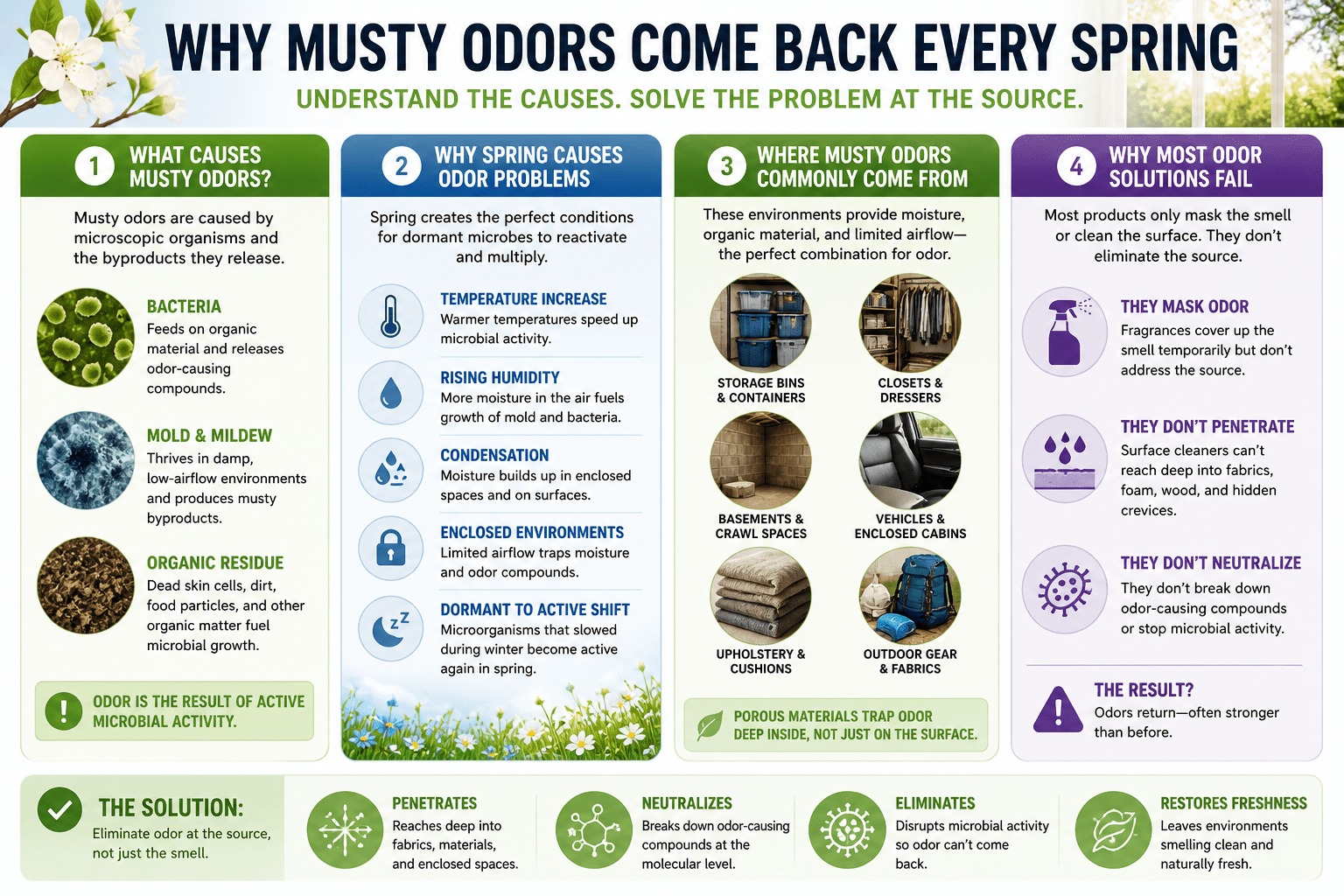
That’s because musty odors aren’t random—they’re predictable, seasonal, and driven by environmental conditions that reactivate odor at the source.
What Actually Causes Musty Odors?
Musty odors are not just “stale air.”
They are the result of active microbial processes, primarily:
- Bacteria
- Mold and mildew
- Organic residue breakdown
These microorganisms feed on microscopic organic material and release volatile organic compounds (VOCs)—the compounds your nose detects as odor.
👉 If you can smell it, something is actively producing it.
Why Spring Triggers Odor Problems
Spring creates the perfect conditions for odor to return:
🌡️ Temperature Increase
Warmer environments accelerate microbial activity
💧 Rising Humidity
Moisture fuels bacterial and mold growth
🔒 Enclosed Storage Conditions
Limited airflow traps odor compounds and allows buildup
💤 Dormant-to-Active Shift
Microorganisms that slowed during winter reactivate rapidly
Where Musty Odors Commonly Develop
This is why you notice odors in:
- Storage bins and containers
- Closets and basements
- Vehicles and enclosed cabins
- Upholstery and cushions
- Seasonal gear and fabrics
These environments combine moisture + limited airflow + porous materials, creating ideal conditions for odor formation.
Why Most Odor Solutions Fail
Most people try to fix the problem with:
- Air fresheners
- Fragrance sprays
- Surface cleaners
These approaches only address the symptom, not the source.
❌ They mask odor
❌ They don’t penetrate materials
❌ They don’t neutralize odor-causing compounds
That’s why the smell returns—often stronger than before.
Why Odor Means Active Contamination
This is where most people underestimate the problem.
Odor is not just a nuisance—it’s a signal.
It indicates:
- Ongoing microbial activity
- Active breakdown of organic material
- Continued release of odor compounds
👉 In other words, the problem isn’t gone—it’s growing.
What It Takes to Actually Eliminate Odor
To solve musty odors at the source, a solution must:
✔ Reach into porous materials (fabric, foam, wood)
✔ Neutralize odor-causing compounds at the molecular level
✔ Penetrate enclosed and hard-to-reach areas
✔ Address both air and surface contamination
This is where chlorine dioxide (ClO₂) technology stands apart.
Also Read 📖The Science of Safe Air | How ClO₂ Purifies Without Harm
How Chlorine Dioxide Technology Works
Chlorine dioxide works through a true neutralization process, not masking.
It:
- Breaks down odor-causing compounds
- Disrupts microbial activity responsible for odor production
- Penetrates areas that sprays and liquids cannot reach
Because it can exist in a gas form, it moves through:
- Airspace
- Fabric fibers
- Hidden crevices
- Enclosed environments
👉 This allows for whole-environment odor treatment, not just surface cleaning.

Real-World Application Example
Consider a storage bin sealed over winter.
Even if items were “clean,” small amounts of moisture and organic residue remain.
Over time:
- Microbial activity continues slowly
- Odor compounds build up
- Enclosed space traps those compounds
When spring arrives, conditions accelerate the process—and the odor becomes noticeable immediately.
For a real-world example of how this affects outdoor gear specifically, see how this applies in camping environments here:
👉 How to remove musty smell from camping gear (FreshTent Solutions)
Why Does Camping Gear Smell Musty Every Year?
How to Prevent Musty Odors from Returning
Prevention is just as important as treatment.
Before Storage:
- Ensure items are completely dry
- Avoid sealing in moisture
- Treat enclosed environments before long-term storage
After Storage:
- Use a full odor-neutralizing treatment
- Allow time for deep penetration
- Avoid relying on fragrance-based solutions
Why This Matters More Than Ever
As awareness around indoor air quality and environmental conditions continues to grow, people are recognizing that odor is not just cosmetic—it’s environmental.
Persistent odors can affect:
- Comfort
- Perceived cleanliness
- Air quality
- Long-term material condition
👉 Eliminating odor at the source is no longer optional—it’s essential.
Also read 📖Ways to Prevent Persistent Odors From Returning for Good In 2026
Conclusion
Musty odors don’t just “come back”—they were never fully eliminated.
They persist because the source remains active beneath the surface.
If you want to break the cycle, the solution isn’t stronger fragrance—it’s true odor neutralization at the molecular level.
👉 If you can smell it, it’s still there.
👉 And if it’s still there, it can be eliminated the right way.
❓ FAQs

1. Why do things smell musty after winter?
Because moisture and dormant bacteria reactivate in warmer, humid spring conditions.
2. What causes musty odors?
Microbial activity such as bacteria and mildew breaking down organic material.
3. Why do odors come back after cleaning?
Because most cleaning methods do not eliminate the source of odor.
4. Is musty smell a sign of contamination?
Yes, it indicates active odor-producing processes.
5. Can odors live in fabric?
Yes, porous materials trap odor-causing compounds deeply.
6. Why don’t air fresheners work long-term?
They mask odor instead of neutralizing it.
7. What eliminates odor at the source?
Treatments that break down odor-causing compounds at the molecular level.
8. Does humidity make odors worse?
Yes, moisture accelerates microbial activity.
9. Can enclosed spaces trap odor?
Yes, lack of airflow allows buildup of odor compounds.
10. How do you prevent musty smells?
Control moisture, treat enclosed areas, and eliminate odor sources before storage.