
The Quiet Chemistry Behind “Fresh” vs. “Still There”
You’ve probably noticed something weirdly consistent in life:
Some smells disappear quickly.
Others cling like they pay rent.
Some residues wipe away easily.
Others keep coming back—especially in damp places.
That isn’t just “strong smell vs. weak smell.” A lot of it comes down to molecular structure—and one of the most important forces shaping that structure is oxidation.
Oxidation is one of those science words people hear in school and then abandon like an old gym membership. But in real life, oxidation is everywhere: browning apples, rust on metal, stale air in a closed room, and yes—changes in the molecules that create odor and grime.
Today we’re going to make oxidation feel simple, useful, and honestly kind of fascinating.
What Oxidation Actually Means (No Lab Coat Required)
At the smallest scale, chemistry is about electrons—tiny particles that help atoms stick together to form molecules.
Oxidation happens when a molecule loses electrons (or effectively shifts electrons during a reaction). The important takeaway isn’t the textbook definition—it’s what oxidation does:
Oxidation often changes a molecule’s shape and behavior.
That’s why oxidation can change things like:
- Smell
- Color
- Stickiness
- How long a residue lasts
- Whether a compound stays “stable” or breaks apart
So when something oxidizes, it’s not just getting “cleaner.” It’s getting chemically different.
Why Odors Are Chemistry Problems, Not “Nose Problems”
Most odors are caused by volatile compounds—meaning molecules that easily float into the air and reach your nose.
A helpful way to think about odor molecules:
- They’re small enough to travel
- They have shapes that “fit” odor receptors in your nose
- They often contain reactive parts that can change form over time
Here’s the key:
If the structure of an odor molecule changes, it may no longer “fit” the same receptors.
So the smell can weaken, shift, or disappear—not because it got covered up, but because the odor molecule is no longer the same molecule.
That’s one reason oxidation matters so much in odor control and residue breakdown.
Oxidation in Everyday Life: Easy Examples That Make It Click
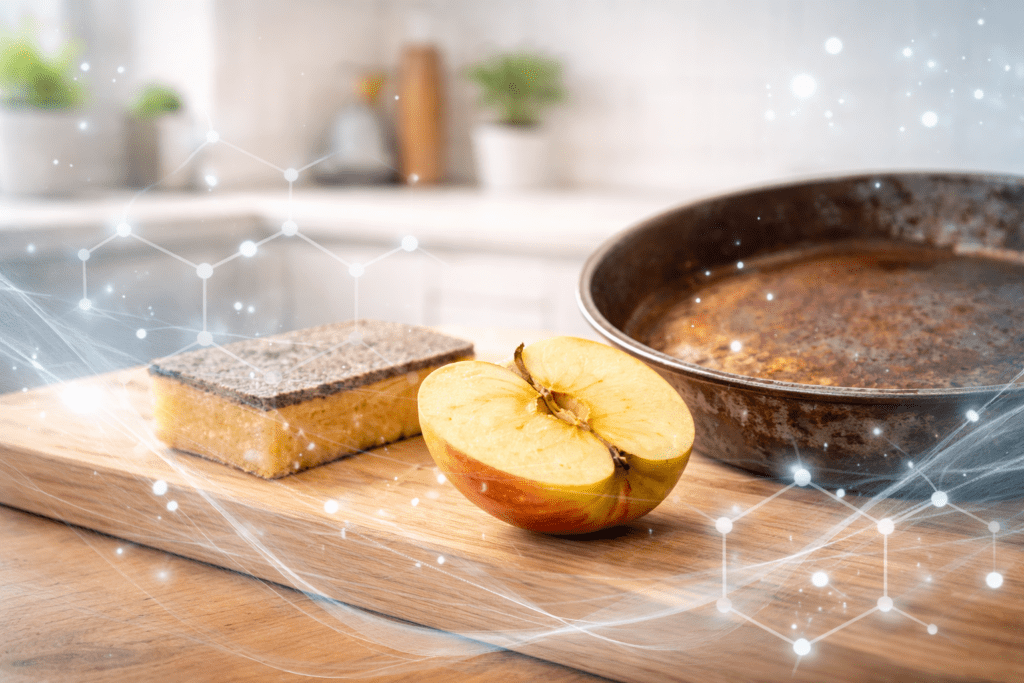
Apples turning brown
That browning is oxidation-driven chemistry happening in the fruit.
Rust on metal
Iron reacts with oxygen and moisture. The metal changes into a different compound—rust.
Old cooking smells in fabrics
Many cooking odors come from organic compounds that bond and linger in fibers, especially when moisture is present.
In all three examples, oxidation is doing one job: transforming molecules into new forms.
Why Some Residues Become “Sticky Layers” Over Time
Many residues in homes aren’t just dirt—they’re mixtures of organic compounds:
- Oils
- Grease
- Soap film
- Skin oils
- Food particles
- Pet-related residues
- Damp organic buildup
When those compounds sit in moisture-rich conditions, they don’t just “wait.” They can:
- Bond to surfaces
- Combine with other compounds
- Form thin films that attract more residue
- Become more stubborn over time
That’s why it’s common for certain areas to develop that “always slightly there” feeling—especially around sinks, trash containers, damp corners, and frequently used surfaces.
Also Read 👉🏻What Are Biofilms, and Why Do They Form on Everyday Surfaces?
Where Chlorine Dioxide Fits Into the Science (In Plain Language)
Chlorine dioxide (ClO₂) is interesting because it’s known for oxidation behavior—meaning it participates in reactions that can change certain organic compounds at the molecular level.
We’re not talking about “harshness.” We’re talking about chemistry style.
Some oxidizers behave in broad, messy ways that leave a strong chemical fingerprint. Others behave more selectively and don’t hang around as long.
One reason people look into chlorine dioxide technology is because it’s fundamentally about molecular change—not just masking, covering, or perfuming.
If you want a simple starting point on what chlorine dioxide is, this page gives the basics:
Chlorine dioxide overview: https://clo2tablets.com/what-is-chlorine-dioxide/
(And don’t worry—we’ll keep this whole series in the everyday-science lane.)
The Big Takeaway: Oxidation Is “Molecule Editing”
If you remember one idea from this article, make it this:
Oxidation is like molecule editing.
It can change:
- how a compound behaves
- whether it clings to a surface
- whether it stays volatile (smelly)
- whether it breaks down into simpler parts
Once you understand oxidation, a lot of home “mystery problems” suddenly feel less mysterious—and more solvable with smarter chemistry.
(FAQs)
1. What is oxidation in simple terms?
Oxidation is a chemical process where molecules change by shifting electrons, often changing how they smell, look, or behave.
2. Why does oxidation matter for odors?
Many odors come from volatile molecules. If oxidation changes their structure, they may no longer smell the same—or may stop being noticeable.
3. Does oxidation remove odors or cover them up?
Oxidation can chemically change certain odor-causing compounds, which is different from covering them with fragrance.
4. Why do some smells linger longer than others?
Some odor molecules are more stable, bond to surfaces more easily, or hide in moisture-rich films and porous materials.
5. Can residue change over time even if it looks dry?
Yes. Thin films can persist and interact with moisture in the air, gradually changing and attracting more buildup.
6. Is oxidation the same thing as oxygen?
Not exactly. Oxidation involves chemical reactions that may include oxygen, but oxidation can also occur through other oxidizing agents.
7. Why do damp areas hold smells more stubbornly?
Moisture helps residues form thin films, slows drying, and can trap organic compounds that release odor over time.
8. What kinds of household odors involve organic compounds?
Common examples include cooking odors, trash odors, pet odors, musty fabrics, and residues that cling to damp surfaces.
9. How does chlorine dioxide relate to oxidation?
Chlorine dioxide is known for oxidation behavior, meaning it can participate in reactions that change certain organic compounds at the molecular level.
10. What’s the benefit of learning oxidation basics?
It helps you understand why smells and residues behave the way they do, so cleaning choices feel more logical and less trial-and-error.