
Cleaning Isn’t Just About Contact
Most people think cleaning works like this:
Cleaner touches surface → surface changes.
In reality, there’s an invisible step in between:
movement.
Before any chemical interaction happens, molecules must travel—through air, moisture, thin surface films, and microscopic spaces we never see. Whether they can do that efficiently depends on three quiet factors:
- Molecular size
- Solubility
- How they behave in thin layers of moisture
Once you understand those, a lot of everyday cleaning frustrations suddenly make sense.
The Invisible Landscape on “Dry” Surfaces
Even surfaces that look dry usually aren’t.
Most household surfaces hold:
- Thin moisture films
- Microscopic residue layers
- Organic material embedded in pores or texture
These layers can be thinner than a human hair, but they still act like terrain. Some molecules move across that terrain easily. Others struggle.
That’s why scrubbing harder doesn’t always solve the problem. Force doesn’t change molecular traffic.
Molecular Size: Why Small Often Moves Differently
At the molecular level, size influences mobility.
Smaller or more neutrally structured molecules can:
- Slip through thin moisture layers more easily
- Reach trapped residues
- Interact without piling up on the surface
Larger or highly reactive compounds may:
- React quickly at the surface
- Leave behind secondary material
- Have limited movement once they bind
This isn’t about “strength.”
It’s about access.
Also Read 👉🏻What Are Biofilms, and Why Do They Form on Everyday Surfaces?
Solubility: Water Changes Everything
Solubility describes how a substance behaves when water is present—and water is almost always present at some level.
In thin films:
- Water can act like a roadway
- It can help transport molecules
- Or it can trap residues and slow evaporation
Chemistry that behaves predictably in moisture tends to be easier to control in real-world environments, where surfaces are rarely perfectly dry.
Why Thin Layers Are So Important
Thick spills are easy to see and clean.
Thin layers are the opposite.
They:
- Spread across surfaces
- Hold odors
- Attract new residue
- Resist simple wiping
Understanding thin-layer chemistry explains why certain areas—like sinks, trash containers, pet spaces, and frequently handled surfaces—feel like they “never quite reset.”
The chemistry isn’t failing.
It’s working inside a very thin, very stubborn environment.
Everyday Residues People Instantly Recognize
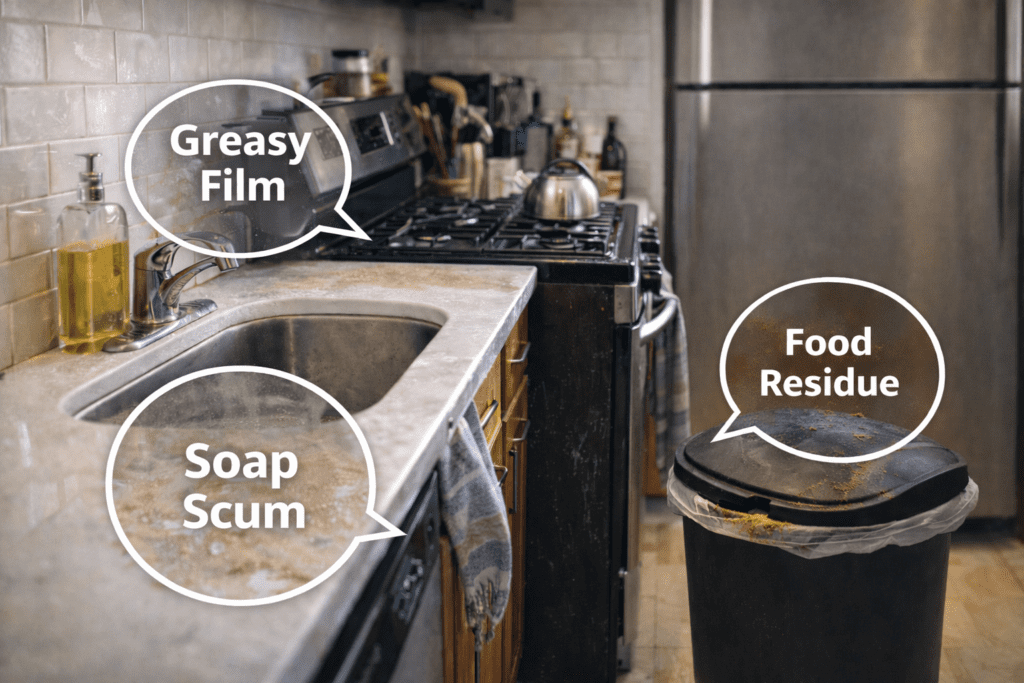
1. Grease That Feels Dry but Isn’t
Think:
- Stove backsplashes
- Cabinet doors near cooking areas
- Range hoods
This residue:
- Starts oily
- Mixes with dust
- Forms a thin, sticky film
- Becomes harder to remove over time
It doesn’t look dirty—but it grabs dirt.
2. Soap Film That Turns Cloudy
Think:
- Shower walls
- Glass doors
- Sink basins
Soap residue:
- Bonds with minerals in water
- Forms a hazy layer
- Builds slowly, not all at once
It’s thin, widespread, and resists quick wiping.
3. Pet Residue (Even in Clean Homes)
Think:
- Dog bowls
- Floors near feeding areas
- Furniture fabrics
Pet-related residue:
- Includes proteins, oils, and saliva
- Spreads easily
- Becomes part of surface films
This is why areas can smell “off” even when they look clean.
4. Trash Can Residue
Even with liners.
Residue builds:
- Around the rim
- Under the bag
- At the bottom seam
It’s a mix of moisture + organic material that clings to textured plastic.
The Key Pattern
Hard-to-reach residues usually share at least one of these traits:
- Thin, spread-out layers
- Moisture involvement
- Organic material (oils, proteins, soaps)
- Time
They aren’t thick.
They aren’t obvious.
They don’t respond well to brute force.
Where Chlorine Dioxide Fits Into This Picture
Chlorine dioxide chemistry is often discussed in terms of oxidation, but movement plays a role too.
Its molecular characteristics are part of why it’s considered differently from traditional chlorine-based compounds. Rather than behaving like a heavy surface coating, it’s associated with chemistry that focuses on interaction within thin layers.
Again, this isn’t a performance claim.
It’s an explanation of why the chemistry behaves differently.
If you’re new to chlorine dioxide and want a simple overview, this page provides a foundation:
What is chlorine dioxide?
Also Read 👉🏻Why Use Chlorine Dioxide Tablets for Cleaning | ClO₂ Benefits & Uses Guide
The Big Picture: Cleaning Is Physics + Chemistry
At the everyday level, cleaning feels like effort.
At the molecular level, it’s a balance of:
- Movement
- Contact
- Reaction
- Breakdown
Once people understand that, cleaning stops feeling random. It becomes a matter of matching chemistry behavior to real-world conditions.
And that’s where confidence replaces guesswork.
(FAQs)
1. Why does cleaning sometimes feel inconsistent?
Because residue and moisture layers vary, changing how molecules move and interact.
2. What are thin moisture layers?
They’re microscopic films of water that remain on surfaces even when they appear dry.
3. Why does molecular size matter in cleaning?
Size affects how easily molecules move through thin layers and reach trapped residue.
4. Is scrubbing harder always more effective?
Not always. Movement and chemistry often matter more than force.
5. What role does solubility play in cleaning?
Solubility affects how substances travel in moisture and interact with residue.
6. Why do some surfaces seem to hold odors longer?
Thin films can trap organic compounds that release odor over time.
7. Does water always help cleaning chemistry?
Water can help transport molecules, but it can also trap residue depending on conditions.
8. Why do damp areas feel harder to reset?
Moisture supports thin films that resist simple wiping.
9. How does chlorine dioxide relate to movement?
Its chemistry is associated with interaction in thin layers rather than heavy surface residue.
10. What’s the benefit of understanding cleaning chemistry basics?
It reduces frustration and helps people choose approaches that make sense for real conditions.