Tag: chlorine dioxide smoke odor removal

  • Why Campfire Smoke Odor Stays in Gear for Months

    Why Campfire Smoke Odor Stays in Gear for Months

    The Campfire Was Perfect… Until the Smell Followed You Home

    The fire finally burned down to glowing coals sometime after midnight.

    Everyone sat back in their camp chairs wrapped in hoodies and blankets while the last sparks drifted into the night sky. The cooler sat beside the picnic table. Someone laughed about ghost stories from earlier in the evening while another person tossed one final log onto the fire before heading into the tent.

    It was one of those camping nights you remember for years.

    Then you got home.

    A few days later, the sleeping bags still smelled like smoke.
    The tent smelled smoky the second it came out of the tote.
    The camper cushions carried that stale campfire odor long after the trip ended.

    Even after washing everything.

    And somehow… once summer humidity rolled around, the smell seemed even stronger.

    That’s because campfire smoke doesn’t just sit on the surface of camping gear.

    It embeds itself deep into porous materials where microscopic smoke particles, oils, and odor compounds become trapped inside fabric fibers, foam, insulation, and enclosed airspaces.

    And once that happens, basic cleaning often isn’t enough to fully eliminate it.
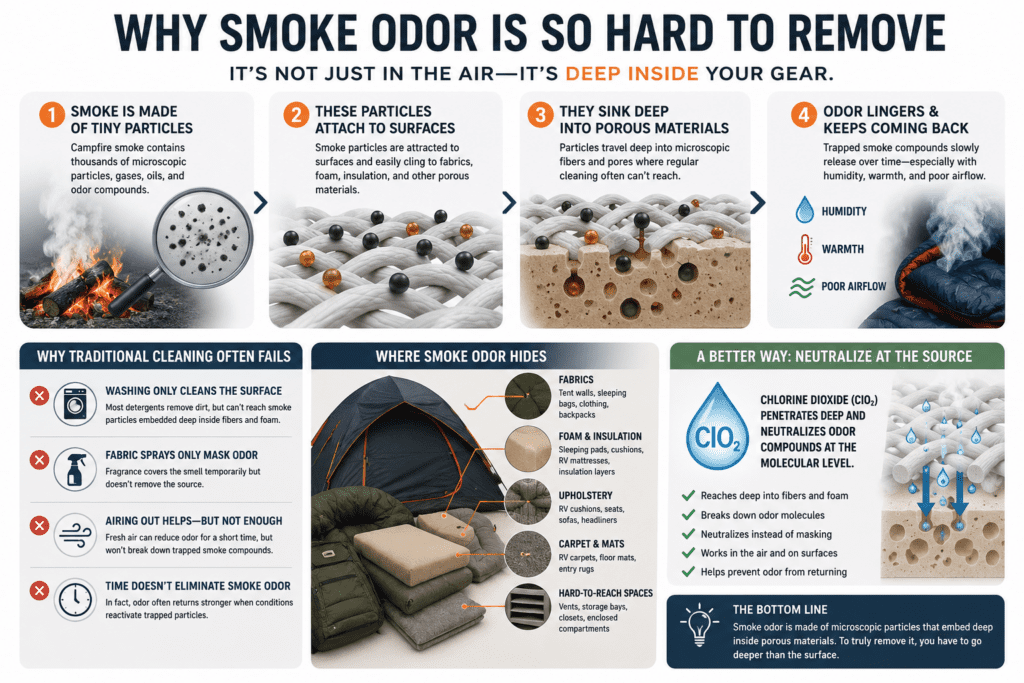

    infograph showing why smoke odor is so hard to get out of porous material.


    Why Smoke Smell Gets Worse Over Time

    One of the strangest things about campfire odor is that it often seems to return even after cleaning.

    That happens because:

    • humidity reactivates trapped odor compounds
    • warmth increases VOC release
    • enclosed spaces concentrate odor
    • embedded particles remain deep inside materials

    This is why:

    • tents smell stronger after storage
    • sleeping bags reactivate odor in humid weather
    • RVs develop stale smoke smells months later

    The odor source was never fully neutralized.
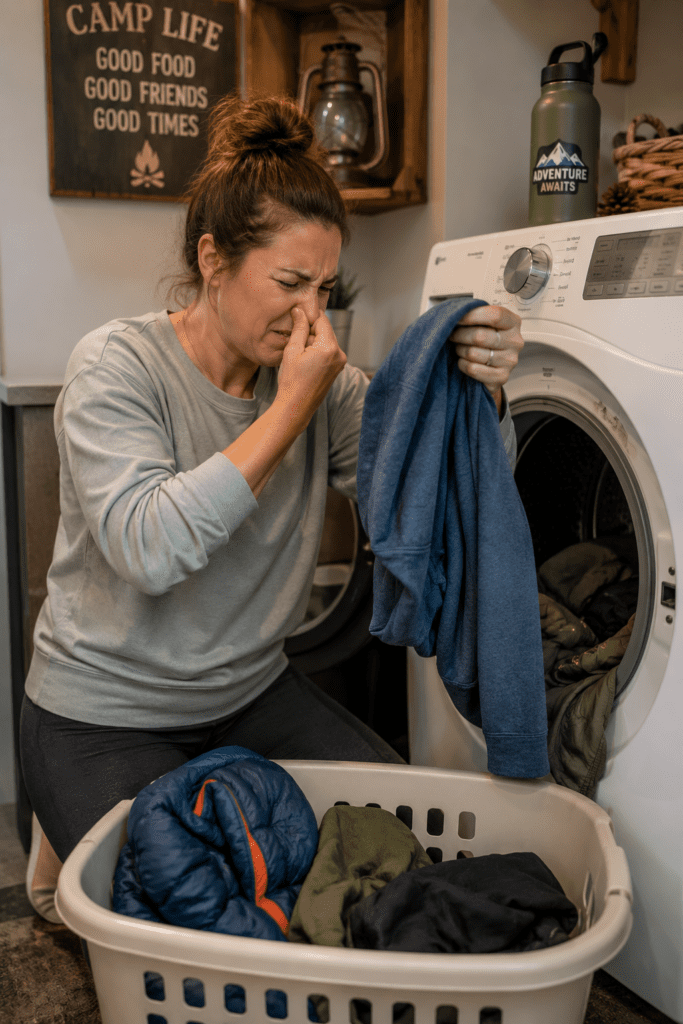

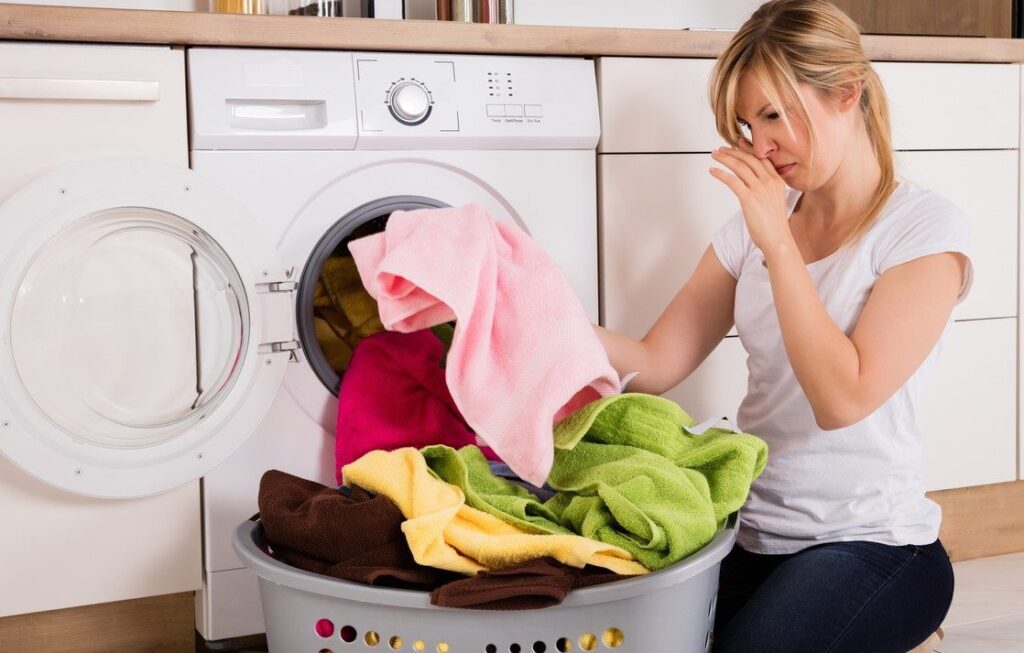
    IOmage of a woman in a well lit laundry room taking laundry out of the dryer holding her nose because the laundry still smells.

    Common Misconceptions About Smoke Odor

    ❌ “If I wash it once, the smell is gone”
    → Surface washing often leaves embedded smoke compounds behind

    ❌ “Fresh air removes smoke smell”
    → Airflow may reduce odor temporarily but not eliminate trapped residue

    ❌ “Fabric spray solves it”
    → Fragrance masks odor without neutralizing the source

    ❌ “Smoke smell is only in fabric”
    → Smoke particles settle into foam, insulation, upholstery, and enclosed airspaces too


    Why Porous Materials Hold Smoke Particles So Easily

    Camping gear is full of microscopic openings and fibers that trap:

    • smoke particles
    • moisture
    • sweat
    • bacteria
    • organic residue

    Materials like:

    • canvas
    • foam
    • upholstery
    • sleeping bag insulation
    • carpet
    • tent fabrics

    essentially absorb smoke compounds deep below the surface.

    Once those compounds settle in, they slowly continue releasing odor for weeks or months.


    Why Traditional Cleaning Often Fails

    Traditional cleaning methods typically:
    ✔ clean visible dirt
    ✔ improve surface appearance
    ✔ temporarily reduce odor

    But they often DON’T:
    ❌ neutralize embedded smoke compounds
    ❌ reach enclosed airspaces
    ❌ penetrate deeply into foam or insulation

    That’s why smoke odors often return after:

    • storage
    • humidity
    • warm temperatures
    • repeated camping trips

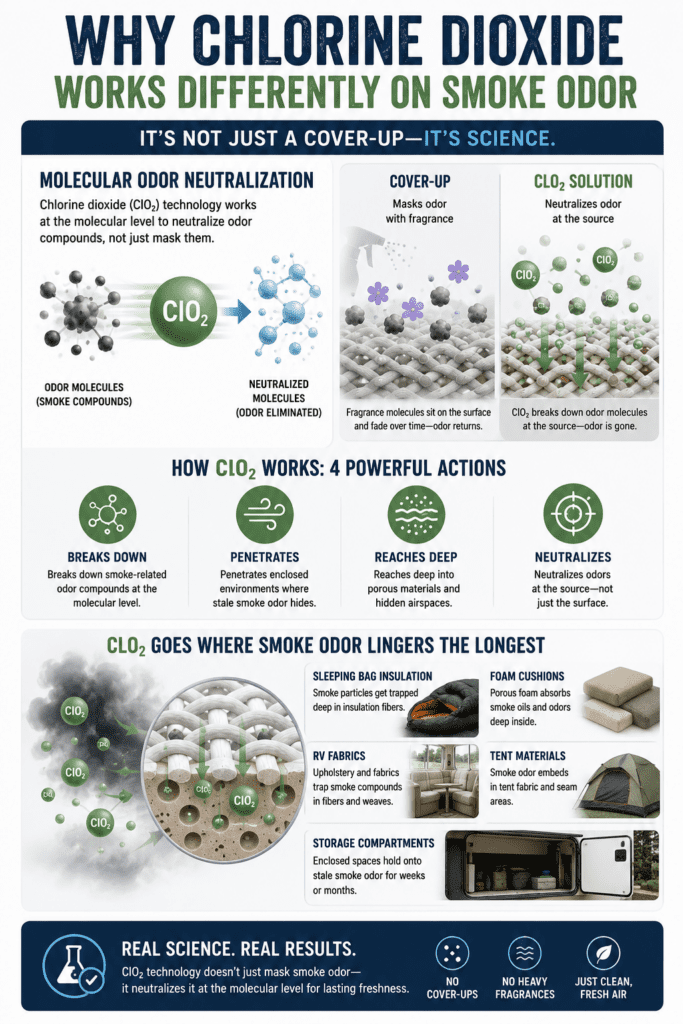
    inforgraph showing how chlorine dioxide neutralizes smoke odors on a molecular level.


    Real-World Example

    A family spends a long holiday weekend camping beside the lake.

    Every night ends around the fire.

    The hoodies smell smoky.
    The tent absorbs the campfire scent.
    The camper interior slowly picks up stale smoke odor from damp jackets and blankets coming inside at night.

    Everything smells “like camping” at first.

    But weeks later, after storage and summer humidity?
    👉 The odor becomes stale, sour, and deeply embedded into the gear.


    Why This Matters More Than People Realize

    Campfire smoke odor isn’t just about smell.

    Smoke particles can continue settling into:

    • fabrics
    • enclosed environments
    • foam materials
    • storage compartments

    where they combine with moisture and humidity over time.

    As people become more aware of:

    • indoor air quality
    • enclosed-space odor
    • environmental contamination
    • long-term gear maintenance

    there’s a growing shift away from masking odors…
    and toward true odor neutralization.


    How to Reduce Campfire Smoke Odor in Gear

    After Camping:

    • Air out gear immediately
    • Avoid sealing smoky fabrics into totes
    • Remove moisture before storage

    Before Storage:

    • Wash fabrics properly
    • Neutralize embedded odor
    • Fully dry insulation and foam

    During Storage:

    • Reduce humidity
    • Allow airflow when possible
    • Treat enclosed spaces proactively

    Want the Real-World Camping Version?

    For practical outdoor tips on removing smoke smell from sleeping bags, tents, RV fabrics, and camping gear:

    👉 How to Get Campfire Smoke Smell Out of Sleeping Bags, Tents, and RV Fabrics (FreshTent)


    What You Should Do Next…

    Campfire smoke is one of the most recognizable parts of outdoor life.

    At first, it even feels nostalgic.

    It reminds people of:

    • late nights around the fire
    • cold mornings at the campsite
    • stories, laughter, and long weekends outdoors

    But when smoke odor lingers deep inside gear for months after the trip ends, it becomes something different entirely.

    That’s because smoke doesn’t simply “sit” on camping equipment.

    It settles deep into the microscopic structure of fabric, foam, insulation, upholstery, and enclosed storage spaces where traditional cleaning methods often can’t fully reach.

    And once humidity, warmth, and storage conditions reactivate those embedded odor compounds, the smell keeps returning over and over again.

    The good news is that smoke odor doesn’t have to become a permanent part of your gear.

    When odor is neutralized at the molecular level instead of temporarily covered up, camping equipment, RV interiors, tents, sleeping bags, and outdoor fabrics stay fresher long after the fire burns out.

    Because the best camping memories should stay with you…

    —not the smell trapped inside your storage tote months later


    ❓ FAQs (10)

    1. Why does campfire smoke stay in camping gear?

    Smoke particles and odor compounds become trapped deep inside porous materials like fabric and foam.

    2. Why does smoke smell come back after washing?

    Surface cleaning often fails to fully remove embedded smoke compounds.

    3. Can sleeping bags absorb smoke odor?

    Yes, sleeping bag insulation easily traps smoke particles and odors.

    4. Why do tents smell smoky for months?

    Tent fabrics absorb smoke oils and odor compounds deep into fibers.

    5. Does humidity make smoke odor worse?

    Yes, humidity can reactivate trapped odor compounds and increase VOC release.

    6. Can RV cushions hold smoke smell?

    Yes, foam and upholstery commonly absorb smoke particles and stale odors.

    7. Why don’t fragrance sprays work long-term?

    They mask odor temporarily instead of neutralizing the source.

    8. What materials trap smoke odor the most?

    Fabric, foam, upholstery, insulation, and carpet are highly porous and retain smoke compounds.

    9. How does chlorine dioxide help remove smoke odor?

    It helps break down smoke-related odor compounds at the molecular level.

    10. How do you prevent smoke odor from building up in gear?

    Air out gear quickly, fully dry materials, and neutralize odors before storage.
  • How Do You Eliminate Odors Safely & Effectively With CLO2?

    How Do You Eliminate Odors Safely & Effectively With CLO2?

    Chlorine Dioxide for Odor Removal — The Complete Guide to Eliminating Odors at the Molecular Level

    Some odors don’t just linger — they fight back. Pet urine, mildew, smoke, body odors, musty basements, mold, trash rooms, and vehicles often smell bad because the odor molecules are trapped inside porous materials or protected by microbial biofilms. Traditional cleaners mask these smells. Chlorine dioxide (ClO₂) tablets eliminate odors at the molecular level. This guide breaks down how ClO₂ works, what odors it can remove, how to use it safely indoors, and why it outperforms conventional odor products.


    Why Chlorine Dioxide Is the Gold Standard in Odor Removal

    Chlorine dioxide is a selective oxidizer recognized by the EPA for disinfection and used in water treatment, hospitals, food-processing facilities, and large-scale odor remediation projects. Unlike enzyme cleaners, perfumes, ozone machines, baking soda, or bleach, ClO₂ targets the odor at the chemical structure.

    ClO₂ doesn’t mask. It doesn’t cover.
    It oxidizes odor-causing molecules and neutralizes them completely.

    This makes it highly effective for homes, businesses, kennels, HVAC systems, storage units, rental properties, vehicles, and more.

    Also Read 👉🏻ClO₂ Tablets Uses: Water, Mold, Surface Cleaning, Odor & More | Full Guide


    What exactly is a biofilm? A structured microbial community encased in a self-produced matrix of polymers, adhering to surfaces.How Chlorine Dioxide Actually Removes Odors
    Odors come from volatile organic compounds (VOCs) — molecules released by bacteria, mold, smoke, and organic material.
    ClO₂ works through selective oxidation:

    • It penetrates organic residues
    • Oxidizes odor-causing molecules
    • Breaks their chemical bonds
    • Neutralizes bacterial and fungal sources
    • Penetrates biofilm layers (where microbes and odors hide)

    Because ClO₂ is non-chlorinating, it doesn’t produce harmful chlorinated byproducts or leave chemical residue. Once the reaction is complete, ClO₂ breaks down into salts and oxygen-related compounds.


    What Types of Odors Can ClO₂ Remove?

    ClO₂ is one of the few odor solutions effective across all major odor categories:

    Removing odors from laundry has never been easier with CLO2. ✔ Pet Odors

    • Cat urine
    • Dog accidents
    • Kennel smells
    • Pet bedding odors

    ✔ Smoke Odors

    • Cigarette
    • Cigar
    • Cannabis
    • Fire damage residue

    ✔ Musty & Moldy Odors

    • Mildew in bathrooms
    • Damp basements
    • Flooded areas
    • Crawlspaces
    • Storage units
    • Laundry Odors

    ✔ Food & Organic Odors

    • Rotten food
    • Trash cans
    • Fridge/freezer odors
    • Compost smells

    ✔ Body & Lifestyle Odors

    • Gym bags
    • Shoes
    • Sports equipment
    • Sweat odors

    ✔ Vehicle & RV Odors

    • Cars
    • Trucks
    • Boats
    • RVs
    • Campers

    ✔ Commercial Odors

    Restaurants, gyms, hospitals, hotels, kennels, rental homes, apartments — anywhere persistent odors arise.

    Also Read 👉🏻Is CLO2 Safer Sanitation for The Food & Beverage Industry?


    Why ClO₂ Works Better Than Traditional Odor Products

    Odor Product How It Works Why It Fails ClO₂ Advantage
    Perfumes / Air Fresheners Mask smells Odor returns; VOCs unchanged ClO₂ eliminates VOCs
    Enzyme Cleaners Break down organic material Slow; doesn’t kill microbes fully ClO₂ penetrates biofilm quickly
    Bleach Chlorinates surfaces Doesn’t neutralize odor molecules; strong fumes ClO₂ oxidizes odors without residue
    Activated Charcoal / Baking Soda Absorb odors Limited range ClO₂ neutralizes odors at source
    Ozone Generators Oxidize air-borne odors Dangerous, must be used with evacuation ClO₂ works safely at lower concentrations

    ClO₂ is the only method that:
    ✔ Neutralizes odors chemically
    ✔ Penetrates hidden sources
    ✔ Kills microbes that generate odors
    ✔ Works safely in occupied buildings (at correct ppm)


    How to Use Chlorine Dioxide for Odor Removal

    ClO₂ can be used in three primary ways depending on odor severity.


    Method 1 — Light-to-Moderate Odors (Surface Deodorizing)

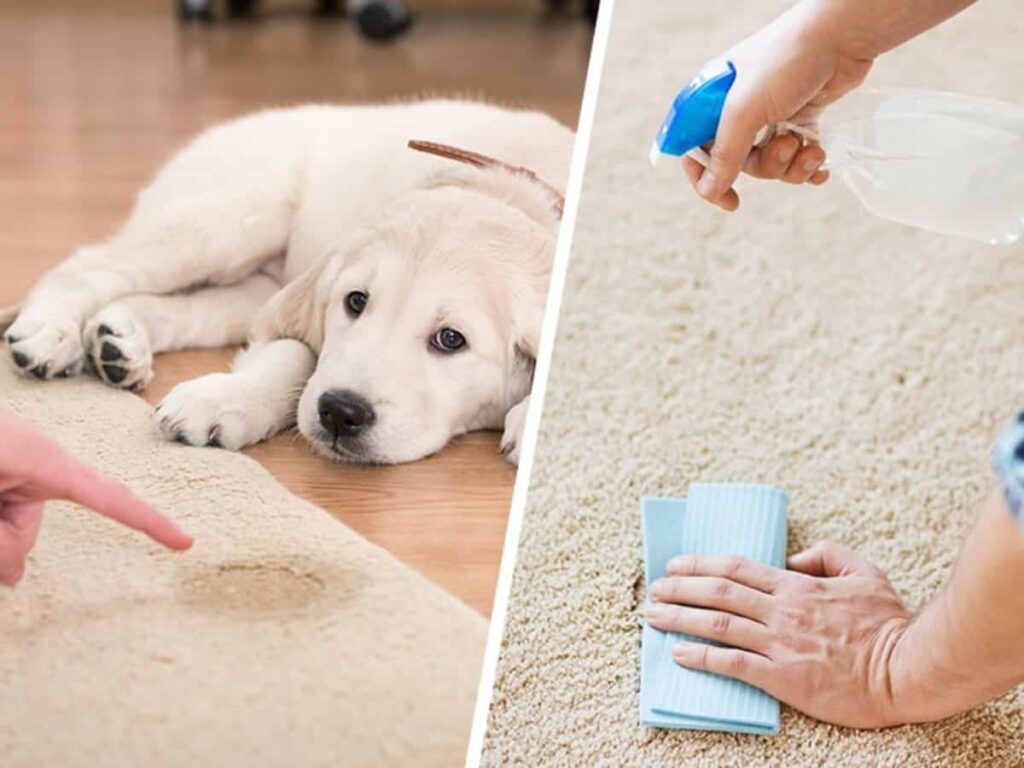
    two parts of picture, on the left side, a urine stain on carpet and a dog sitting sad and a hand pointing finger to the urine stain and on the right side, a close shot of hands with a cloth and spraying on urine stain.Use concentration: 50–200 ppm
    Ideal for:

    • Pet accidents
    • Bathroom smells
    • Small odor patches
    • Kitchen surfaces

    How to Apply:

    • Mix tablet to correct ppm
    • Allow full activation (solution turns amber/yellow)
    • Spray directly on odor source
    • Let sit 5–10 minutes
    • Rinse if needed (food surfaces)

    Also Read 👉🏻Deodorizing Pet Bedding with ClO2


    Method 2 — Deep Odor Penetration (Heavy Surfaces & Porous Materials)

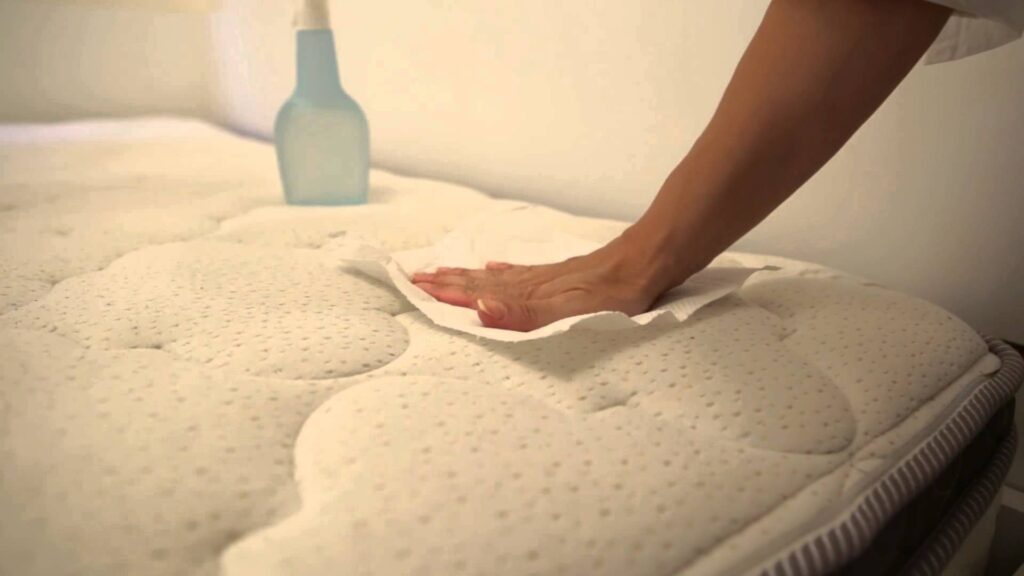
    sanitizing-mattress-with-sanitizer.Use concentration: 500 ppm
    Ideal for:

    • Carpets (spot treatment)
    • Mattresses
    • Gym gear
    • Pet bedding
    • Moldy areas
    • Trash cans

    How to Apply:

    • Spray or wipe affected area
    • Allow 10–30 minutes dwell time
    • Repeat if needed
    • Allow drying & ventilation

    Also Read 👉🏻 How to Sanitize Your Mattress After the Flu | Envirotab ClO₂ Solutions


    Method 3 — Room Shock Treatment (Severe Odor Remediation)

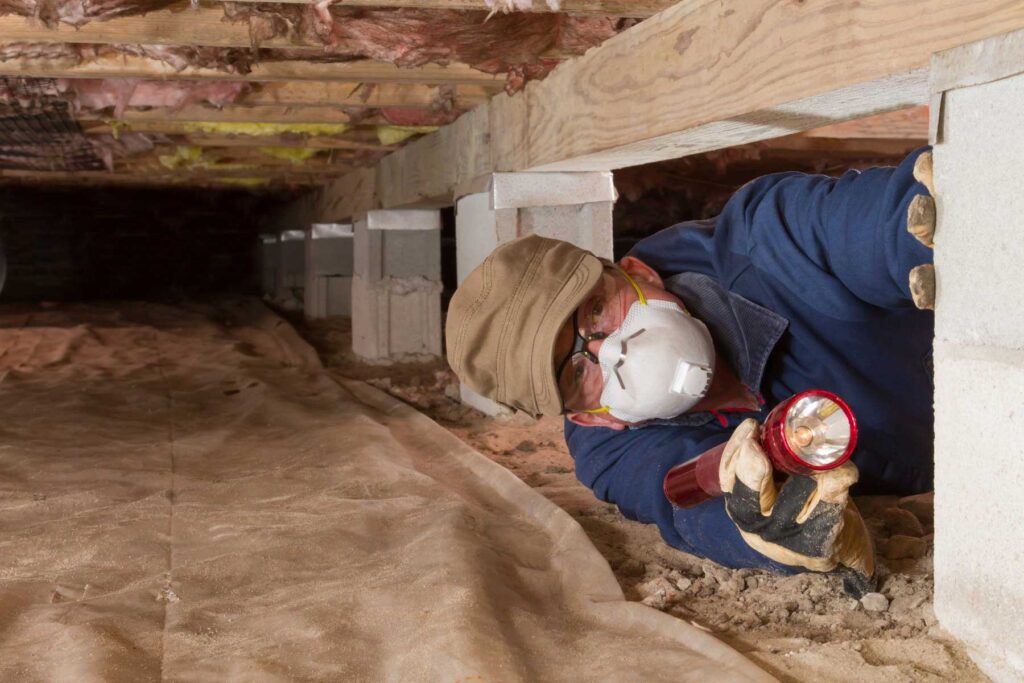
    mold inspector looking for mold in a crawl space and a torch in his hand.Use concentration: Based on tablet type
    Ideal for:

    • Smoke-damaged rooms
    • Musty basements
    • Vacant rentals
    • Storage units
    • Cars & RVs

    How Shock Treatment Works:
    ClO₂ slowly releases vapor into the air in a controlled way — safe when done properly.

    Procedure:

    • Place activated solution in a bowl or container
    • Seal room or vehicle
    • Leave 2–6 hours depending on intensity
    • Ventilate space for 10–20 minutes before re-entry

    NEVER:
    – Perform shock treatments in occupied rooms
    – Use ClO₂ gas aggressively without ventilation
    – Combine shock concentrations with ozone

    Also Read 👉🏻Airbnb & Short-Term Rental Cleaning | Odor Removal & Sanitizing With ClO₂


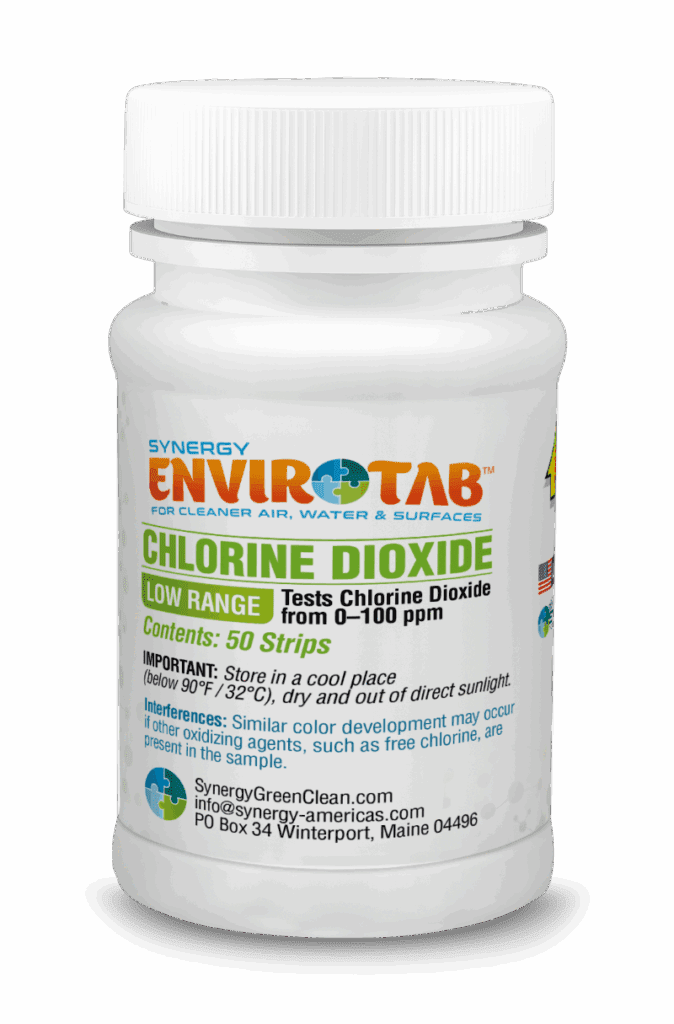
    Low Range Test Strip BottleSafety Guidelines for Indoor Odor Removal

    ClO₂ is safe indoors when:

    ✔ Used at correct ppm
    ✔ Basic ventilation is provided
    ✔ Room is unoccupied during shock treatments
    ✔ Pets and children avoid wet solution
    ✔ Solutions are not mixed with other chemicals
    ✔ Activation containers are not sealed tightly

    ClO₂ is less irritating than bleach and produces minimal fumes at cleaning levels.

    Order CLO2 Test strips here 👉🏻https://clo2tablets.com/clo2-test-strips-low-range-0-100ppm-50-bottle/

    Also Read 👉🏻How Safe Is Chlorine Dioxide for Indoor Use Around People and Pets?


    When NOT to Use ClO₂ for Odor Removal

    ClO₂ is not suitable for:

    • Diffusers
    • Devices that aerosolize chemicals
    • Fully enclosed, unventilated spaces
    • Highly porous materials (very old carpets, insulation) without testing
    • Removing non-organic chemical odors (solvents, gasoline)
    • Using concentrations above recommended levels in occupied spaces


    Always remember that CLO2 is highly affective if use properly.Quick Summary Box — Odor Removal With ClO₂

    • ClO₂ neutralizes odors at the molecular level through selective oxidation
    • Safe for indoor use when diluted properly
    • Effective on pet, smoke, mold, mildew, food, and musty odors
    • Works on surfaces, fabrics (spot treatment), and in enclosed shock treatments
    • Requires ventilation for stronger applications
    • Far safer and more versatile than ozone or bleach for odor remediation

    Ready to eliminate stubborn odors safely and effectively? Discover professional-grade chlorine dioxide tablets at Clo2Tablets.com and restore freshness to any space — without harsh chemicals.

    Order Here 👉🏻http://Clo2Tablets.com


    Frequently Asked Questions

    1. Does chlorine dioxide remove cat urine smell?

    Yes — ClO₂ oxidizes the uric acid crystals responsible for cat urine odor.

    2. Is ClO₂ safe for pets during odor removal?

    Yes, once surfaces are dry; keep pets away from wet applications.

    3. Can ClO₂ remove smoke smell from walls?

    Yes — both surface cleaning and shock treatments work well.

    4. How long does it take to remove odors?

    Anywhere from a few minutes (surface odors) to several hours (room shock).

    5. Will ClO₂ discolor fabrics?

    No — it is non-chlorinating and does not bleach fabrics at proper ppm.

    6. Can it remove moldy or musty smells?

    Yes — ClO₂ destroys both mold spores and musty VOCs.

    7. Is ClO₂ better than ozone for odor removal?

    Yes — because it is effective at lower concentrations and safer indoors.

    8. Does ClO₂ leave any after-smell?

    No — once dry, no chemical odor remains.

    9. Can I use ClO₂ in my car?

    Yes — both surface cleaning and vehicle cabin shock treatments work well.

    10. Can I spray ClO₂ on furniture?

    Yes, on non-porous surfaces. Test fabrics first.