

Same Family Name, Very Different Behavior
It’s a common assumption:
“If it has ‘chlorine’ in the name, it must work like bleach.”
Chemically speaking, that’s a bit like assuming carbon dioxide behaves like charcoal because both contain carbon. Names can be misleading. What matters is molecular structure and how a compound reacts.
Chlorine dioxide (ClO₂) and household bleach (commonly sodium hypochlorite) are fundamentally different substances. Understanding why they behave differently doesn’t require a chemistry degree—just a look at how molecules interact.
A Quick Clarification: Names vs. Chemistry
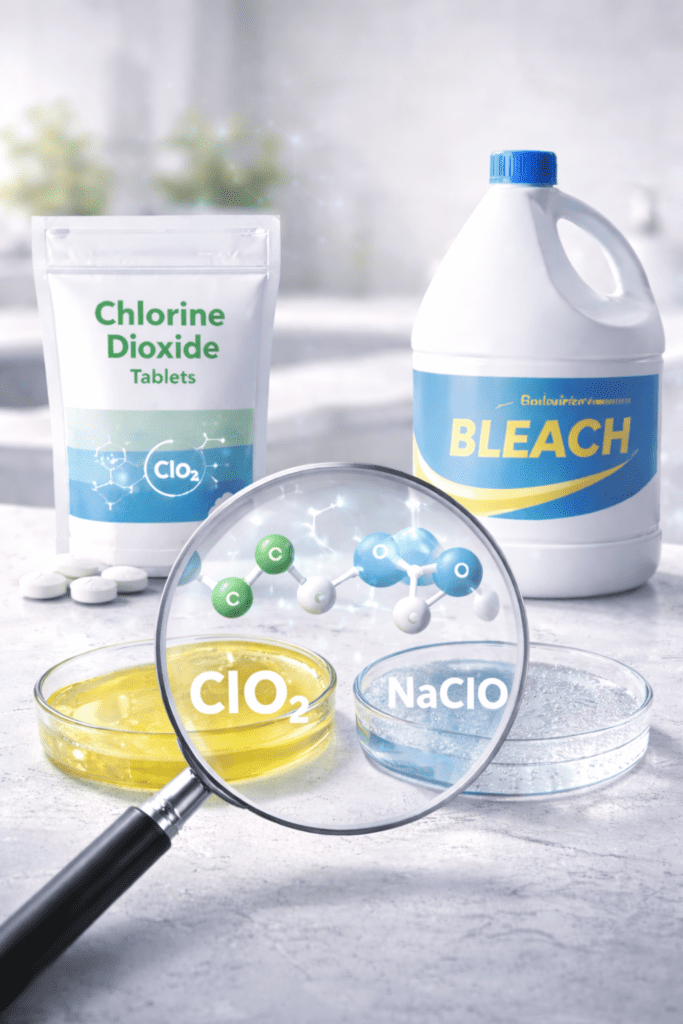
Bleach is typically a chlorine-based compound dissolved in water, forming hypochlorous-related species. It reacts readily with many substances and tends to leave behind secondary compounds as it breaks down.
Chlorine dioxide, by contrast, is a neutral gas dissolved in water. Its structure and behavior are different from elemental chlorine or hypochlorite solutions.
The shared word “chlorine” describes an element involved—not how the chemistry actually works.
Molecular Structure: Why Shape Matters
At the molecular level, structure determines behavior.
Bleach-related compounds:
- React broadly
- Tend to bind quickly
- Can leave residues or secondary reaction products
Chlorine dioxide:
- Has a smaller, neutral molecular form
- Acts primarily through oxidation reactions
- Does not behave like a “sticky” chlorine compound
This difference in structure helps explain why the two substances interact with surfaces, residues, and organic material in different ways.
Reaction Style: Broad vs. Selective Chemistry
A helpful way to think about this is reaction style.
Some chemicals react with almost everything they touch. Others interact more selectively with certain types of compounds.
Bleach chemistry tends to:
- React quickly and broadly
- Alter a wide range of materials
- Produce noticeable chemical signatures
Chlorine dioxide chemistry tends to:
- Focus on specific reactive sites
- Change certain organic compounds at the molecular level
- Break down without forming the same kinds of chlorine-based residues
This distinction matters when the goal is understanding why outcomes feel different, not making performance claims.
Also Read 👉🏻From Bleach to Breakthrough: Why Smart Cleaners Are Choosing CLO₂
Residue, Smell, and “Chemical Footprints”
Many people associate bleach with a strong, lingering smell. That scent isn’t just “clean”—it’s a sign of reactive chemistry and byproducts.
Chlorine dioxide behaves differently. Because it follows a different oxidation pathway, it doesn’t leave the same type of chemical footprint behind.
Again, this isn’t about “better” or “worse.”
It’s about different chemistry doing different things.
Why This Difference Matters for Everyday Understanding
For everyday users, the takeaway isn’t technical—it’s practical understanding:
- Not all chlorine-containing compounds behave the same
- Strong smell doesn’t equal stronger chemistry
- Molecular structure shapes how substances interact with residue and odor
- Different tools exist because different problems exist
Once people understand that, cleaning stops feeling like guesswork and starts feeling logical.
Where Chlorine Dioxide Fits Into the Bigger Picture
Chlorine dioxide sits in a category of chemistry focused on controlled oxidation rather than blanket reaction. That’s why it’s often discussed separately from traditional chlorine-based cleaners.
If you’d like a simple overview of what chlorine dioxide is (without technical jargon), this page covers the basics:
What is chlorine dioxide? https://clo2tablets.com/what-is-chlorine-dioxide/
FAQs
1. Is chlorine dioxide the same thing as bleach?
No. They are chemically different substances with different molecular structures and reaction behaviors.
2. Why do both contain the word “chlorine”?
They both involve the element chlorine, but the element behaves differently depending on how it’s bonded in a molecule.
3. Why does bleach have such a strong smell?
The smell comes from reactive chlorine-related compounds and byproducts formed during reactions.
4. Does chlorine dioxide smell the same as bleach?
No. Chlorine dioxide follows a different chemical pathway and does not produce the same chlorine-type odor.
5. Are these chemicals interchangeable?
They serve different purposes and behave differently due to their chemistry.
6. Why does molecular structure matter in cleaning chemistry?
Structure determines how a molecule reacts, what it interacts with, and what byproducts form.
7. Is oxidation the same as chlorination?
No. Oxidation refers to electron transfer reactions, while chlorination involves chlorine bonding directly to compounds.
8. Do stronger smells mean stronger chemistry?
Not necessarily. Smell reflects volatility and byproducts, not overall chemical effectiveness.
9. Why is chlorine dioxide discussed separately from bleach?
Because its chemistry, structure, and reaction behavior are fundamentally different.
10. What’s the benefit of understanding these differences?
It helps people make informed choices and understand why different products behave differently.