
You Thought It Was Clean Last Fall…
Last October, the camping season ended the same way it always does.
The tent was folded up and packed away.
The sleeping bags were aired out in the driveway.
The RV cushions were wiped down before the camper got closed up for winter.
Everything looked clean. Dry. Ready for storage.
You even remember thinking:
“Perfect. This will make spring setup easy next year.”
Fast forward a few months.
The first warm weekend finally arrives, and suddenly everyone’s excited again. The camper gets uncovered. The gear totes come down from the shelf. Someone starts setting up the tent in the backyard while another person drags the cooler into the driveway.
Then it happens.
The zipper opens on the sleeping bag… and that smell hits immediately.
Not just stale.
Not just “old fabric.”
That unmistakable damp, sour, musty odor that somehow survived an entire winter hidden inside gear you KNOW was cleaned before storage.
Suddenly the excitement of camping season turns into:
- opening windows
- spraying fabrics
- rewashing gear
- trying to figure out where the smell is even coming from
And that’s the frustrating part.
Most people did clean their gear before putting it away.
But odor in porous materials doesn’t disappear just because the surface looks clean. Deep inside fabric fibers, foam padding, insulation, and upholstery, small amounts of trapped moisture and organic buildup can continue developing slowly over time—especially inside enclosed spaces with little airflow.
By spring, the odor problem has already been building quietly for months.
And once it reaches that point, basic cleaning alone usually isn’t enough to fully eliminate it.
Why Porous Materials Trap Odor So Easily
Materials like:
- Fabric
- Foam
- Upholstery
- Insulation
- Carpeting
- Canvas
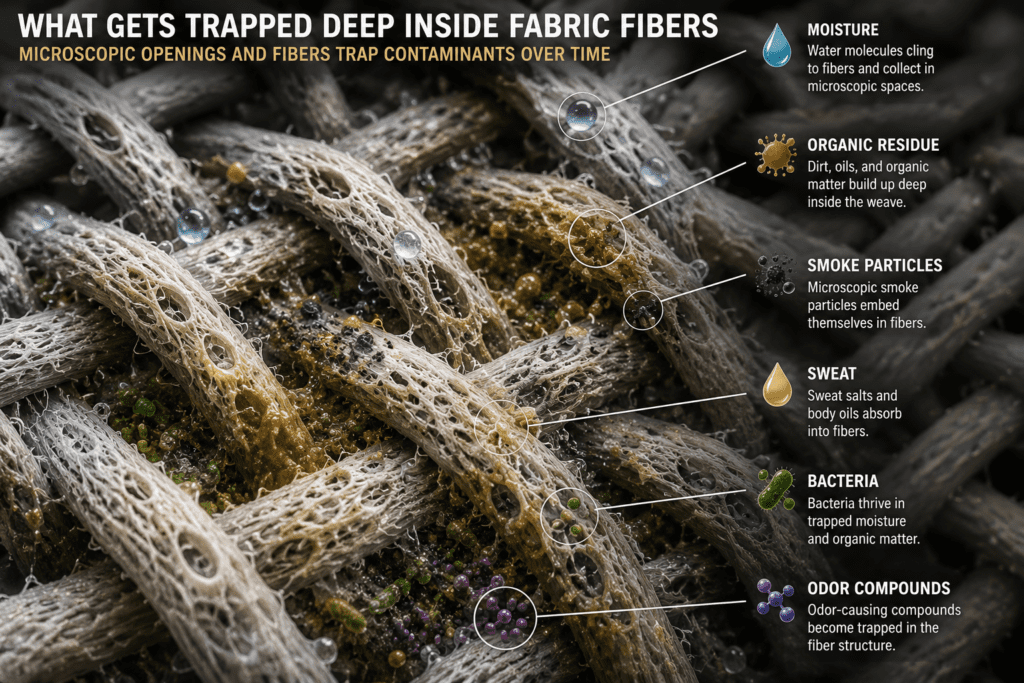
…are full of microscopic openings and fibers that trap:
- Moisture
- Organic residue
- Smoke particles
- Sweat
- Bacteria
- Odor compounds
Once trapped inside, these materials slowly hold and release odor over time.
Why Odor Comes Back After Cleaning
This is where most frustration comes from.
Traditional cleaning:
✔ Cleans surfaces
✔ Removes visible dirt
✔ Improves appearance
But it often DOESN’T:
❌ Reach deep inside fibers
❌ Neutralize embedded odor compounds
❌ Treat trapped airspaces
So even though the material looks clean…
👉 the odor source is still active underneath.
Also Read 📖The Hidden Science of Mold and Odor Growth in Enclosed Spaces

Common Misconceptions About Fabric Odor
❌ “If it smells clean now, it’s fixed”
→ Many odors return once humidity and heat increase
❌ “Dry means odor-free”
→ Materials can hold odor compounds even when dry
❌ “Laundry detergent removes everything”
→ Surface cleaning doesn’t always reach embedded odor
❌ “Fragrance sprays solve the problem”
→ They temporarily mask odor instead of neutralizing it
Why This Problem Gets Worse in Spring and Summer
Warm temperatures and humidity reactivate odor compounds trapped inside porous materials.
This is why people notice odors returning in:
- Sleeping bags
- RV cushions
- Camping tents
- Boat upholstery
- Outdoor furniture
- Seasonal clothing
👉 The odor may have been developing slowly for months.
Real-World Example
A sleeping bag gets packed away after a fall camping trip.
It feels dry enough.
But deep inside the insulation:
- Small amounts of moisture remain
- Organic residue stays trapped
- Odor compounds continue developing slowly
By spring, opening the tote releases that unmistakable musty smell almost instantly.
Also Read 📖Why Musty Odors Come Back Every Spring?

Why Chlorine Dioxide Works Differently
Chlorine dioxide technology works through:
✔ Molecular neutralization
✔ Deep penetration into porous materials
✔ Whole-environment odor treatment
Instead of masking odor, it:
- Breaks down odor-causing compounds
- Reaches deep into fibers and foam
- Neutralizes odor at the source
Because chlorine dioxide can move through enclosed airspaces and porous materials, it reaches areas traditional cleaners often miss.
What’s Changing in Odor Control
More people are realizing:
- Odor is deeper than surface dirt
- Indoor air quality matters
- Traditional masking sprays don’t last
There’s a growing shift toward:
👉 Source-level odor neutralization
How to Reduce Odor in Porous Materials
Before Storage:
- Fully dry all materials
- Avoid sealing in moisture
- Clean organic residue completely
During Storage:
- Reduce humidity
- Allow airflow when possible
- Avoid damp environments
After Storage:
- Neutralize odors deeply
- Treat enclosed spaces fully
- Avoid relying only on fragrance sprays
Want to See How This Happens in Camping Gear?
For a real-world outdoor example involving sleeping bags, tents, and camping fabrics:
👉 How to remove musty smells from camping fabrics (FreshTent)
Read the article here 👉https://freshtent.com/why-camping-fabrics-hold-onto-odors-and-how-to-fix-it/
What Should You Do Next...
❓ FAQs (10)
1. Why do fabrics hold odor?
Porous materials trap moisture and odor compounds deep inside fibers.
2. Why does odor return after washing?
Surface cleaning often fails to remove embedded odor compounds.
3. Can foam hold odor?
Yes, foam materials easily trap moisture and bacteria.
4. Does sunlight eliminate odor?
Sunlight may help temporarily but doesn’t fully neutralize embedded odor.
5. Why do sleeping bags smell musty?
Trapped moisture and organic buildup inside insulation create odor over time.
6. Can upholstery hold mold smell?
Yes, porous upholstery materials commonly retain odor compounds.
7. What causes odor in RV cushions?
Moisture, humidity, and trapped organic residue.
8. Why don’t fragrance sprays last?
Because they mask odor instead of removing the source.
9. How does chlorine dioxide neutralize odor?
It breaks down odor-causing compounds at the molecular level.
10. How do you prevent odor in porous materials?
Control moisture, dry materials fully, and neutralize odor before storage.