Author: Michele Matthews

  • How Chlorine Dioxide Helps Control Odors in High-Humidity Environments During The Summer

    How Chlorine Dioxide Helps Control Odors in High-Humidity Environments During The Summer

    Why Odors Get Worse During Humid Weather

    Every summer, facility managers, maintenance teams, transportation authorities, hospitality operators, marina owners, and commercial cleaning professionals notice a familiar trend: odor complaints increase.

    Spaces that seemed manageable during cooler months suddenly develop persistent musty smells, stale air, mildew odors, or organic odors that become difficult to eliminate.

    While heat often gets the blame, humidity is frequently the hidden factor.

    When humidity levels rise, moisture accumulates in porous materials, ventilation systems, flooring, fabrics, insulation, and hard-to-reach spaces. This added moisture creates ideal conditions for microbial activity while simultaneously intensifying many odor-producing compounds.

    The result is an environment where odors develop faster, linger longer, and become more noticeable to occupants.


    The Science Behind Humidity and Odor Formation

    Humidity affects odors in several ways simultaneously.

    First, moisture supports the growth of bacteria, mold, mildew, and fungi. These microorganisms feed on organic matter commonly found in facilities, transportation systems, and occupied environments.

    As these organisms grow, they release metabolic byproducts known as microbial volatile organic compounds (mVOCs). Many of these compounds produce the musty, sour, earthy, or stale odors commonly associated with damp environments.

    Second, humidity can increase the volatility of existing odor molecules, making them easier for occupants to detect.

    Finally, moisture can become trapped inside porous materials, allowing odor-producing organisms to survive and multiply beyond the reach of routine cleaning practices.

    This combination creates a cycle where odors continually return despite repeated cleaning efforts

    Also Read 📖The Hidden Science of Mold and Odor Growth in Enclosed Spaces
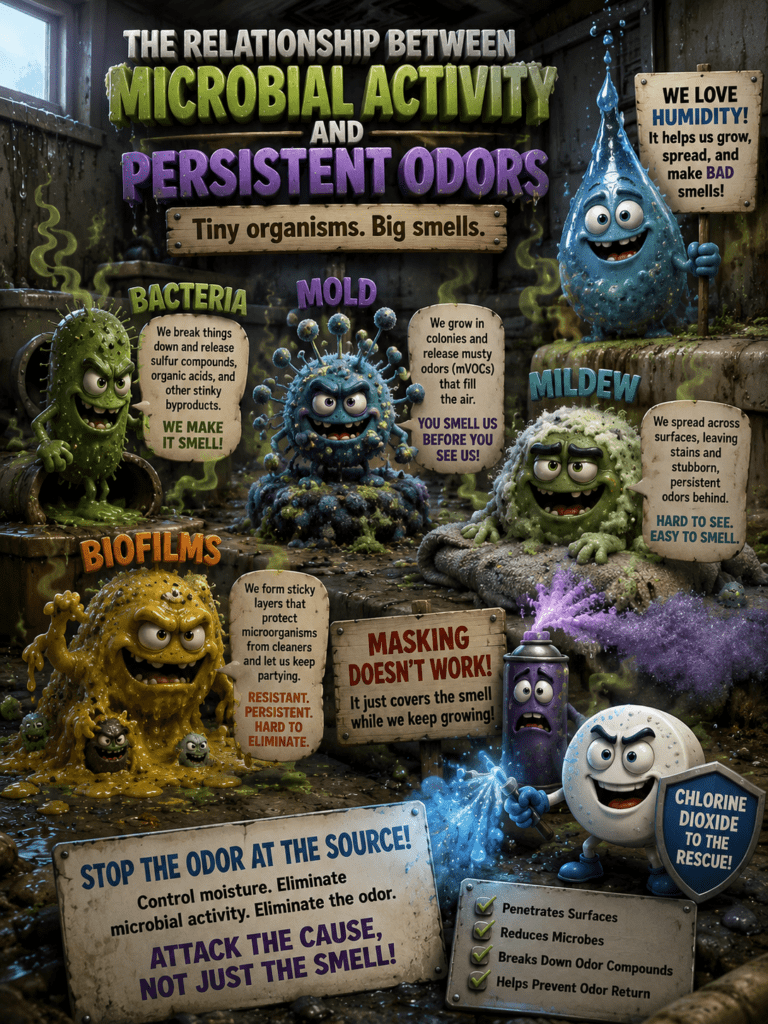
    Microbial activity and persistent odors explained


    Industrial Facilities: Continuous Operations Create Continuous Challenges
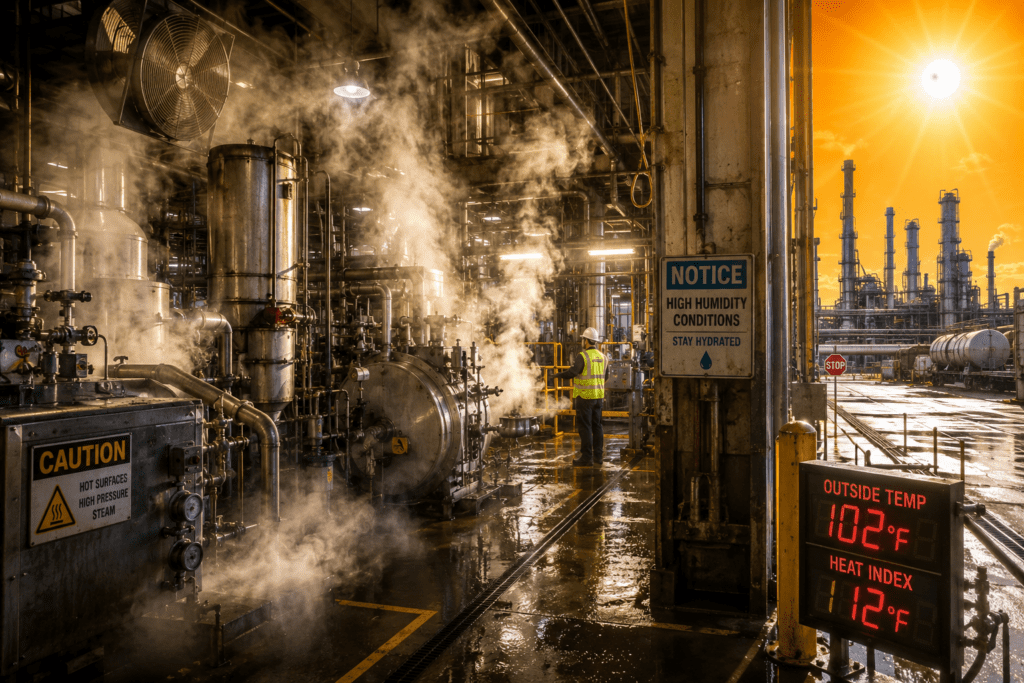
    an industrial steam plant on a hot humid day

    Industrial environments often experience elevated humidity due to manufacturing processes, equipment operation, steam generation, washdown procedures, and limited ventilation.

    Common examples include:

    • Manufacturing facilities
    • Food processing plants
    • Warehouses
    • Distribution centers
    • Waste handling operations
    • Equipment maintenance facilities

    In these settings, odors may originate from organic residues, standing water, drains, production materials, or microbial growth within equipment and ventilation systems.

    The challenge is compounded by continuous operation schedules that leave little opportunity for extensive shutdowns or remediation projects.

    When humidity remains consistently high, odor-producing microorganisms can establish themselves throughout the facility, creating recurring complaints from employees and visitors alike.


    Public Transportation Systems: High Occupancy Meets High Humidity

    over crowded public transportation bus on a hot day without any AC

    Few environments experience the combination of moisture, occupancy, and limited ventilation found in public transportation systems.

    Examples include:

    • City buses
    • Subway cars
    • Rail systems
    • Airport shuttles
    • Transit stations
    • Passenger terminals

    Thousands of passengers introduce moisture daily through breathing, perspiration, wet clothing, umbrellas, and outdoor contaminants.

    During summer months, elevated humidity levels combine with HVAC condensation and constant occupancy to create ideal conditions for microbial growth.

    Because these spaces are continually occupied, odor issues can quickly affect passenger perception and overall customer experience.

    Also Read 📖How Do I Get Rid of Food Odors in My Car Fast?

    Marine Environments: Constant Exposure to Moisture

    a marina in the fog after a rain storm

    Marine facilities face some of the most persistent humidity-related odor challenges.

    Examples include:

    • Boats
    • Ferries
    • Marinas
    • Yacht clubs
    • Harbor facilities
    • Cruise vessels

    Salt air, condensation, fluctuating temperatures, and limited airflow create conditions that encourage mold, mildew, and bacterial growth.

    Common marine odors often originate from:

    • Bilges
    • Storage compartments
    • Upholstery
    • HVAC systems
    • Engine spaces
    • Moisture-damaged materials

    Without effective odor management, these odors can become deeply embedded within the vessel and surrounding infrastructure.

    Also Read 📖Why Musty Odors Come Back Every Spring?

    Hotels and Hospitality Facilities: Guest Perception Matters
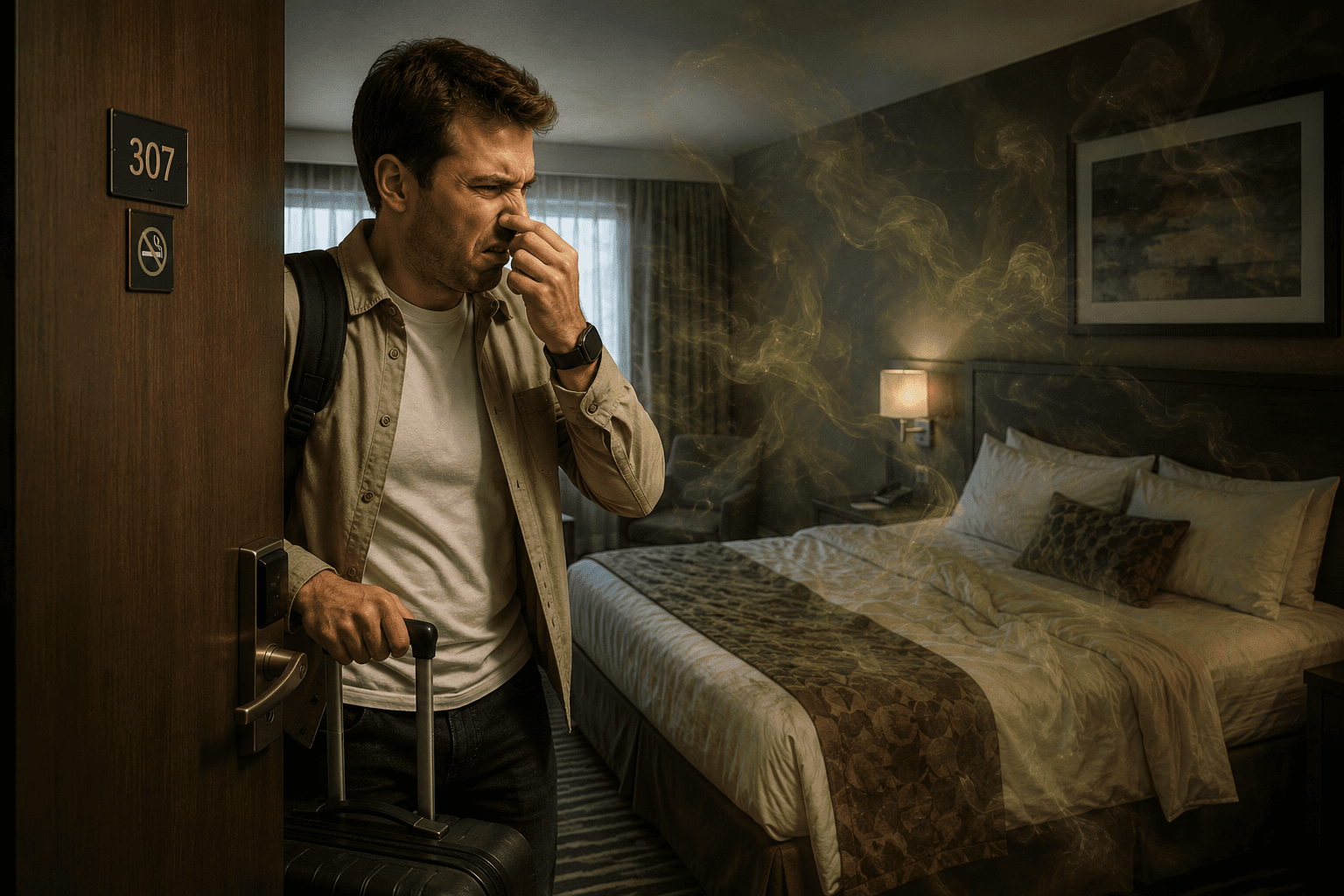
    a new hotel customer enters a room that still has the musty stink of the previous person in it.

    In hospitality environments, odor complaints can directly impact guest satisfaction and online reviews.

    Hotels face unique humidity-related challenges due to:

    • High occupancy rates
    • Frequent guest turnover
    • Bathroom moisture
    • HVAC condensation
    • Laundry operations
    • Seasonal weather conditions

    Areas most vulnerable to odor development include guest rooms, hallways, fitness centers, laundry facilities, conference rooms, and storage areas.

    Even minor odor issues can create negative impressions that influence guest experiences long before other service factors are evaluated.

    Also Read 📖Hotel Room Air Quality: The Silent KPI in Housekeeping

    RV Rental Fleets: Seasonal Humidity Meets Frequent Occupancyrv rental and a family traveling in the rain to camp with a wet dog , on a muddy road and a boat.

    RV rental operators often encounter significant odor challenges during peak travel seasons.

    Each rental cycle introduces:

    • Moisture from occupants
    • Cooking odors
    • Bathroom humidity
    • Wet clothing and equipment
    • Limited ventilation between rentals

    During summer months, elevated temperatures and humidity can rapidly accelerate microbial activity inside enclosed RV interiors.

    If left untreated, odors may become increasingly difficult to eliminate between renters, leading to customer complaints and reduced fleet appeal.

    Also Read 📖Why Odors Stay Trapped in Fabric, Foam, and Porous Materials

    Fitness Centers, Locker Rooms, and Shower Facilities

    three people working out in the gym creating an environment of high humidity.

    Fitness facilities provide ideal conditions for odor formation.

    Common contributing factors include:

    • Perspiration
    • Wet flooring
    • Damp towels
    • High traffic
    • Warm temperatures
    • Constant moisture exposure

    Locker rooms, shower areas, and fitness studios often experience nearly continuous humidity throughout the day.

    These conditions support microbial growth on flooring, walls, drains, equipment surfaces, and ventilation systems.

    As a result, odors frequently return shortly after routine cleaning unless the underlying sources are effectively addressed.

    👉🏻Chlorine Dioxide for Gyms & Fitness Centers


    Summer Camps and Recreational Facilities

    Summer camps face a unique combination of challenges:

    • High occupancy
    • Seasonal reopening
    • Shared facilities
    • Limited ventilation
    • Wet gear and clothing
    • Constant activity

    Cabins, bathhouses, dining halls, recreation centers, and storage buildings often experience elevated humidity throughout the season.

    Because many camp facilities remain closed during portions of the year, reopening can reveal odor issues that developed during storage periods and intensified once humidity levels increased.

    summer camp, a row of camp chairs lined up with brightly colored towels as the kids are swimming and the life guards are watching

    How Chlorine Dioxide Works in High-Humidity Environments

    Traditional odor-control products often focus on masking unpleasant smells with fragrances. While this may temporarily improve perceived air quality, it frequently leaves the underlying cause untouched.

    In high-humidity environments, the source of the odor often remains active beneath the surface.

    Chlorine dioxide approaches odor management differently.

    Rather than covering odors with fragrance, chlorine dioxide functions as a powerful oxidizing agent that can interact with odor-causing compounds and microorganisms. This oxidation process helps break down many of the compounds responsible for unpleasant smells while targeting microbial populations that contribute to recurring odor formation.

    This makes chlorine dioxide particularly useful in environments where:

    • Humidity remains elevated for extended periods
    • Odors originate from microbial growth
    • Airflow is limited
    • Moisture accumulates in hidden spaces
    • Traditional cleaning methods provide only temporary results

    Because chlorine dioxide can move throughout enclosed environments, it can help reach odor sources hidden within porous materials, HVAC systems, storage areas, equipment compartments, and other difficult-to-access locations.

    Also Read 📖Camping Gear Storage Tips | Prevent Mold with ClO2 Tablets

    The Science Behind How Chlorine Dioxide Prevents Odors

    Many odor-control products attempt to hide unpleasant smells by introducing fragrances into the environment. While this may temporarily improve perceived air quality, it typically leaves the underlying odor source untouched.

    Chlorine dioxide works differently.

    Rather than masking odors, chlorine dioxide is a selective oxidizing molecule that reacts with many of the compounds responsible for foul smells.

    Step 1: It Targets Odor Molecules
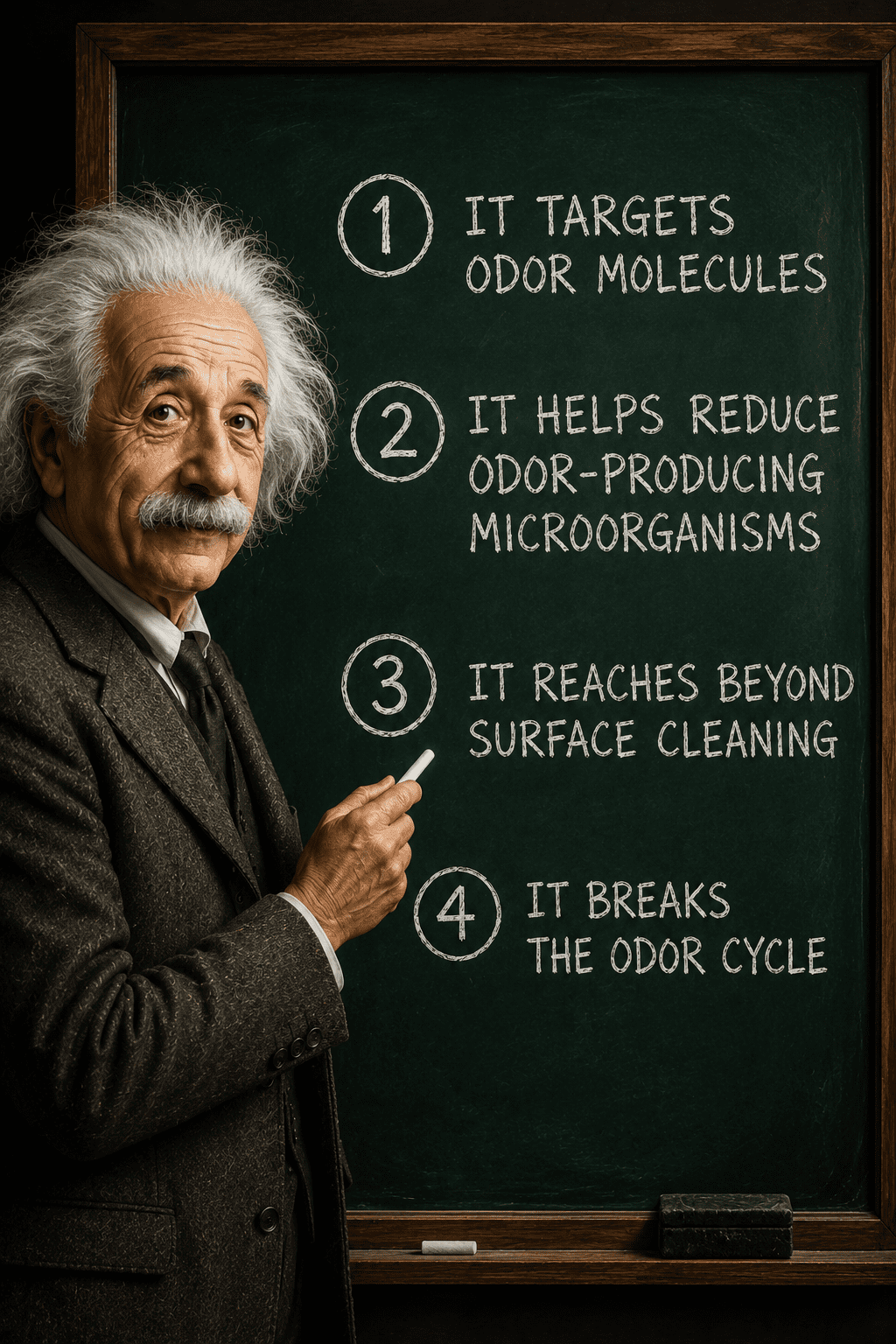
    The Science Behind How Chlorine Dioxide Prevents Odors

    Many unpleasant odors originate from sulfur-containing compounds, amines, organic acids, and microbial byproducts released by bacteria, mold, and mildew.

    These compounds often contain chemical structures that produce strong odors even at very low concentrations.

    When chlorine dioxide encounters these compounds, oxidation reactions alter their molecular structure.

    Once these compounds are changed chemically, they often lose the characteristics that make them detectable as odors.

    Step 2: It Helps Reduce Odor-Producing Microorganisms

    Humidity creates ideal conditions for microorganisms to multiply.

    As bacteria, mold, mildew, and fungi grow, they continuously generate new odor-producing compounds.

    Chlorine dioxide can penetrate areas where microorganisms commonly thrive, including:

    • Porous materials
    • HVAC systems
    • Upholstery
    • Drains
    • Wall cavities
    • Storage compartments
    • Hard-to-reach enclosed spaces

    By helping reduce microbial populations, chlorine dioxide may interrupt the cycle that continually produces new odors.

    Step 3: It Reaches Beyond Surface Cleaning

    Many odor problems originate in places that routine cleaning cannot easily reach.

    Examples include:

    • Beneath flooring
    • Behind wall surfaces
    • Inside ductwork
    • Inside vehicle interiors
    • Under equipment
    • Inside storage compartments

    Because chlorine dioxide functions as a gas when activated, it can move throughout enclosed spaces and contact areas that sprays and wipes may miss.

    This broader distribution helps address odor sources that would otherwise remain untouched.

    Step 4: It Breaks the Odor Cycle

    Humidity-driven odor problems often follow a repeating pattern:

    Humidity → Microbial Growth → Odor Production → Occupant Complaints

    Traditional fragrance products typically affect only the final step in that cycle.

    Chlorine dioxide is used to address the earlier stages by targeting both odor-causing compounds and many of the microorganisms responsible for producing them.

    As a result, odor control efforts may become more effective and longer-lasting than approaches that focus solely on masking smells.

    Also Read 📖Chlorine Dioxide Safety: Myths vs. Science | Complete Safe-Use Guide
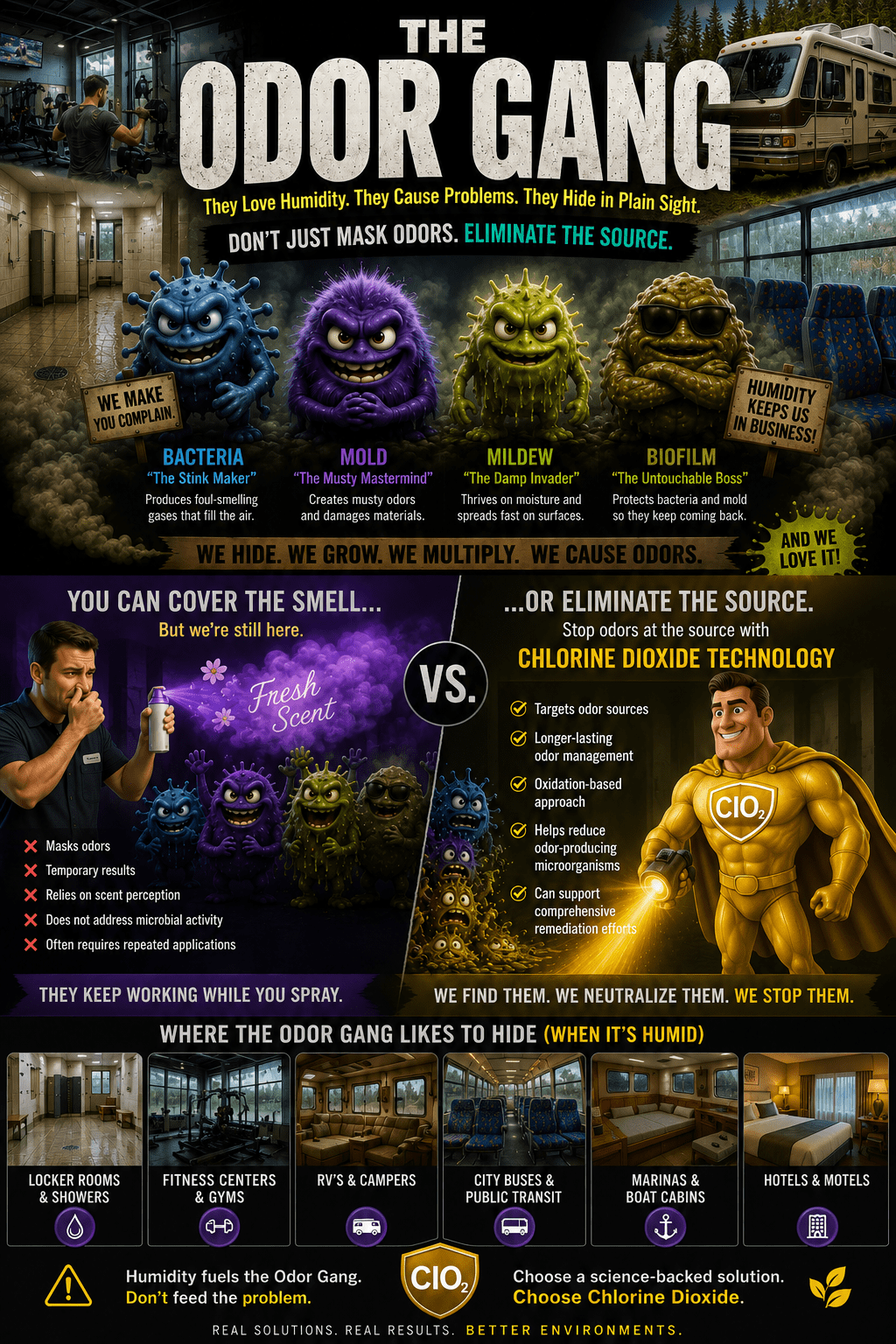
    the odor gang and why clo2 outperforms fragrance sprays to eliminate odors


    When Summer Humidity Creates the Perfect Storm

    Within short periods of time in high humidity even in clean environments the smell of musty odor is present

    Imagine a coastal hotel entering peak tourist season.

    Occupancy rates are high. Guest showers generate moisture throughout the day. Laundry facilities run continuously. HVAC systems work harder than normal due to rising outdoor temperatures.

    Meanwhile, outdoor humidity remains elevated for weeks at a time.

    The result is a perfect environment for microbial activity.

    Within a short period, musty odors begin appearing in guest rooms, hallways, storage areas, and fitness facilities. Housekeeping teams clean aggressively, but complaints continue.

    The problem isn’t necessarily inadequate cleaning.

    The issue is that humidity is accelerating microbial activity behind the scenes.

    This same scenario plays out every summer in:

    • Hotels
    • RV fleets
    • Marinas
    • Summer camps
    • Transit systems
    • Industrial facilities
    • Athletic centers

    Organizations that understand the connection between humidity and odor formation are often better positioned to implement long-term odor management strategies.


    Why Chlorine Dioxide Performs Well In Humid Environments

    Humidity creates ideal conditions for microorganisms to thrive.

    As microbial populations grow, they continuously release new odor-producing compounds.

    This creates a cycle where odors return shortly after cleaning.

    Chlorine dioxide helps break that cycle in two ways:

    1. It Targets Existing Odor Molecules

    It reacts directly with many compounds already producing unpleasant smells.

    2. It Helps Reduce Odor-Producing Microorganisms

    By helping reduce bacteria, mold, mildew, and other microorganisms, chlorine dioxide may limit the production of future odor compounds.

    This is why chlorine dioxide is often viewed as a source-control technology rather than a fragrance-based solution.

    Also read 📖How Can I Kill Mold and Eliminate Musty Odors at Home

    Why Gas Distribution Matters
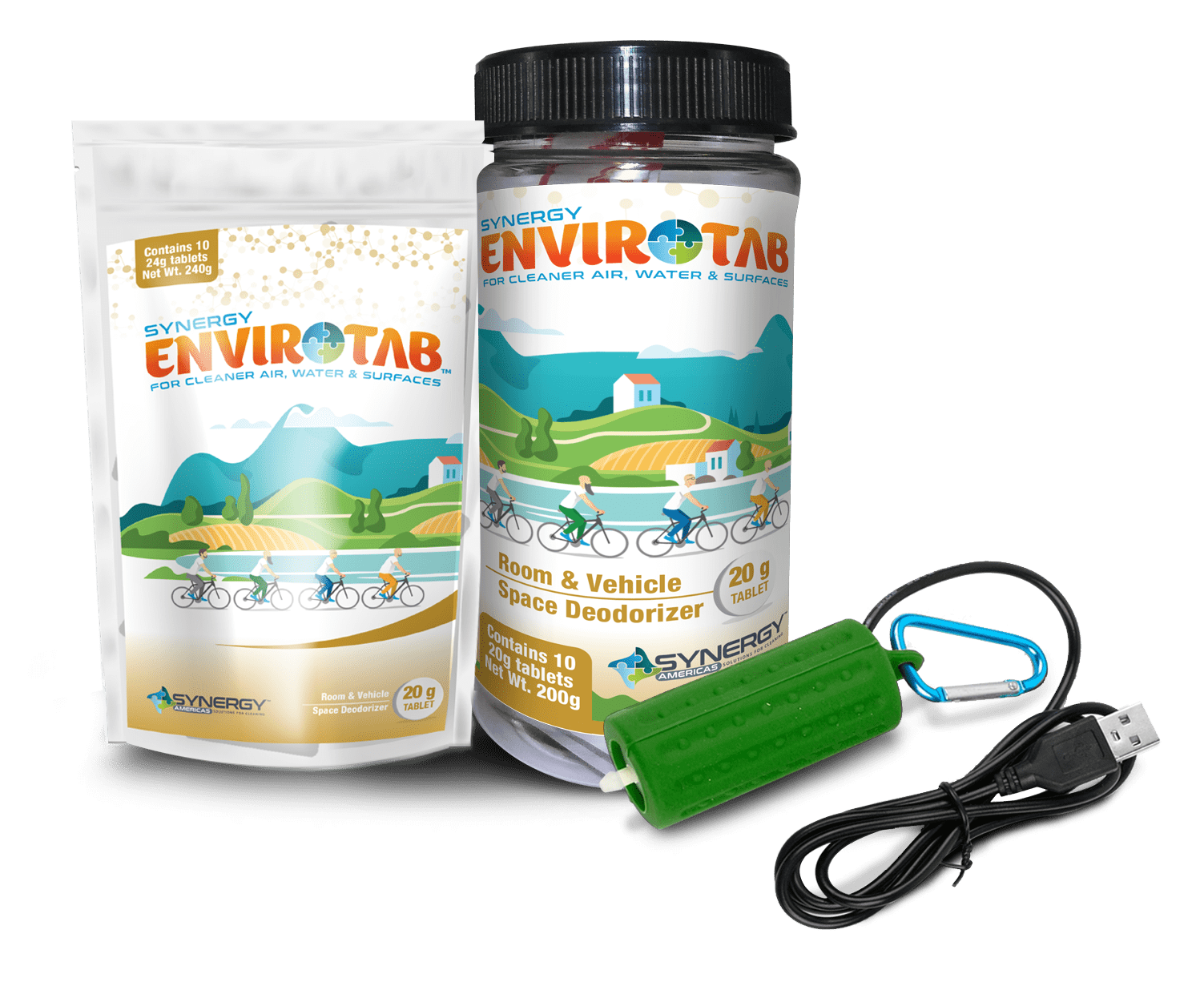
    Deodorizing Kit

    One of the biggest challenges in humid facilities is that odor sources are often hidden.

    Examples include:

    • HVAC systems
    • Wall cavities
    • Under flooring
    • Upholstery
    • Drain systems
    • Storage compartments
    • Vehicle interiors
    • Boat cabins

    When activated, chlorine dioxide gas can move throughout enclosed spaces and contact areas that traditional cleaning methods may not easily reach.

    This allows treatment to extend beyond visible surfaces.

    👉🏻Chlorine Dioxide for Cleaning the Air


    Humidity Challenges Are Increasing

    Many regions are experiencing longer periods of elevated temperatures and humidity.

    At the same time, facilities are becoming more energy efficient and tightly sealed, reducing natural airflow while increasing reliance on HVAC systems.

    These trends create new challenges for odor management professionals.

    Future facility maintenance programs will likely place greater emphasis on:

    • Moisture management
    • Indoor air quality
    • Microbial control
    • HVAC sanitation
    • Proactive odor prevention

    Organizations that address odor sources before they become visible or widespread can often reduce complaints, improve occupant experiences, and maintain cleaner indoor environments.

    Also Read 📖How Chlorine Dioxide Improves HVAC Air Quality and Indoor Environments

    What To Understand

    Humidity is far more than an environmental comfort issue.

    It serves as a catalyst for microbial growth, odor production, and persistent air-quality challenges across a wide range of industries.

    From industrial facilities and transportation systems to hotels, RV rentals, fitness centers, marine environments, and summer camps, high-humidity conditions create ideal circumstances for recurring odor problems.

    Understanding the relationship between moisture, microbial activity, and odor formation is the first step toward effective odor management.

    Rather than simply masking unpleasant smells, chlorine dioxide technologies offer a science-based approach focused on addressing odor sources at their origin.

    For facilities operating in environments where humidity never seems to take a break, proactive odor management can play an important role in maintaining cleaner, fresher, and more comfortable spaces.

    Also Read 📖How Chlorine Dioxide Neutralizes the Odor Compounds Created by Wet Summer Gear
    call to action

    Have More Questions About Humidity, Odors, and Chlorine Dioxide?

    1. Why do odors seem stronger during hot and humid weather?

    Humidity increases moisture levels in the air and on surfaces, creating favorable conditions for bacteria, mold, mildew, and other microorganisms to grow. As these organisms multiply, they release odor-causing compounds that become more noticeable and persistent.


    2. What types of odors are commonly associated with high-humidity environments?

    High-humidity environments often experience musty odors, mildew smells, locker room odors, marine odors, stale air, organic decomposition odors, and other odors produced by microbial activity.


    3. How does humidity contribute to microbial growth?

    Microorganisms require moisture to survive and reproduce. Elevated humidity provides the moisture needed for bacteria, mold, mildew, and biofilms to thrive on surfaces, fabrics, HVAC systems, and other materials.


    4. Why do odors often return shortly after cleaning?

    Many odor sources exist in hidden locations such as drains, wall cavities, ductwork, upholstery, and porous materials. While cleaning may remove surface contamination, underlying microbial activity can continue producing odors if the source is not addressed.


    5. How does chlorine dioxide help control odors?

    Chlorine dioxide helps control odors by oxidizing many odor-causing compounds and helping reduce odor-producing microorganisms. This approach targets the source of odors rather than simply covering them with fragrances.


    6. Does chlorine dioxide mask odors like air fresheners?

    No. Air fresheners typically work by introducing fragrances that temporarily cover unpleasant smells. Chlorine dioxide works differently by reacting with many odor-causing compounds and helping address the microorganisms responsible for producing them.


    7. Why is chlorine dioxide effective in enclosed environments?

    When activated, chlorine dioxide gas can move throughout enclosed spaces and reach areas that traditional cleaning methods may not easily access, including HVAC systems, storage compartments, vehicle interiors, wall cavities, and other hidden spaces.


    8. What industries commonly use chlorine dioxide for odor management?

    Chlorine dioxide is commonly used in hospitality, transportation, marine operations, industrial facilities, commercial cleaning, healthcare environments, restoration projects, RV rentals, fitness centers, and other facilities where persistent odor challenges occur.


    9. Can chlorine dioxide help with musty or mildew-related odors?

    Musty odors are often associated with mold, mildew, and microbial growth. Chlorine dioxide is frequently used as part of odor remediation programs designed to address these types of odor sources.


    10. Why is source elimination more effective than odor masking?

    Masking products only affect how an odor smells temporarily. If the microorganisms and odor-producing compounds remain active, the odor often returns. Source elimination focuses on interrupting the cycle of microbial growth and odor production, helping create longer-lasting odor control results.


    Bonus FAQ

    11. What are the best environments for chlorine dioxide odor treatment?

    Chlorine dioxide treatments are commonly used in hotels, RVs, boats, buses, locker rooms, shower facilities, summer camps, industrial plants, warehouses, healthcare facilities, and other high-humidity environments where recurring odors are difficult to control using conventional deodorizing methods.

    🏡Homepage

    👉🏻Check Out This Article Over At FreshTent https://freshtent.com/why-humidity-makes-your-rv-smell-worse-in-summer-rv-odor-control-guide/

  • How Chlorine Dioxide Neutralizes the Odor Compounds Created by Wet Summer Gear

    How Chlorine Dioxide Neutralizes the Odor Compounds Created by Wet Summer Gear

    The Smell Usually Starts Long Before You Notice It

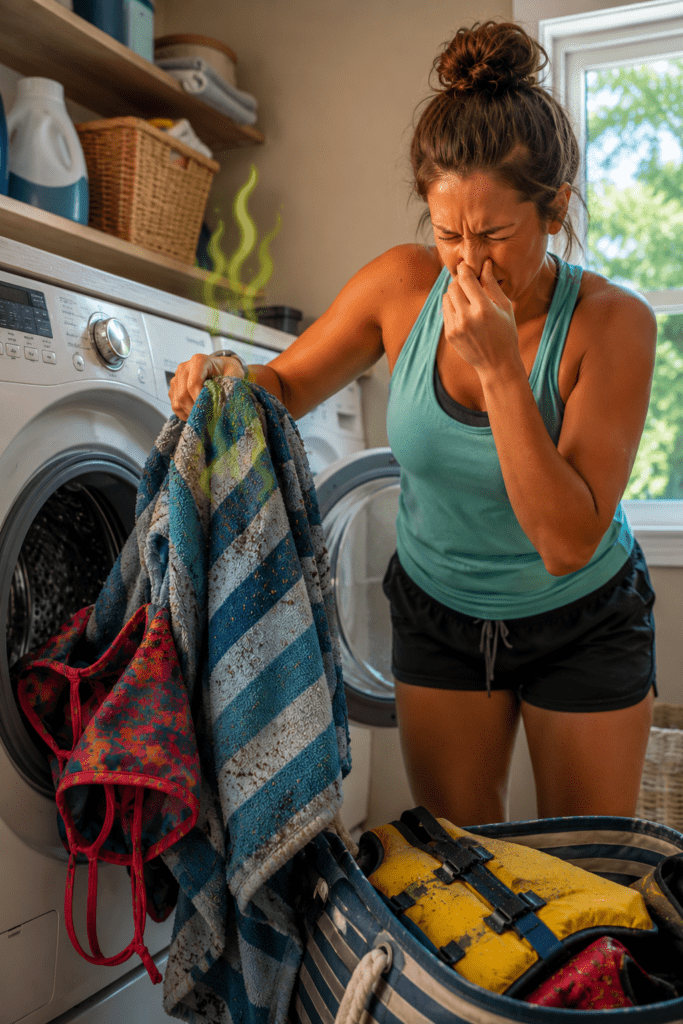
    woman opens the back of the SUV to find sour summer gear in the back after a lake trip and forgotten towels and swimware

    You spend the day on the lake.

    The kids jump off the dock all afternoon. Towels get tossed into the back of the SUV. Life jackets dry in a pile beside the camper. Wet swimsuits end up hanging over folding chairs while everyone enjoys dinner around the campsite.

    Everything seems normal.

    A day or two later, however, something changes.

    The towels smell sour.

    The life jackets have a strange stale odor.

    The swimsuit that seemed perfectly clean suddenly smells like it has been sitting in a gym locker for weeks.

    Most people assume these odors are simply caused by moisture.

    But moisture is only part of the story.

    The real source of many summer odors is a complex mixture of bacterial activity, organic residue, and odor-producing compounds that develop as microorganisms begin breaking down organic material trapped within wet fabrics and porous surfaces.

    Understanding how those odor compounds form is the first step toward understanding why chlorine dioxide works so differently than traditional odor-control products.


    image of monsters depicting seat, body oil, bacteria and debris in fabric fibers that cause odors.

    What Actually Creates Summer Odors?

    Many summer odors begin when moisture combines with:

    • Sweat
    • Skin oils
    • Organic debris
    • Environmental contaminants
    • Bacteria naturally present on surfaces

    When these materials remain trapped inside damp fabrics or porous materials, microorganisms begin feeding on the available organic matter.

    As they do, they release byproducts known as volatile organic compounds (VOCs).

    These VOCs are what your nose detects as odor.

    Common examples include:

    • Sour towel smell
    • Locker room odor
    • Stale fabric odor
    • Wet life jacket smell
    • Musty gear odor

    In many cases, the odor is not the bacteria itself.

    The odor comes from the compounds produced by microbial activity.


    Why Odors Get Stronger in Summer

    Summer conditions accelerate odor formation.

    Higher temperatures increase microbial activity.

    Humidity slows drying.

    Enclosed vehicles, campers, storage compartments, and gear bags trap moisture longer.

    As temperatures rise, VOCs become more active and are released into the air more rapidly.

    This is why a towel that seemed fine yesterday can suddenly smell terrible after sitting in a hot vehicle for a few hours.

    The compounds were already present.

    The heat simply increased their release into the surrounding air.

    Also Read ☀️The Hidden Science of Mold and Odor Growth in Enclosed Spaces


    Why Traditional Odor Solutions Often Fail

    Many odor-control products focus on masking odor rather than eliminating it.

    Common approaches include:

    • Fragrances
    • Air fresheners
    • Scent boosters
    • Perfumed sprays

    While these products may temporarily improve the smell, they often leave the underlying odor compounds untouched.

    As the fragrance fades, the original odor returns.

    This cycle leads many people to repeatedly wash, spray, and deodorize the same items without ever addressing the source of the problem.


    How Chlorine Dioxide Works Differently

    Chlorine dioxide operates through oxidation.

    Unlike fragrances that attempt to cover odor, chlorine dioxide interacts directly with many odor-causing compounds.

    At the molecular level, chlorine dioxide helps alter and neutralize the chemical structures responsible for offensive odors.

    Instead of adding another scent to the environment, chlorine dioxide targets the compounds producing the smell.

    This distinction is important because odor molecules cannot continue producing the same odor once their molecular structure has been altered.


    Why Chlorine Dioxide Is Effective on Wet Gear Odors

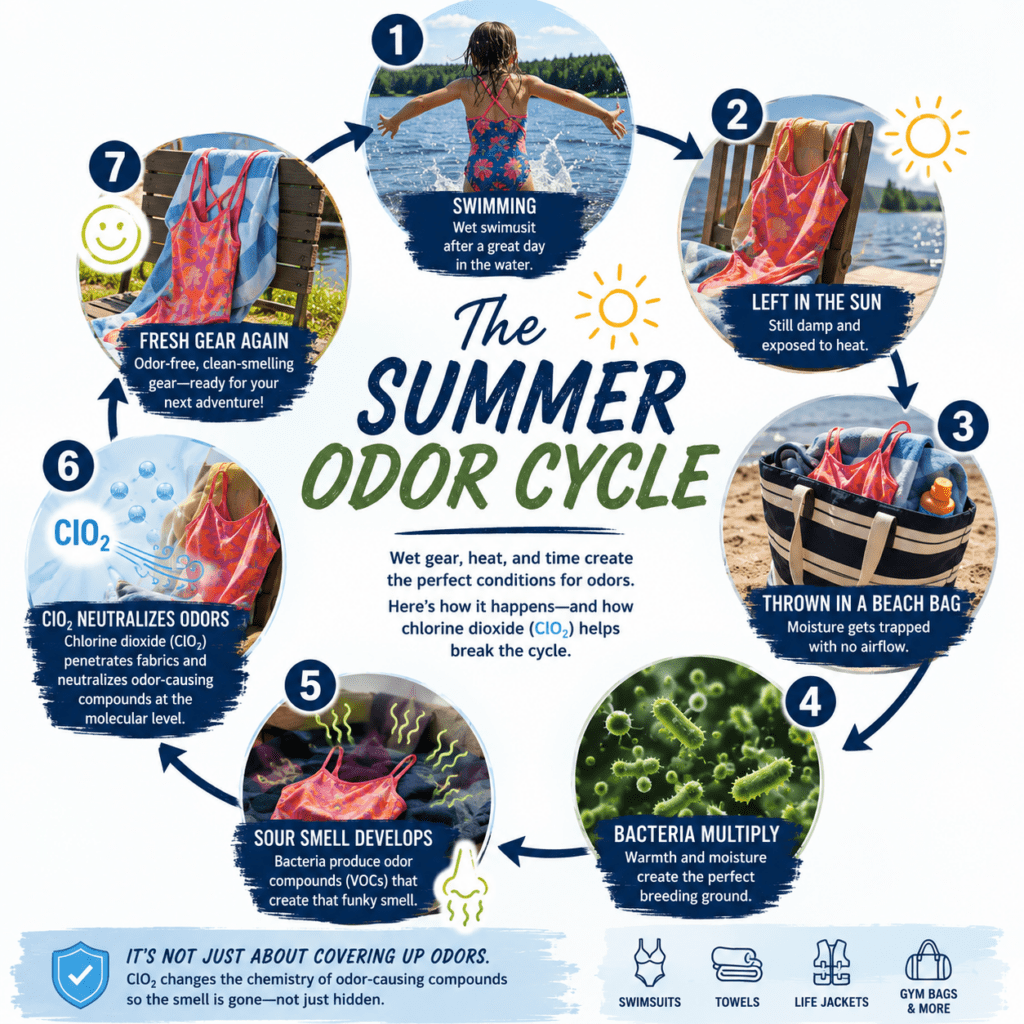
    circular infograph showing the summer odor cycle with clo2.

    Check out this article over at FreshTent ☀️https://freshtent.com/how-to-stop-wet-towels-swimsuits-and-lake-gear-from-smelling/


    Wet gear creates the perfect environment for odor development because moisture allows microbial activity to continue deep within materials.

    Chlorine dioxide is particularly useful because it can move through airspaces and penetrate difficult-to-reach environments where odor compounds often remain trapped.

    Examples include:

    • Towels
    • Swimsuits
    • Life jackets
    • Camping gear
    • Storage totes
    • Athletic equipment
    • RV fabrics
    • Marine upholstery

    These materials often contain small fibers, pores, and airspaces that allow odors to persist long after surfaces appear dry.

    Also Read ☀️Why Campfire Smoke Odor Stays in Gear for Months

    The Science of Molecular Odor Neutralization

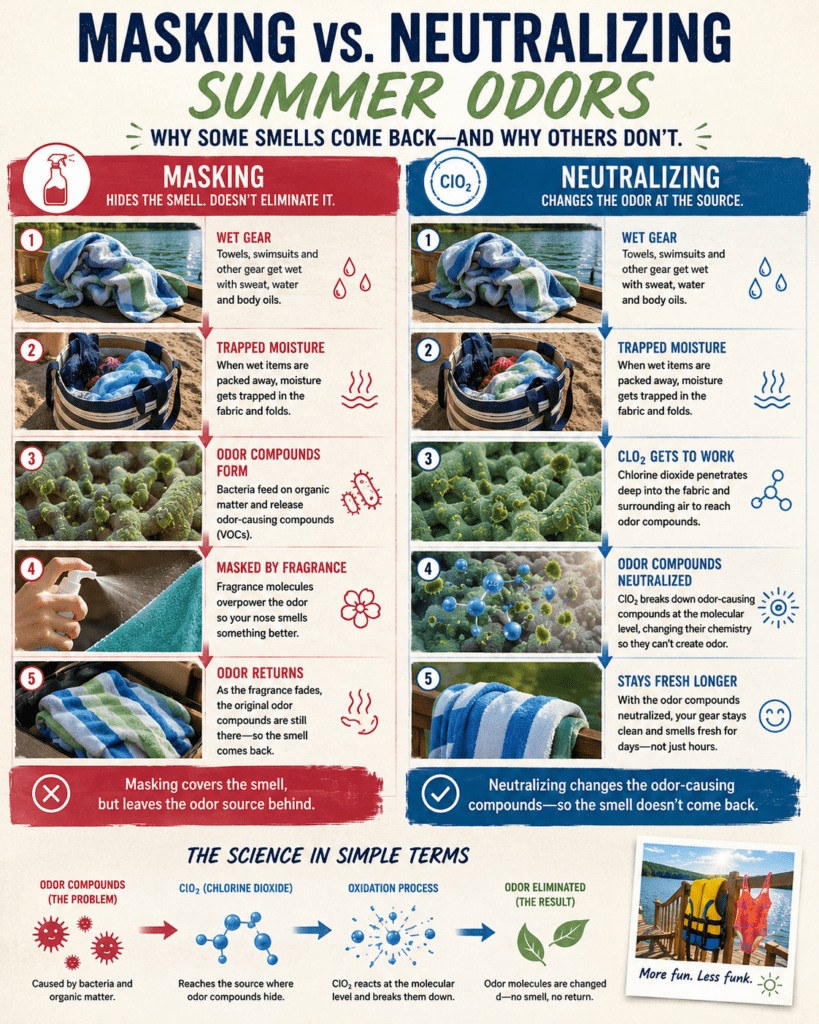
    infograph showing the science of masking odors vs actually removing odors on a molecular level.


    How This Helps Summer Activities

    Summer means:

    • Camping
    • Boating
    • Swimming
    • Fishing
    • Lake trips
    • RV travel
    • Outdoor recreation

    All of these activities create moisture.

    And moisture creates opportunities for odor development.

    The sooner odor compounds are addressed, the easier it becomes to prevent them from becoming deeply embedded within fabrics and porous materials.


    Wrapping Things Up…

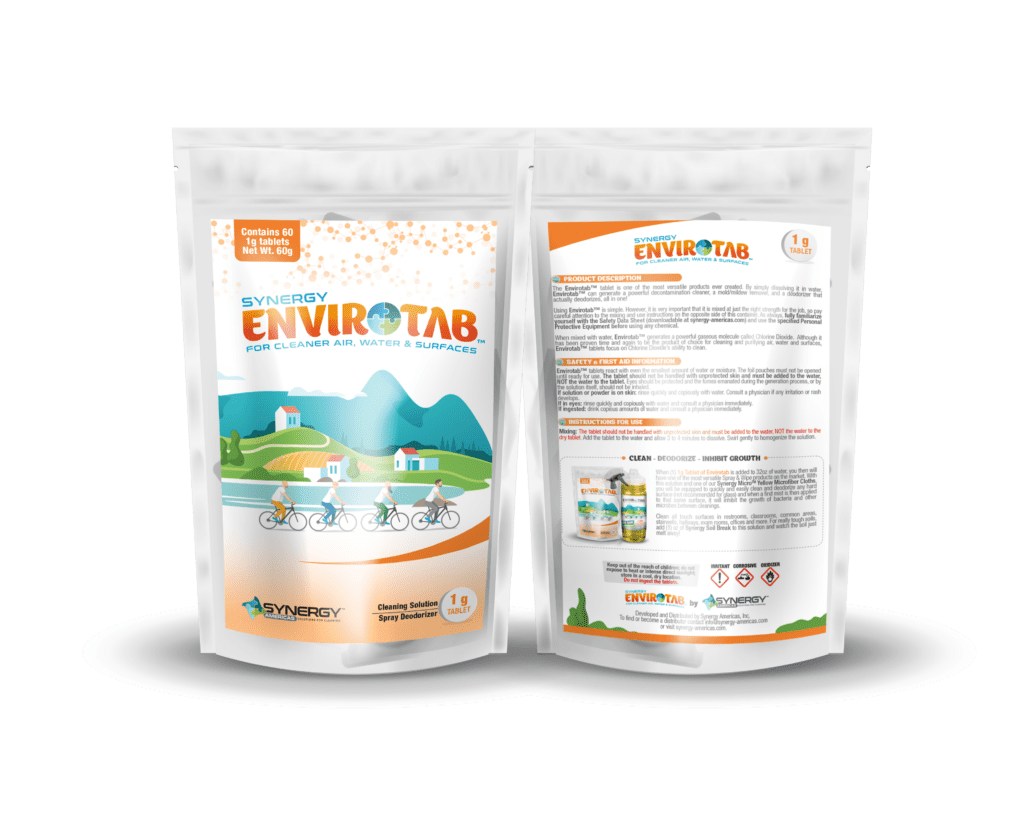
    1g Pouch

    Most summer odors begin long before anyone notices them.

    What starts as a damp towel, wet swimsuit, or moisture-filled life jacket quickly becomes a breeding ground for the chemical compounds responsible for unpleasant smells.

    While traditional fragrance products attempt to cover those odors temporarily, chlorine dioxide works differently.

    By helping neutralize odor-causing compounds at the molecular level, chlorine dioxide addresses the chemistry behind the smell itself rather than simply masking it.

    As summer activities increase and wet gear becomes part of everyday life, understanding the science behind odor formation can help explain why some odor-control approaches provide only temporary relief while others deliver more lasting results.

    Because the goal isn’t to make odors smell different.

    It’s to eliminate the compounds creating them in the first place.

    Also Read ☀️Why Odors Stay Trapped in Fabric, Foam, and Porous Materials

    Have More Questions?

    1. Why do wet towels develop a sour smell?

    Wet towels can develop a sour smell when moisture combines with sweat, skin oils, bacteria, and organic residue. As microorganisms break down these materials, they release odor-causing compounds that create unpleasant smells.


    2. What causes wet swimsuits to smell bad?

    Wet swimsuits often trap moisture, body oils, sunscreen residue, and bacteria. When left damp for extended periods, these materials can produce odor compounds that create stale or sour smells.


    a woman picking up a sour towel and putting it in the washing machine.

    3. Why do odors seem stronger during summer?

    Warm temperatures and humidity accelerate microbial activity and increase the release of volatile organic compounds (VOCs), making odors more noticeable during the summer months.


    4. What are VOCs and how do they create odors?

    Volatile Organic Compounds (VOCs) are molecules released by bacteria, mold, mildew, and decomposing organic matter. These compounds are often responsible for the odors people associate with damp fabrics, lockers, and wet gear.


    5. Why does odor return after washing?

    Odor can return when odor-causing compounds remain trapped inside porous materials or when moisture allows microbial activity to continue after washing.


    6. How is chlorine dioxide different from fragrance sprays?

    Fragrance sprays temporarily cover odors with stronger scents. Chlorine dioxide works differently by helping neutralize odor-causing compounds at the molecular level rather than simply masking them.


    7. Can chlorine dioxide help with locker room odors?

    Yes. Locker room odors are commonly caused by bacteria, sweat, and trapped moisture. Chlorine dioxide helps neutralize many of the compounds responsible for these persistent odors.


    8. Why do life jackets and water gear develop odors so quickly?

    Life jackets, wetsuits, and water gear often stay damp longer than expected. Trapped moisture combined with organic residue creates ideal conditions for odor-producing microorganisms.


    9. What types of summer gear commonly develop odor problems?

    Common items include:

    • Towels
    • Swimsuits
    • Life jackets
    • Water shoes
    • Gym bags
    • Camping gear
    • RV fabrics
    • Boat upholstery

    These materials frequently encounter moisture and limited airflow.


    10. How does chlorine dioxide neutralize odor compounds?

    Chlorine dioxide works through an oxidation process that helps alter odor-causing compounds at the molecular level. By changing the chemistry of these compounds, chlorine dioxide helps eliminate odors at their source rather than simply covering them up.

  • Why Campfire Smoke Odor Stays in Gear for Months

    Why Campfire Smoke Odor Stays in Gear for Months

    The Campfire Was Perfect… Until the Smell Followed You Home

    The fire finally burned down to glowing coals sometime after midnight.

    Everyone sat back in their camp chairs wrapped in hoodies and blankets while the last sparks drifted into the night sky. The cooler sat beside the picnic table. Someone laughed about ghost stories from earlier in the evening while another person tossed one final log onto the fire before heading into the tent.

    It was one of those camping nights you remember for years.

    Then you got home.

    A few days later, the sleeping bags still smelled like smoke.
    The tent smelled smoky the second it came out of the tote.
    The camper cushions carried that stale campfire odor long after the trip ended.

    Even after washing everything.

    And somehow… once summer humidity rolled around, the smell seemed even stronger.

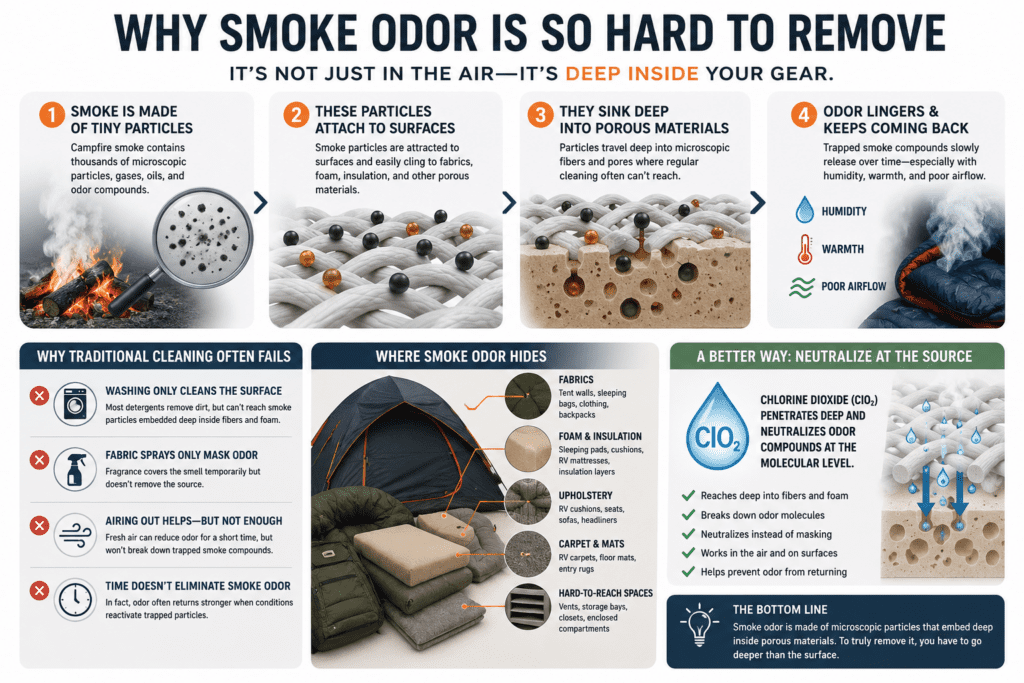
    That’s because campfire smoke doesn’t just sit on the surface of camping gear.

    It embeds itself deep into porous materials where microscopic smoke particles, oils, and odor compounds become trapped inside fabric fibers, foam, insulation, and enclosed airspaces.

    And once that happens, basic cleaning often isn’t enough to fully eliminate it.


    infograph showing why smoke odor is so hard to get out of porous material.


    Why Smoke Smell Gets Worse Over Time

    One of the strangest things about campfire odor is that it often seems to return even after cleaning.

    That happens because:

    • humidity reactivates trapped odor compounds
    • warmth increases VOC release
    • enclosed spaces concentrate odor
    • embedded particles remain deep inside materials

    This is why:

    • tents smell stronger after storage
    • sleeping bags reactivate odor in humid weather
    • RVs develop stale smoke smells months later

    The odor source was never fully neutralized.


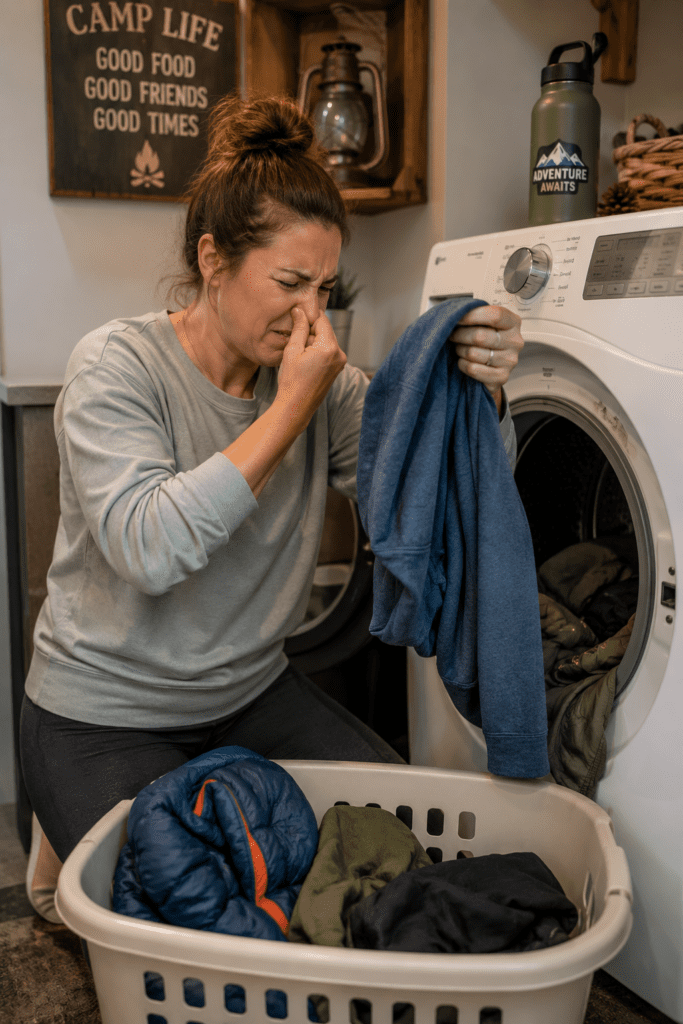
    IOmage of a woman in a well lit laundry room taking laundry out of the dryer holding her nose because the laundry still smells.

    Common Misconceptions About Smoke Odor

    ❌ “If I wash it once, the smell is gone”
    → Surface washing often leaves embedded smoke compounds behind

    ❌ “Fresh air removes smoke smell”
    → Airflow may reduce odor temporarily but not eliminate trapped residue

    ❌ “Fabric spray solves it”
    → Fragrance masks odor without neutralizing the source

    ❌ “Smoke smell is only in fabric”
    → Smoke particles settle into foam, insulation, upholstery, and enclosed airspaces too


    Why Porous Materials Hold Smoke Particles So Easily

    Camping gear is full of microscopic openings and fibers that trap:

    • smoke particles
    • moisture
    • sweat
    • bacteria
    • organic residue

    Materials like:

    • canvas
    • foam
    • upholstery
    • sleeping bag insulation
    • carpet
    • tent fabrics

    essentially absorb smoke compounds deep below the surface.

    Once those compounds settle in, they slowly continue releasing odor for weeks or months.


    Why Traditional Cleaning Often Fails

    Traditional cleaning methods typically:
    ✔ clean visible dirt
    ✔ improve surface appearance
    ✔ temporarily reduce odor

    But they often DON’T:
    ❌ neutralize embedded smoke compounds
    ❌ reach enclosed airspaces
    ❌ penetrate deeply into foam or insulation

    That’s why smoke odors often return after:

    • storage
    • humidity
    • warm temperatures
    • repeated camping trips

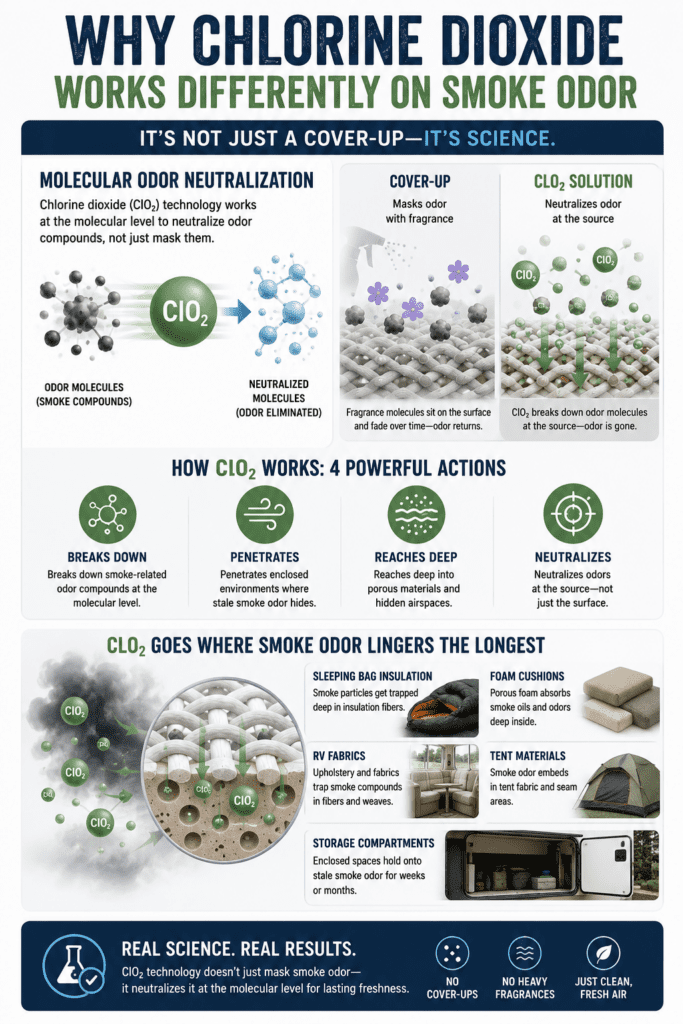
    inforgraph showing how chlorine dioxide neutralizes smoke odors on a molecular level.


    Real-World Example

    A family spends a long holiday weekend camping beside the lake.

    Every night ends around the fire.

    The hoodies smell smoky.
    The tent absorbs the campfire scent.
    The camper interior slowly picks up stale smoke odor from damp jackets and blankets coming inside at night.

    Everything smells “like camping” at first.

    But weeks later, after storage and summer humidity?
    👉 The odor becomes stale, sour, and deeply embedded into the gear.


    Why This Matters More Than People Realize

    Campfire smoke odor isn’t just about smell.

    Smoke particles can continue settling into:

    • fabrics
    • enclosed environments
    • foam materials
    • storage compartments

    where they combine with moisture and humidity over time.

    As people become more aware of:

    • indoor air quality
    • enclosed-space odor
    • environmental contamination
    • long-term gear maintenance

    there’s a growing shift away from masking odors…
    and toward true odor neutralization.


    How to Reduce Campfire Smoke Odor in Gear

    After Camping:

    • Air out gear immediately
    • Avoid sealing smoky fabrics into totes
    • Remove moisture before storage

    Before Storage:

    • Wash fabrics properly
    • Neutralize embedded odor
    • Fully dry insulation and foam

    During Storage:

    • Reduce humidity
    • Allow airflow when possible
    • Treat enclosed spaces proactively

    Want the Real-World Camping Version?

    For practical outdoor tips on removing smoke smell from sleeping bags, tents, RV fabrics, and camping gear:

    👉 How to Get Campfire Smoke Smell Out of Sleeping Bags, Tents, and RV Fabrics (FreshTent)


    What You Should Do Next…

    Campfire smoke is one of the most recognizable parts of outdoor life.

    At first, it even feels nostalgic.

    It reminds people of:

    • late nights around the fire
    • cold mornings at the campsite
    • stories, laughter, and long weekends outdoors

    But when smoke odor lingers deep inside gear for months after the trip ends, it becomes something different entirely.

    That’s because smoke doesn’t simply “sit” on camping equipment.

    It settles deep into the microscopic structure of fabric, foam, insulation, upholstery, and enclosed storage spaces where traditional cleaning methods often can’t fully reach.

    And once humidity, warmth, and storage conditions reactivate those embedded odor compounds, the smell keeps returning over and over again.

    The good news is that smoke odor doesn’t have to become a permanent part of your gear.

    When odor is neutralized at the molecular level instead of temporarily covered up, camping equipment, RV interiors, tents, sleeping bags, and outdoor fabrics stay fresher long after the fire burns out.

    Because the best camping memories should stay with you…

    —not the smell trapped inside your storage tote months later


    ❓ FAQs (10)

    1. Why does campfire smoke stay in camping gear?

    Smoke particles and odor compounds become trapped deep inside porous materials like fabric and foam.

    2. Why does smoke smell come back after washing?

    Surface cleaning often fails to fully remove embedded smoke compounds.

    3. Can sleeping bags absorb smoke odor?

    Yes, sleeping bag insulation easily traps smoke particles and odors.

    4. Why do tents smell smoky for months?

    Tent fabrics absorb smoke oils and odor compounds deep into fibers.

    5. Does humidity make smoke odor worse?

    Yes, humidity can reactivate trapped odor compounds and increase VOC release.

    6. Can RV cushions hold smoke smell?

    Yes, foam and upholstery commonly absorb smoke particles and stale odors.

    7. Why don’t fragrance sprays work long-term?

    They mask odor temporarily instead of neutralizing the source.

    8. What materials trap smoke odor the most?

    Fabric, foam, upholstery, insulation, and carpet are highly porous and retain smoke compounds.

    9. How does chlorine dioxide help remove smoke odor?

    It helps break down smoke-related odor compounds at the molecular level.

    10. How do you prevent smoke odor from building up in gear?

    Air out gear quickly, fully dry materials, and neutralize odors before storage.

  • Why Odors Stay Trapped in Fabric, Foam, and Porous Materials

    Why Odors Stay Trapped in Fabric, Foam, and Porous Materials

    You Thought It Was Clean Last Fall…

    Last October, the camping season ended the same way it always does.

    The tent was folded up and packed away.
    The sleeping bags were aired out in the driveway.
    The RV cushions were wiped down before the camper got closed up for winter.
    Everything looked clean. Dry. Ready for storage.

    You even remember thinking:
    “Perfect. This will make spring setup easy next year.”

    Fast forward a few months.

    The first warm weekend finally arrives, and suddenly everyone’s excited again. The camper gets uncovered. The gear totes come down from the shelf. Someone starts setting up the tent in the backyard while another person drags the cooler into the driveway.

    Then it happens.

    The zipper opens on the sleeping bag… and that smell hits immediately.

    Not just stale.
    Not just “old fabric.”
    That unmistakable damp, sour, musty odor that somehow survived an entire winter hidden inside gear you KNOW was cleaned before storage.

    Suddenly the excitement of camping season turns into:

    • opening windows
    • spraying fabrics
    • rewashing gear
    • trying to figure out where the smell is even coming from

    And that’s the frustrating part.

    Most people did clean their gear before putting it away.

    But odor in porous materials doesn’t disappear just because the surface looks clean. Deep inside fabric fibers, foam padding, insulation, and upholstery, small amounts of trapped moisture and organic buildup can continue developing slowly over time—especially inside enclosed spaces with little airflow.

    By spring, the odor problem has already been building quietly for months.

    And once it reaches that point, basic cleaning alone usually isn’t enough to fully eliminate it.


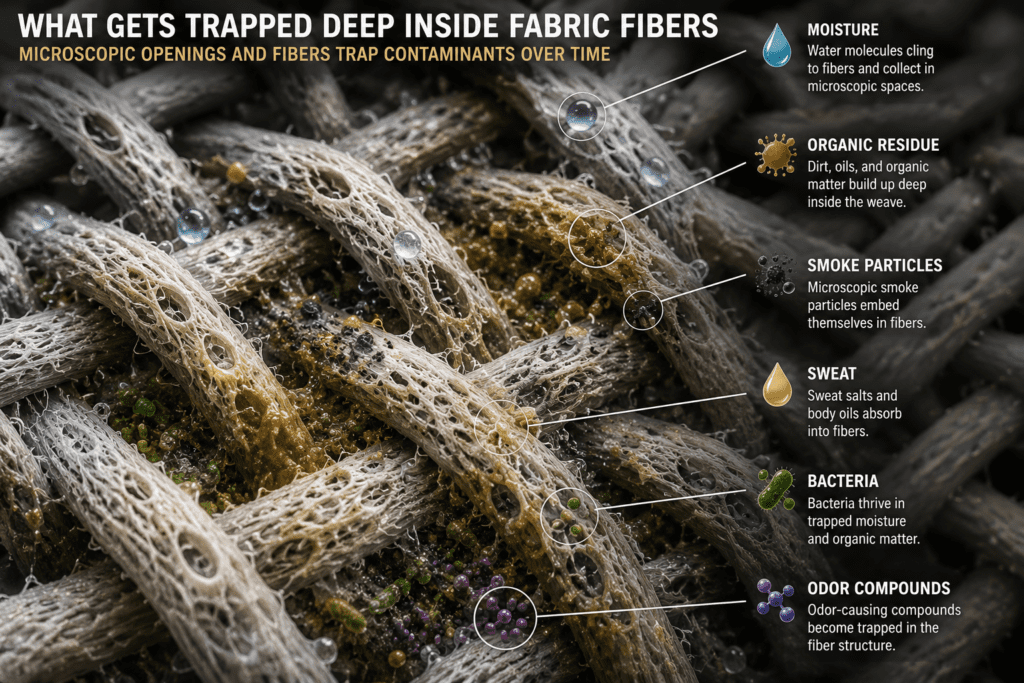
    image showing microscopic pores in fabric and what gets trapped inside them.

    Why Porous Materials Trap Odor So Easily


    Materials like:

    • Fabric
    • Foam
    • Upholstery
    • Insulation
    • Carpeting
    • Canvas

    …are full of microscopic openings and fibers that trap:

    • Moisture
    • Organic residue
    • Smoke particles
    • Sweat
    • Bacteria
    • Odor compounds

    Once trapped inside, these materials slowly hold and release odor over time.


    Why Odor Comes Back After Cleaning

    This is where most frustration comes from.

    Traditional cleaning:
    ✔ Cleans surfaces
    ✔ Removes visible dirt
    ✔ Improves appearance

    But it often DOESN’T:
    ❌ Reach deep inside fibers
    ❌ Neutralize embedded odor compounds
    ❌ Treat trapped airspaces

    So even though the material looks clean…
    👉 the odor source is still active underneath.

    Also Read 📖The Hidden Science of Mold and Odor Growth in Enclosed Spaces


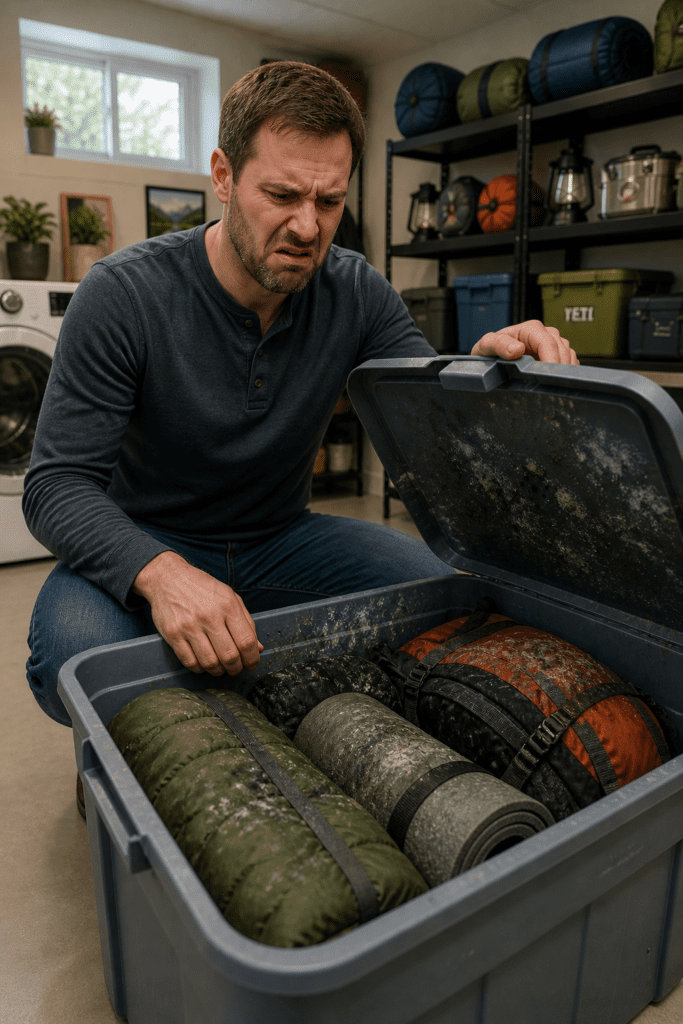
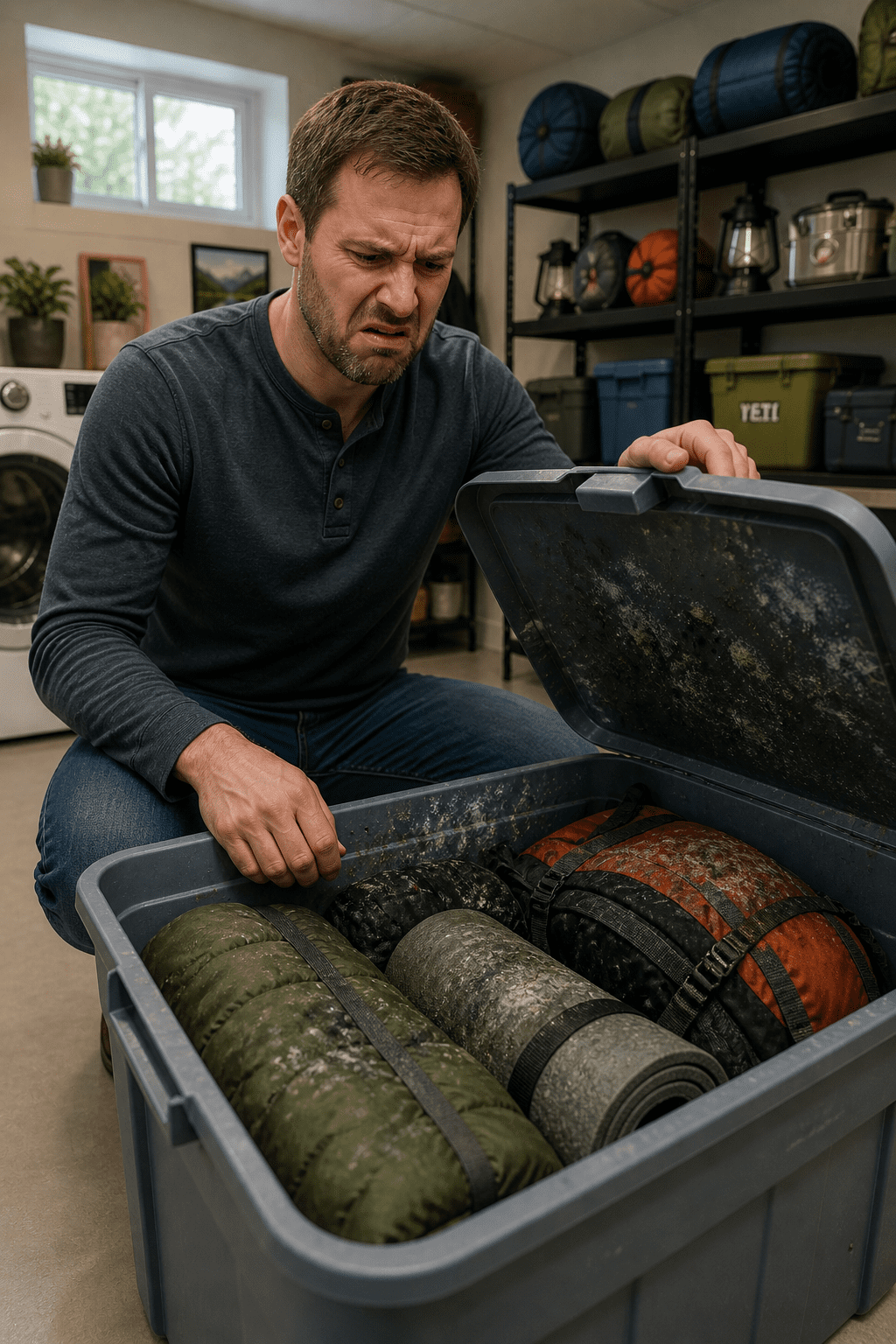
    Man opening a storage tote of camping gear and reacting to moldy, musty equipment in a basement storage area

    Common Misconceptions About Fabric Odor

    ❌ “If it smells clean now, it’s fixed”
    → Many odors return once humidity and heat increase

    ❌ “Dry means odor-free”
    → Materials can hold odor compounds even when dry

    ❌ “Laundry detergent removes everything”
    → Surface cleaning doesn’t always reach embedded odor

    ❌ “Fragrance sprays solve the problem”
    → They temporarily mask odor instead of neutralizing it


    Why This Problem Gets Worse in Spring and Summer

    Warm temperatures and humidity reactivate odor compounds trapped inside porous materials.

    This is why people notice odors returning in:

    • Sleeping bags
    • RV cushions
    • Camping tents
    • Boat upholstery
    • Outdoor furniture
    • Seasonal clothing

    👉 The odor may have been developing slowly for months.


    Real-World Example

    A sleeping bag gets packed away after a fall camping trip.

    It feels dry enough.

    But deep inside the insulation:

    • Small amounts of moisture remain
    • Organic residue stays trapped
    • Odor compounds continue developing slowly

    By spring, opening the tote releases that unmistakable musty smell almost instantly.

    Also Read 📖Why Musty Odors Come Back Every Spring?


    image showing clo2 and the process of how it breaks down the debris on a molecular level

    Why Chlorine Dioxide Works Differently

    Chlorine dioxide technology works through:
    ✔ Molecular neutralization
    ✔ Deep penetration into porous materials
    ✔ Whole-environment odor treatment

    Instead of masking odor, it:

    • Breaks down odor-causing compounds
    • Reaches deep into fibers and foam
    • Neutralizes odor at the source

    Because chlorine dioxide can move through enclosed airspaces and porous materials, it reaches areas traditional cleaners often miss.


    What’s Changing in Odor Control

    More people are realizing:

    • Odor is deeper than surface dirt
    • Indoor air quality matters
    • Traditional masking sprays don’t last

    There’s a growing shift toward:
    👉 Source-level odor neutralization


    How to Reduce Odor in Porous Materials

    Before Storage:

    • Fully dry all materials
    • Avoid sealing in moisture
    • Clean organic residue completely

    During Storage:

    • Reduce humidity
    • Allow airflow when possible
    • Avoid damp environments

    After Storage:

    • Neutralize odors deeply
    • Treat enclosed spaces fully
    • Avoid relying only on fragrance sprays

    Want to See How This Happens in Camping Gear?

    For a real-world outdoor example involving sleeping bags, tents, and camping fabrics:

    👉 How to remove musty smells from camping fabrics (FreshTent)

    Read the article here 👉https://freshtent.com/why-camping-fabrics-hold-onto-odors-and-how-to-fix-it/


    What Should You Do Next…

    By the time most people notice odor in camping gear, RV cushions, sleeping bags, or stored fabrics, the process has already been happening far longer than they realize.

    What smells like “old gear” is often trapped moisture, microbial buildup, and odor compounds that settled deep inside the material months earlier while everything sat sealed away for the winter.

    That’s why the smell keeps returning.

    Not because the gear was never cleaned…
    …but because the source was never fully neutralized.

    And once odor becomes embedded inside porous materials, surface sprays and quick wipe-downs usually only provide temporary relief before the cycle starts all over again next season.

    The good news?

    Once you understand how odor actually develops inside fabric, foam, upholstery, and enclosed spaces, you can finally approach the problem differently.

    Not by masking it.
    Not by covering it up.
    But by targeting the source itself.

    Because when odor is eliminated at the molecular level instead of simply hidden, camping gear, RV interiors, outdoor fabrics, and stored equipment stay fresher longer—and the start of camping season feels exciting again instead of frustrating.

    👉 The goal isn’t just cleaner gear.
    👉 It’s breaking the cycle completely.


    ❓ FAQs (10)

    1. Why do fabrics hold odor?

    Porous materials trap moisture and odor compounds deep inside fibers.

    2. Why does odor return after washing?

    Surface cleaning often fails to remove embedded odor compounds.

    3. Can foam hold odor?

    Yes, foam materials easily trap moisture and bacteria.

    4. Does sunlight eliminate odor?

    Sunlight may help temporarily but doesn’t fully neutralize embedded odor.

    5. Why do sleeping bags smell musty?

    Trapped moisture and organic buildup inside insulation create odor over time.

    6. Can upholstery hold mold smell?

    Yes, porous upholstery materials commonly retain odor compounds.

    7. What causes odor in RV cushions?

    Moisture, humidity, and trapped organic residue.

    8. Why don’t fragrance sprays last?

    Because they mask odor instead of removing the source.

    9. How does chlorine dioxide neutralize odor?

    It breaks down odor-causing compounds at the molecular level.

    10. How do you prevent odor in porous materials?

    Control moisture, dry materials fully, and neutralize odor before storage.

  • The Hidden Science of Mold and Odor Growth in Enclosed Spaces

    The Hidden Science of Mold and Odor Growth in Enclosed Spaces

    The Cooler Was Clean When You Put It Away… So What Happened?

    You spent the afternoon last fall doing everything right.

    The cooler was emptied, rinsed out, wiped down, and left open in the driveway to dry before you finally packed it away for the winter. The camping gear went into storage bins, the RV got covered, and another season of outdoor adventures came to an end.

    Fast forward to spring.

    The weather finally breaks, you start getting excited for that first camping trip of the year, and you pull the cooler back out of storage expecting it to be ready to go.

    Then you open the lid.

    Instead of fresh, clean air… you’re hit with that unmistakable sour, stale, musty smell. Maybe there are dark spots forming in the corners. Maybe the seals feel damp. Suddenly the cooler you cleaned so carefully months ago looks and smells like it sat forgotten in a swamp all winter.

    And that’s the frustrating part.

    Most campers, hikers, backpackers, and outdoor enthusiasts did clean their gear before putting it away. But odor and mold problems usually don’t happen overnight. They develop slowly inside enclosed spaces where trapped moisture, limited airflow, and microscopic organic buildup create the perfect environment for microbial growth.

    By the time you smell it in spring, the process has already been happening for months.

    And once it starts, surface cleaning alone usually isn’t enough to fully stop it.


    Why This Problem Gets Worse in Spring and Summer

    As temperatures rise and humidity increases, enclosed environments become even more active odor zones.

    Spring and early summer create:

    • Higher moisture levels
    • Faster microbial activity
    • More condensation in sealed spaces
    • Stronger odor compound release

    This is why people suddenly notice odor problems in:

    • Coolers
    • Storage bins
    • RVs
    • Boats
    • Seasonal equipment
    • Closets and garages

    👉 The problem may have started months ago—it just becomes noticeable now.


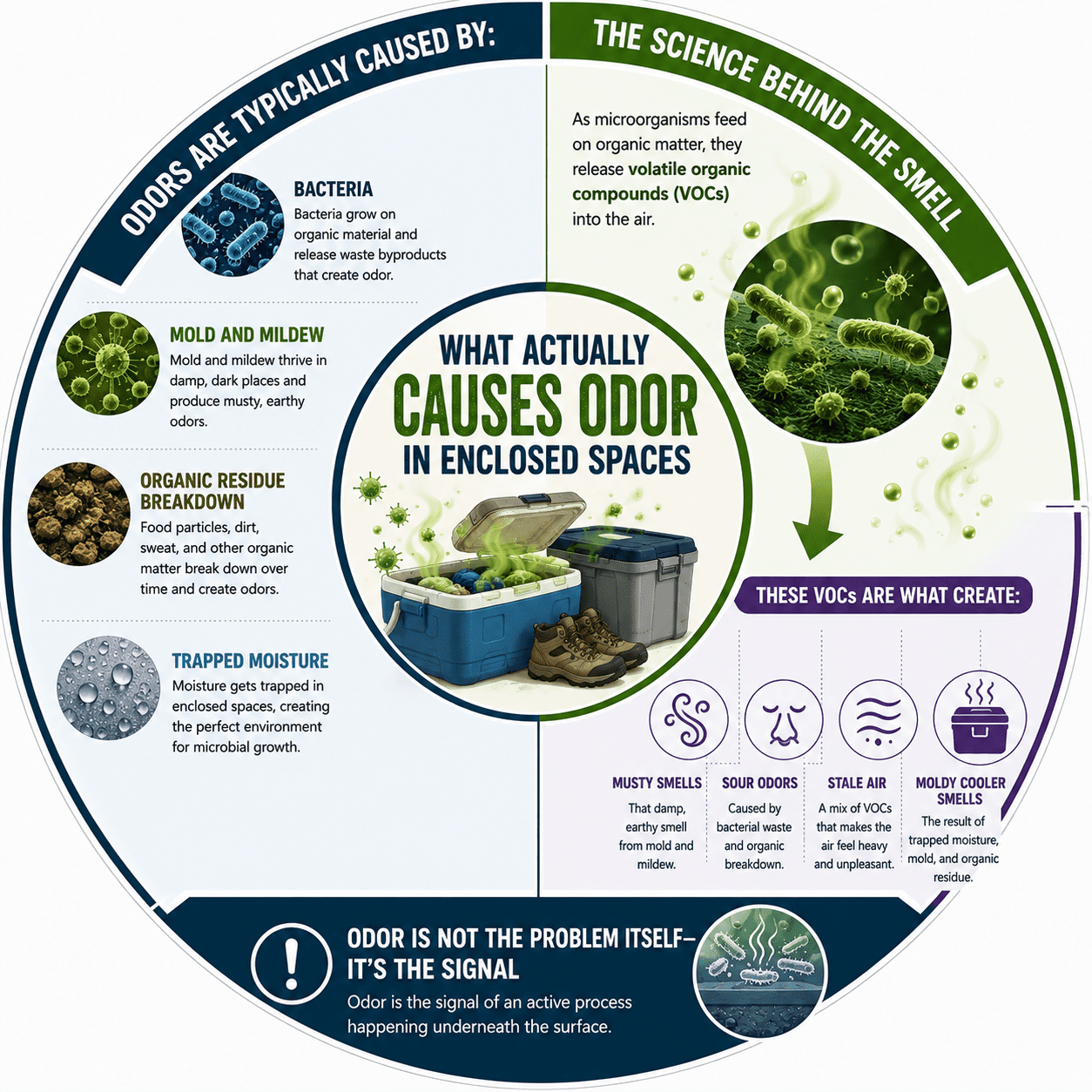
    circular infograph show what actually causes odors in closed in spaces.


    Why Enclosed Spaces Become Odor Traps

    Enclosed spaces are ideal environments for odor buildup because they combine:

    ✔ Limited airflow
    ✔ Trapped humidity
    ✔ Temperature fluctuation
    ✔ Porous materials
    ✔ Residual organic contamination

    Even small amounts of moisture can create a chain reaction over time.

    Also Read 📖Why Musty Odors Come Back Every Spring?


    Common Misconceptions About Odor Problems

    Let’s clear up a few common myths:

    ❌ “If I dry it out, the smell will disappear”
    → Odor compounds can remain deep inside materials

    ❌ “Bleach fixes mold smell”
    → Bleach may clean surfaces but doesn’t always neutralize embedded odor

    ❌ “Air fresheners solve the problem”
    → They only mask odor temporarily

    ❌ “If I can’t see mold, there’s no issue”
    → Odor-causing buildup often exists before visible growth appears


    Why Surface Cleaning Often Fails

    This is where many people get frustrated.

    They clean the surface…
    …and the smell still comes back.

    Why?

    Because:

    • Odor compounds remain trapped inside materials
    • Enclosed airspaces retain contamination
    • Sprays don’t penetrate deeply enough

    👉 If the source remains active, the odor cycle continues.


    Why Chlorine Dioxide Technology Works Differently

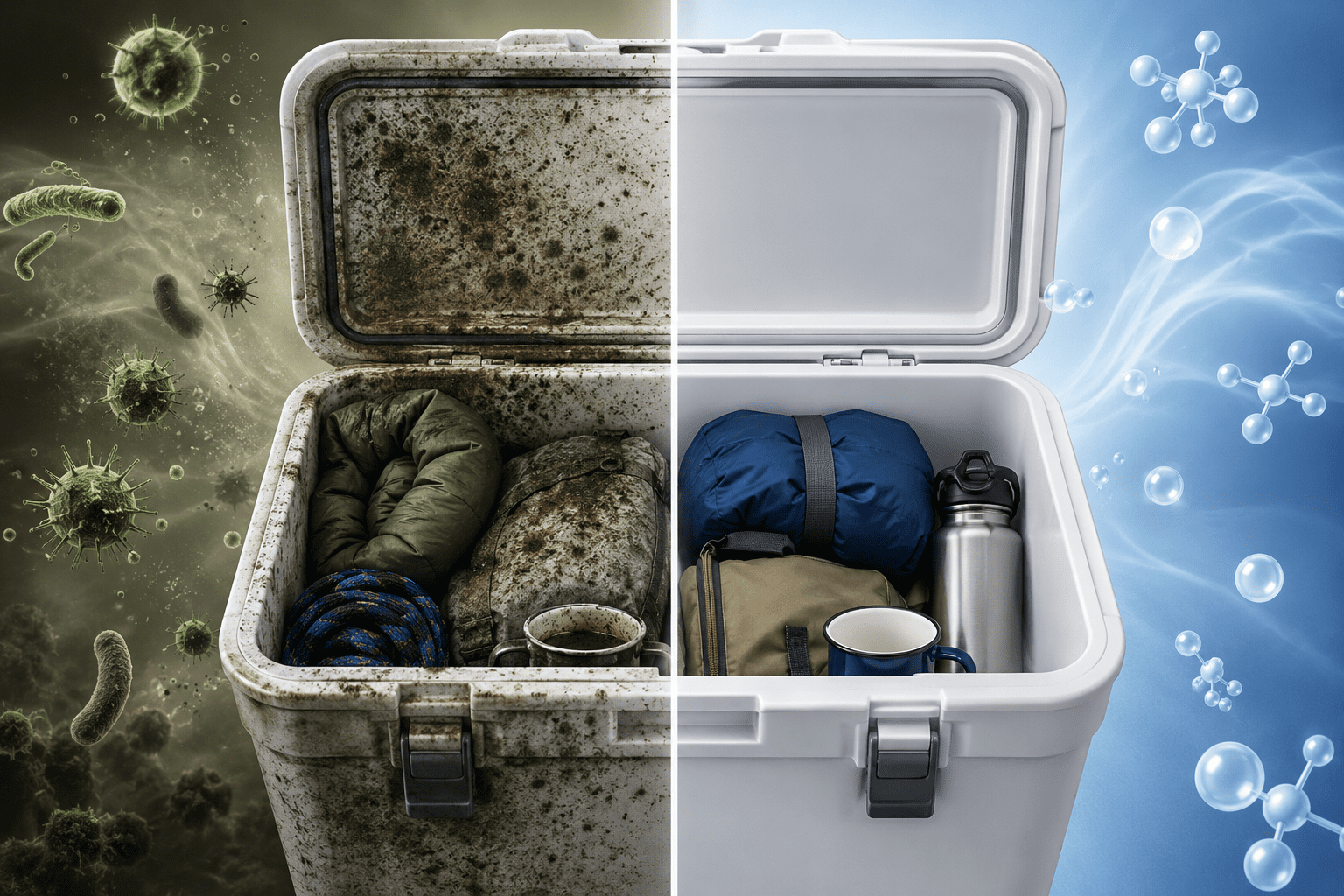
    image of a cooler, one side moldy from storage and the other clean and deodorized.

    Chlorine dioxide technology works through true odor neutralization, not masking.

    It:

    • Breaks down odor-causing compounds
    • Penetrates enclosed environments
    • Reaches into porous materials
    • Neutralizes odors at the molecular level

    Because chlorine dioxide can exist in a gas phase, it can travel into:

    • Fabric fibers
    • Foam materials
    • Hard-to-reach crevices
    • Sealed storage areas

    👉 This creates a more complete odor treatment process.

    👉https://freshtent.com/how-to-clean-a-moldy-cooler/


    Real-World Example

    A cooler put away after summer may seem “mostly dry.”

    But inside:

    • Small moisture pockets remain
    • Organic residue stays trapped
    • Enclosed conditions continue developing odor

    Months later, opening the lid releases the unmistakable smell of microbial buildup.

    For a practical step-by-step example of how this happens in camping coolers specifically, see:
    👉 How to clean a moldy cooler before your first trip


    Why This Matters More Than Ever

    People are becoming more aware of:

    • Indoor air quality
    • Environmental odor issues
    • Hidden contamination sources
    • Long-term storage conditions

    As awareness grows, odor treatment is shifting away from masking and toward:
    👉 Source-level neutralization


    infograph showing how to reduce mold in enclosed spaces.


    Conclusion 

    Odor problems in enclosed spaces don’t happen by accident.

    They develop through a predictable combination of moisture, microbial activity, and trapped air.

    And once odor compounds form, masking them isn’t enough.

    👉 Real odor control starts by neutralizing the source.


    ❓ FAQs (10)

    1. Why do enclosed spaces smell musty?

    Because trapped moisture and microbial activity create odor compounds over time.

    2. Why do coolers smell after storage?

    Residual moisture and organic buildup continue developing odor in enclosed conditions.

    3. What causes odor compounds?

    Bacteria, mildew, and organic breakdown release VOCs into the air.

    4. Why doesn’t surface cleaning remove odor?

    Because odor compounds remain embedded inside materials and enclosed airspaces.

    5. Can odor exist without visible mold?

    Yes, odor-causing microbial activity often starts before visible growth appears.

    6. Why does humidity make odors worse?

    Humidity accelerates microbial activity and VOC release.

    7. Do air fresheners eliminate odor?

    No, they only mask odor temporarily.

    8. Why are storage bins high-risk for odor?

    They trap moisture and limit airflow.

    9. How does chlorine dioxide neutralize odor?

    It breaks down odor-causing compounds at the molecular level.

    10. How do you prevent enclosed-space odor problems?

    Control moisture, improve drying, and neutralize odor sources before storage.

  • Why Musty Odors Come Back Every Spring?

    Why Musty Odors Come Back Every Spring?

    Every spring, the same thing happens.

    You open a storage bin, step into the garage, or pull out seasonal items—and that unmistakable musty smell hits you instantly.

    It’s not just unpleasant.
    It’s persistent.
    And no matter how many times you try to “freshen it up,” it keeps coming back.

    That’s because musty odors aren’t random—they’re predictable, seasonal, and driven by environmental conditions that reactivate odor at the source.


    What Actually Causes Musty Odors?

    Musty odors are not just “stale air.”

    They are the result of active microbial processes, primarily:

    • Bacteria
    • Mold and mildew
    • Organic residue breakdown

    These microorganisms feed on microscopic organic material and release volatile organic compounds (VOCs)—the compounds your nose detects as odor.

    👉 If you can smell it, something is actively producing it.


    Why Spring Triggers Odor Problems

    Spring creates the perfect conditions for odor to return:

    🌡️ Temperature Increase

    Warmer environments accelerate microbial activity

    💧 Rising Humidity

    Moisture fuels bacterial and mold growth

    🔒 Enclosed Storage Conditions

    Limited airflow traps odor compounds and allows buildup

    💤 Dormant-to-Active Shift

    Microorganisms that slowed during winter reactivate rapidly


    Where Musty Odors Commonly Develop

    This is why you notice odors in:

    • Storage bins and containers
    • Closets and basements
    • Vehicles and enclosed cabins
    • Upholstery and cushions
    • Seasonal gear and fabrics

    These environments combine moisture + limited airflow + porous materials, creating ideal conditions for odor formation.


    Why Most Odor Solutions Fail

    Most people try to fix the problem with:

    • Air fresheners
    • Fragrance sprays
    • Surface cleaners

    These approaches only address the symptom, not the source.

    ❌ They mask odor

    ❌ They don’t penetrate materials

    ❌ They don’t neutralize odor-causing compounds

    That’s why the smell returns—often stronger than before.

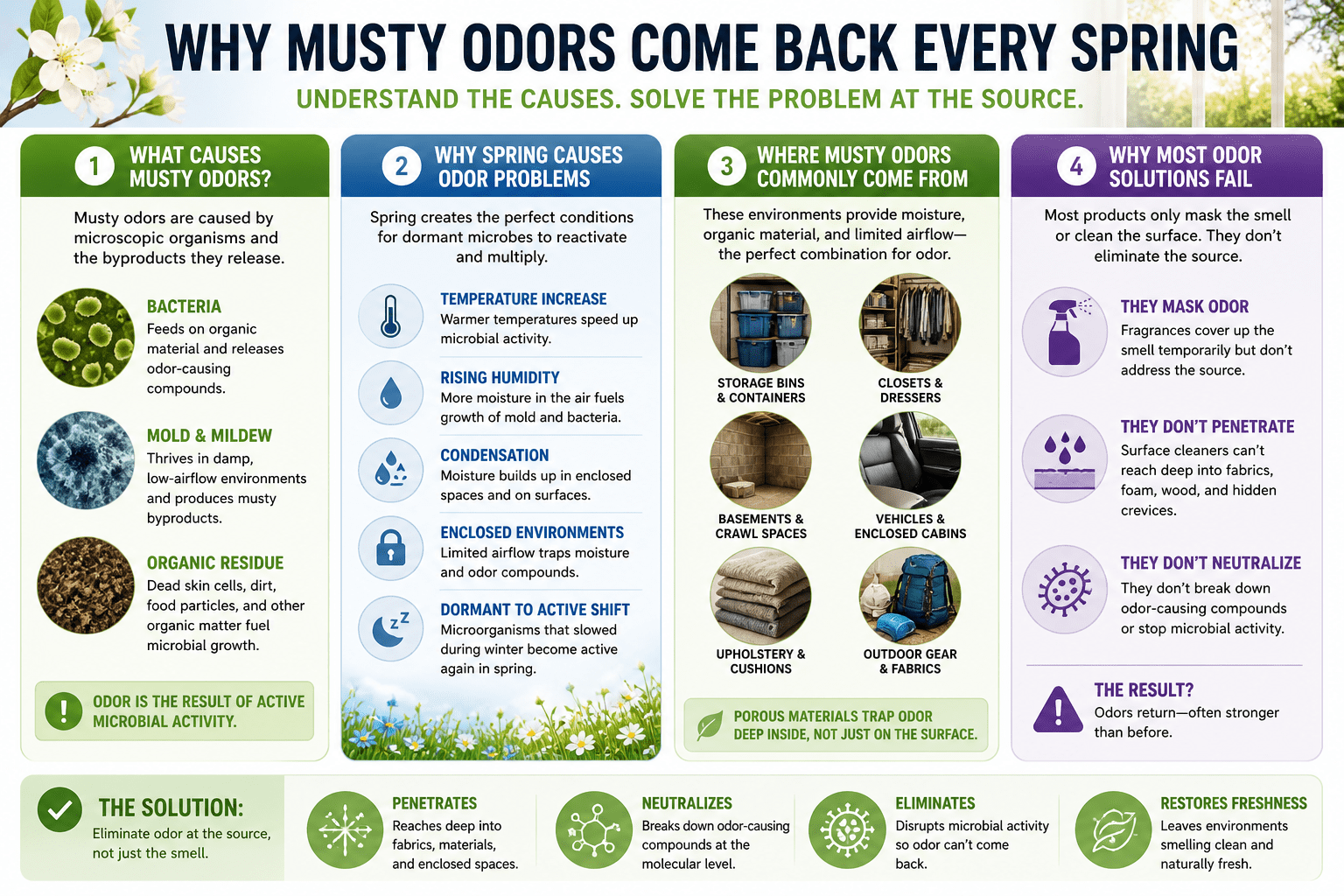
    infograph exolaining what causes musty odors and why they are worse in the spring.


    Why Odor Means Active Contamination

    This is where most people underestimate the problem.

    Odor is not just a nuisance—it’s a signal.

    It indicates:

    • Ongoing microbial activity
    • Active breakdown of organic material
    • Continued release of odor compounds

    👉 In other words, the problem isn’t gone—it’s growing.


    What It Takes to Actually Eliminate Odor

    To solve musty odors at the source, a solution must:

    ✔ Reach into porous materials (fabric, foam, wood)
    ✔ Neutralize odor-causing compounds at the molecular level
    ✔ Penetrate enclosed and hard-to-reach areas
    ✔ Address both air and surface contamination

    This is where chlorine dioxide (ClO₂) technology stands apart.

    Also Read 📖The Science of Safe Air | How ClO₂ Purifies Without Harm


    How Chlorine Dioxide Technology Works

    Chlorine dioxide works through a true neutralization process, not masking.

    It:

    • Breaks down odor-causing compounds
    • Disrupts microbial activity responsible for odor production
    • Penetrates areas that sprays and liquids cannot reach

    Because it can exist in a gas form, it moves through:

    • Airspace
    • Fabric fibers
    • Hidden crevices
    • Enclosed environments

    👉 This allows for whole-environment odor treatment, not just surface cleaning.

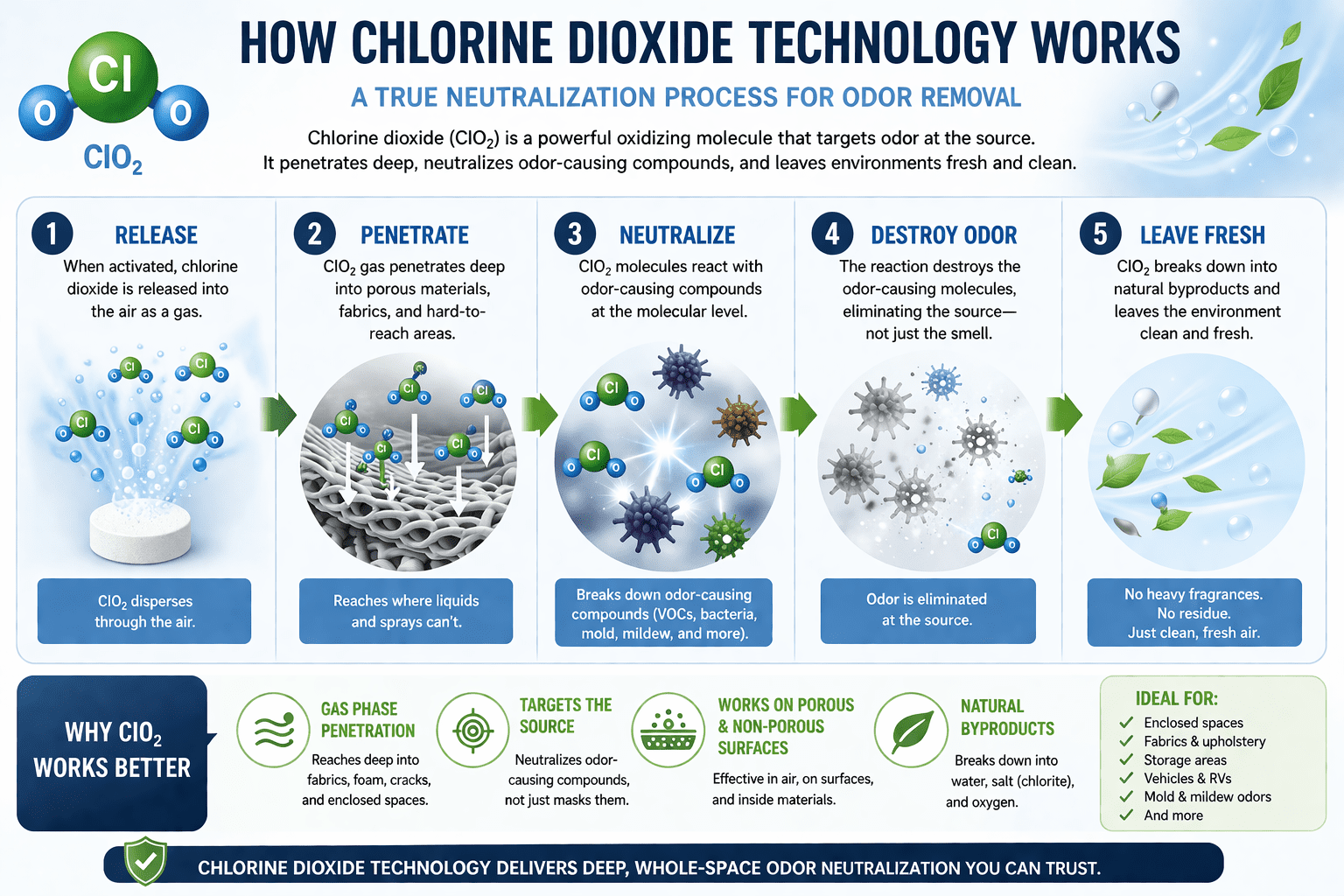
    Infographic explaining chlorine dioxide odor removal process, including gas penetration, molecular neutralization, and elimination of odor-causing bacteria and compounds


    Real-World Application Example

    Consider a storage bin sealed over winter.

    Even if items were “clean,” small amounts of moisture and organic residue remain.

    Over time:

    • Microbial activity continues slowly
    • Odor compounds build up
    • Enclosed space traps those compounds

    When spring arrives, conditions accelerate the process—and the odor becomes noticeable immediately.

    For a real-world example of how this affects outdoor gear specifically, see how this applies in camping environments here:


    👉 How to remove musty smell from camping gear (FreshTent Solutions)

    Why Does Camping Gear Smell Musty Every Year?


    How to Prevent Musty Odors from Returning

    Prevention is just as important as treatment.

    Before Storage:

    • Ensure items are completely dry
    • Avoid sealing in moisture
    • Treat enclosed environments before long-term storage

    After Storage:

    • Use a full odor-neutralizing treatment
    • Allow time for deep penetration
    • Avoid relying on fragrance-based solutions

    Why This Matters More Than Ever

    As awareness around indoor air quality and environmental conditions continues to grow, people are recognizing that odor is not just cosmetic—it’s environmental.

    Persistent odors can affect:

    • Comfort
    • Perceived cleanliness
    • Air quality
    • Long-term material condition

    👉 Eliminating odor at the source is no longer optional—it’s essential.

    Also read 📖Ways to Prevent Persistent Odors From Returning for Good In 2026


    Conclusion 

    Musty odors don’t just “come back”—they were never fully eliminated.

    They persist because the source remains active beneath the surface.

    If you want to break the cycle, the solution isn’t stronger fragrance—it’s true odor neutralization at the molecular level.

    👉 If you can smell it, it’s still there.
    👉 And if it’s still there, it can be eliminated the right way.


    ❓ FAQs

    Man opening a storage tote of camping gear and reacting to moldy, musty equipment in a basement storage area

    1. Why do things smell musty after winter?

    Because moisture and dormant bacteria reactivate in warmer, humid spring conditions.

    2. What causes musty odors?

    Microbial activity such as bacteria and mildew breaking down organic material.

    3. Why do odors come back after cleaning?

    Because most cleaning methods do not eliminate the source of odor.

    4. Is musty smell a sign of contamination?

    Yes, it indicates active odor-producing processes.

    5. Can odors live in fabric?

    Yes, porous materials trap odor-causing compounds deeply.

    6. Why don’t air fresheners work long-term?

    They mask odor instead of neutralizing it.

    7. What eliminates odor at the source?

    Treatments that break down odor-causing compounds at the molecular level.

    8. Does humidity make odors worse?

    Yes, moisture accelerates microbial activity.

    9. Can enclosed spaces trap odor?

    Yes, lack of airflow allows buildup of odor compounds.

    10. How do you prevent musty smells?

    Control moisture, treat enclosed areas, and eliminate odor sources before storage.

  • Will Professional Carpet Cleaning Remove Pet Odors? The Real Answer

    Will Professional Carpet Cleaning Remove Pet Odors? The Real Answer

    The Truth About Pet Odors in Carpets

    Let’s start with what most homeowners experience:

    You clean the carpet…
    Maybe even hire a professional…
    It smells better for a while…

    And then?
    👉 The odor comes back.

    That’s not bad cleaning.
    👉 That’s an incomplete solution.


    Why Pet Odors Are So Hard to Remove

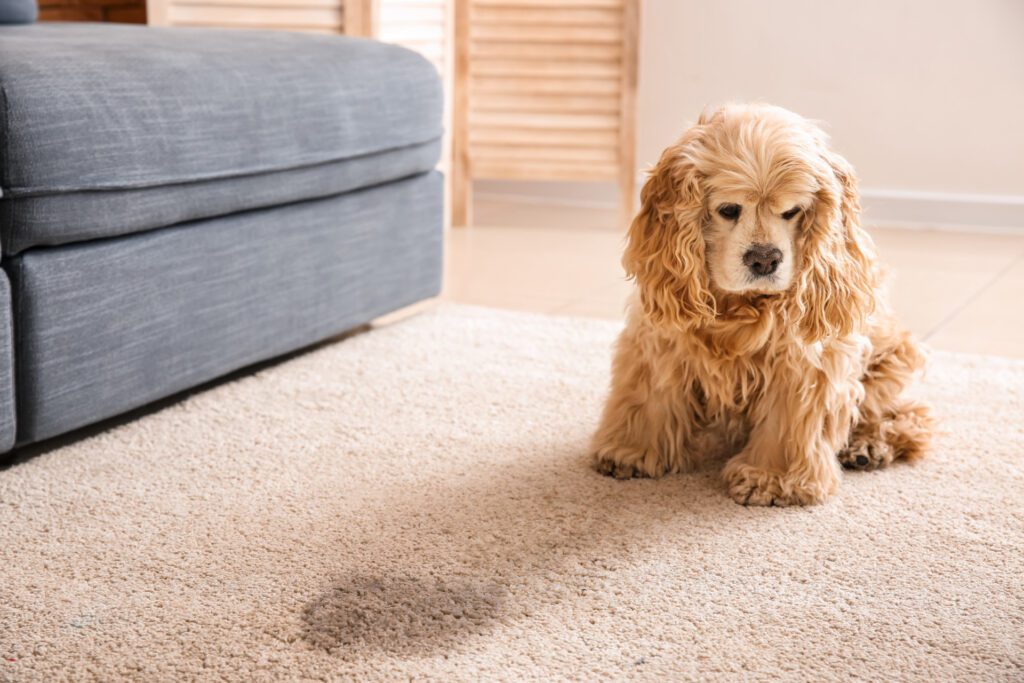
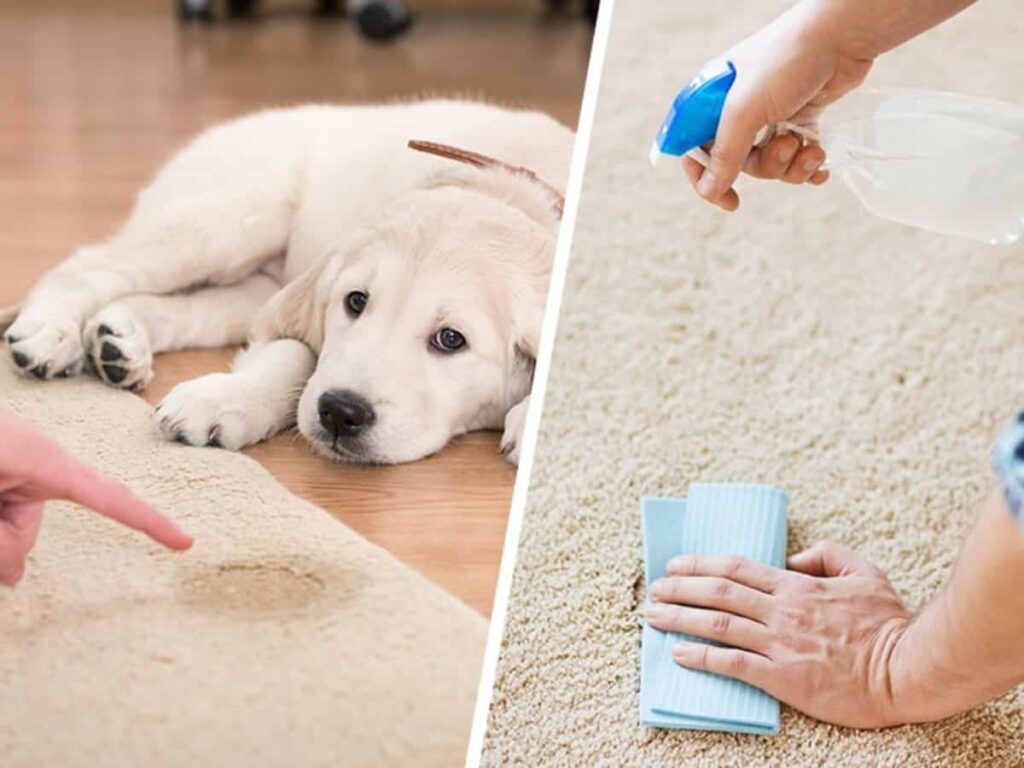
    pet urine on carpet

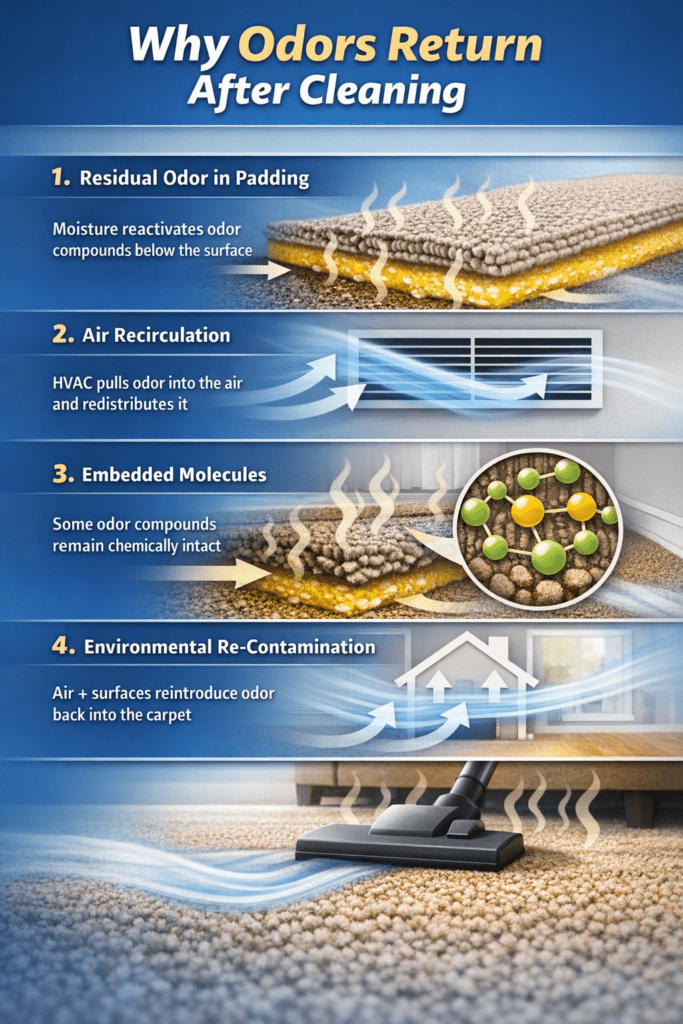
    Pet odors—especially urine—don’t stay on the surface.

    They penetrate:

    • Carpet fibers
    • Carpet backing
    • Padding underneath
    • Even subfloor in severe cases

    At the same time:

    • Pet dander and oils cling to materials
    • Odor compounds bind at a molecular level

    👉 Which means the smell is embedded—not just sitting on top

    Also Read How Can Chlorine Dioxide Tablets Sanitize & Deodorize Carpets Safely?


    How Pet Odors Affect Your Entire Environment

    Here’s what most people miss:

    It’s not just the carpet.

    Once odor exists:

    • It enters the air
    • It gets pulled into the HVAC system
    • It gets redistributed throughout the home

    👉 Now it’s an indoor air quality (IAQ) issue—not just a carpet issue


    What Professional Carpet Cleaning Actually Does

    Let’s be fair—professional cleaning has real value.

    ✔ What it DOES well:

    • Removes surface contamination
    • Extracts dirt and debris
    • Improves appearance
    • Reduces odor intensity

    ❌ What it often DOESN’T fully do:

    • Eliminate deep odor sources in padding
    • Address airborne odor molecules
    • Treat the HVAC system
    • Prevent odors from returning

    👉 It’s a reduction process—not always elimination


    infograph explaining why odors return after cleaning.


    The Missing Step: Treating the Environment

    If you want odors gone—not reduced—you need to treat:

    ✔ The carpet
    ✔ The air
    ✔ The system

    Not just one piece.


    How Chlorine Dioxide Eliminates Pet Odors

    two parts of picture, on the left side, a urine stain on carpet and a dog sitting sad and a hand pointing finger to the urine stain and on the right side, a close shot of hands with a cloth and spraying on urine stain.

    Chlorine dioxide (ClO₂) works differently than cleaning methods.

    It doesn’t:

    • Scrub
    • Mask
    • Add fragrance

    Instead, it:

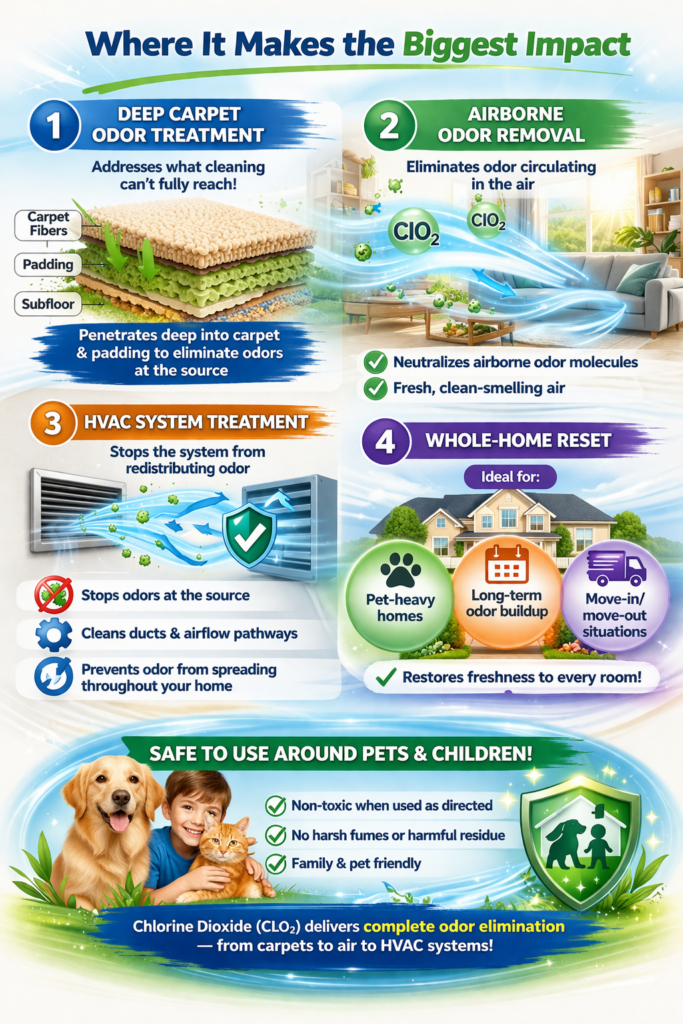
    ✔ Breaks Down Odor Molecules

    Targets the chemical structure of odor compounds


    ✔ Penetrates Deep Into Materials

    Reaches:

    • Carpet fibers
    • Padding
    • Airspace

    ✔ Moves Through the Entire Environment

    Including:

    • HVAC systems
    • Airflow pathways
    • Hidden odor zones

    👉 This is what stops the cycle—not just interrupts it.

    Also Read How Safe Is Chlorine Dioxide for Indoor Use Around People and Pets?


    Infographic explaining chlorine dioxide odor elimination in carpets, indoor air, HVAC systems, and whole-home environments


    Use-Case Scenario

    A homeowner hires a professional carpet cleaner.

    Results:
    ✔ Carpet looks great
    ✔ Smell improves temporarily

    But within days:
    👉 The odor returns when the HVAC runs

    Why?

    Because:

    • The source remained below the surface
    • The system reintroduced it

    After a chlorine dioxide treatment:

    • Odor molecules are neutralized
    • Air is clean—not scented
    • The problem stops returning

    So… Is Professional Cleaning Worth It?

    Yes—but only as part of the solution.

    Think of it this way:

    • Carpet cleaning = removes buildup
    • Chlorine dioxide = eliminates what remains

    👉 Together, they create a complete solution


    Why This Matters for Indoor Air Quality

    Fighting Allergens Header Image

    Pet odors don’t just affect smell—they affect:

    • Air quality perception
    • Comfort
    • Cleanliness standards
    • Overall indoor experience

    And since air circulates:
    👉 what’s in your carpet ends up in your air


    Final Answer: Can Carpet Cleaning Remove Pet Odors?

    It can reduce them.

    But if you want them gone
    you need to eliminate the source at the molecular level.

    That’s where chlorine dioxide changes the outcome.


    Call to Action

    If you’ve cleaned your carpets and the odor keeps coming back, it’s time to go beyond surface solutions.

    Discover how chlorine dioxide tablets can help eliminate pet odors at the source—and restore your indoor environment.

    (FAQs)

    1. Does professional carpet cleaning remove pet urine odor completely?

    It can reduce odor significantly, but deep or embedded odor sources may remain and cause odors to return.


    2. Why does pet odor come back after carpet cleaning?

    Because odor-causing compounds can remain in the padding, subfloor, or air system and continue to circulate.


    3. Can carpet cleaning reach deep odor sources?

    It can reach into fibers, but may not fully eliminate odor embedded below the surface or in surrounding airspaces.


    4. How does chlorine dioxide remove pet odors?

    It breaks down odor-causing molecules at a chemical level, eliminating the source rather than masking it.


    5. Can chlorine dioxide reach carpet padding?

    Yes, it can penetrate into materials and airspaces where odor molecules exist.


    6. Will this help with pet odors throughout the house?

    Yes, it treats the entire environment, including air and HVAC systems.


    7. Is pet odor an indoor air quality issue?

    Yes, because odor molecules become airborne and circulate throughout the home.


    8. Do I still need professional carpet cleaning?

    It is recommended as part of the process, but it may not be sufficient alone for full odor elimination.


    9. How long does it take to eliminate pet odors?

    Results depend on severity, but noticeable improvement can occur within hours to days.


    10. What is the most effective way to remove pet odors permanently?

    A combination of cleaning and molecular-level odor elimination provides the most complete solution.

  • How to Prevent Odors from Returning: HVAC & Indoor Air Quality Solutions

    How to Prevent Odors from Returning: HVAC & Indoor Air Quality Solutions

    The Real Reason Odors Keep Coming Back

    You clean.
    You open windows.
    You use sprays or candles.

    And yet… the smell returns.

    That’s not a cleaning problem.
    👉 It’s a system problem.

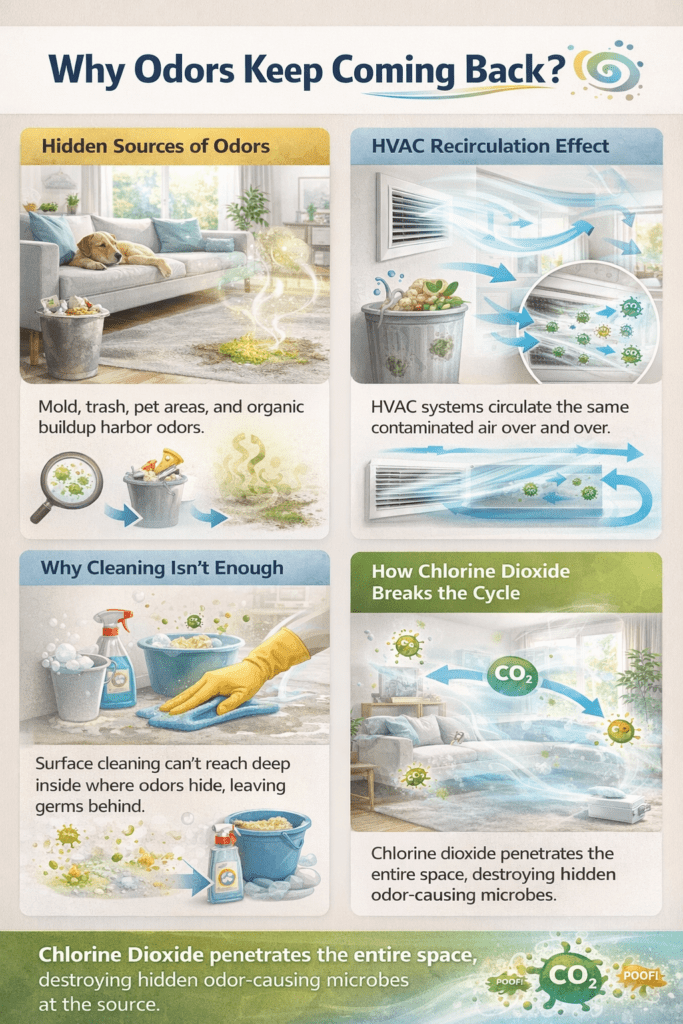
    Most recurring odors don’t live on surfaces—they live in:

    • Air circulation pathways
    • HVAC systems
    • Porous materials

    Which means every time air moves…
    👉 the odor comes back with it.


    Why “Fresh Air” Isn’t a Long-Term Solution

    Opening windows feels like it works—and temporarily, it does.

    But here’s the catch:

    • It dilutes odors
    • It doesn’t eliminate them
    • It doesn’t address the source

    Once the windows close…
    👉 the environment resets to where it was.

    Also Read Winter IAQ Solutions: Stop Wood Smoke, Dry Air & Stale Indoor Odors


    Where Odors Actually Hide

    infograph showing different areas that are missed when just surface cleaning is applied.

    To stop odors, you have to understand where they live.

    Primary Hidden Sources:

    • HVAC ductwork
    • Coils and condensation areas
    • Filters and airflow systems
    • Carpets and upholstery
    • Subflooring and wall materials

    These areas:
    ✔ Trap odor-causing compounds
    ✔ Protect them from surface cleaning
    ✔ Reintroduce them into the air continuously


    Why Surface Cleaning Alone Fails

    Let’s call it out clearly:

    Surface Cleaning:

    ✔ Removes visible dirt
    ✔ Improves appearance

    But it does NOT:

    ❌ Reach inside HVAC systems
    ❌ Eliminate airborne odor molecules
    ❌ Treat embedded contamination

    👉 That’s why odors return—even in “clean” spaces.


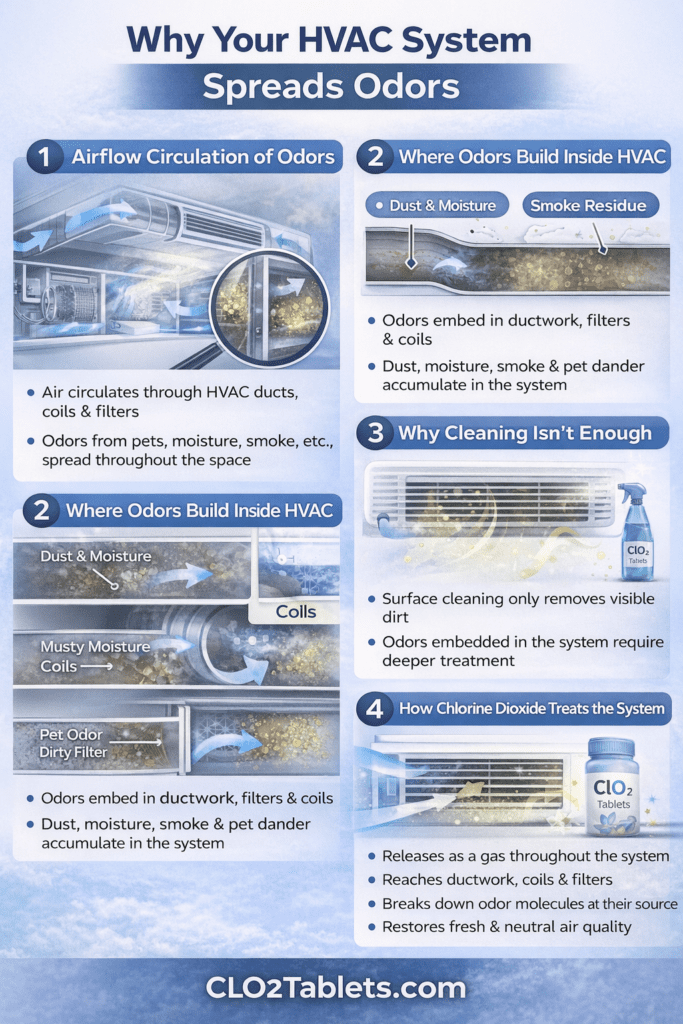
    The HVAC Connection: Your Hidden Odor Distributor


    Your HVAC system doesn’t just move air—it moves everything in it.

    If odor exists inside the system:

    • It spreads room to room
    • It recirculates continuously
    • It becomes part of the environment

    Common signs:

    • Smell when AC or heat turns on
    • Odors stronger in certain rooms
    • “Clean house” that still smells off

    The Shift: From Cleaning to Environmental Control

    If you want odors gone for good,
    you need to stop thinking in terms of cleaning…

    …and start thinking in terms of environmental treatment.


    How Chlorine Dioxide Prevents Odors from Returning

    Chlorine dioxide (ClO₂) works differently.

    It doesn’t:

    • Cover odors
    • Add fragrance
    • Rely on repeated application

    Instead, it:

    ✔ Targets Odor Molecules

    Breaks them down at a chemical level


    ✔ Moves Through the Entire Air System

    Reaches:

    • Ductwork
    • Coils
    • Hidden airflow zones

    ✔ Treats the Source

    Not just where you smell it—but where it originates


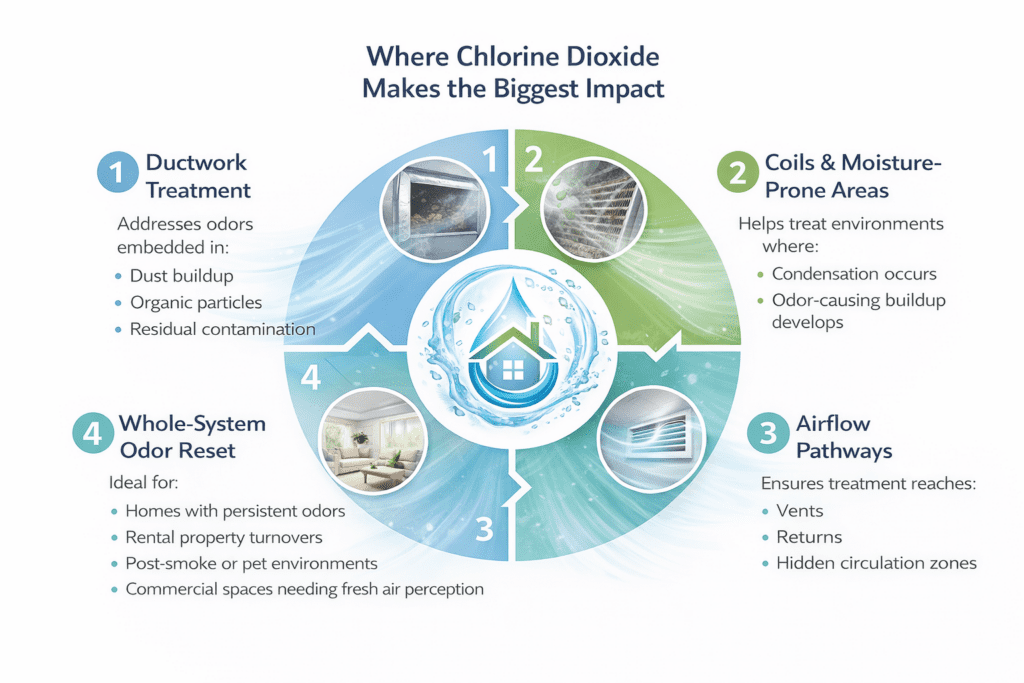
    Where It Makes the Biggest Difference

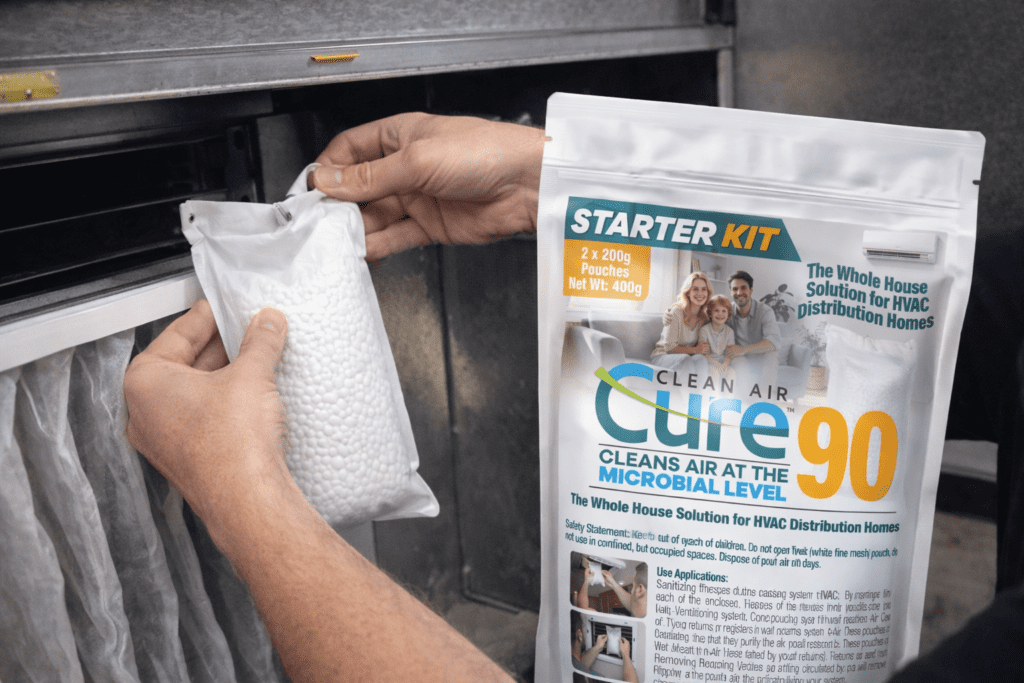
    1. HVAC Systems

    Stops odor recirculation at the source

    A new pouch is inserted into a HVAC unit


    2. Moisture-Prone Areas

    Prevents odor buildup in:

    • Basements
    • Bathrooms
    • Utility spaces

    3. Whole-Home Airspace

    Treats:

    • Air
    • Surfaces
    • Hidden zones

    4. Recurring Odor Environments

    Ideal for:

    • Pet-related odors
    • Smoke exposure
    • Rental turnovers
    • Stale or musty homes

    Also Read Will Professional Carpet Cleaning Remove Pet Odors?


    Air quality improvement strategies infographic


    Use-Case Scenario

    A homeowner:

    • Cleans regularly
    • Uses air purifiers
    • Opens windows

    But still notices:
    👉 A stale, musty smell when the system runs

    The issue?

    Not the room.
    👉 The HVAC system.

    After a chlorine dioxide treatment:

    • Odor source is neutralized
    • Air feels clean—not fragranced
    • The problem stops returning

    Health, Comfort, and Perception

    Always remember that CLO2 is highly affective if use properly.

    Air quality affects more than smell.

    It impacts:

    • Comfort
    • Breathing experience
    • Perception of cleanliness
    • Overall indoor environment quality

    When air is clean:
    ✔ Spaces feel better
    ✔ People stay longer
    ✔ Environments feel healthier

    Also Read Ways to Prevent Persistent Odors From Returning for Good In 2026


    Why This Matters More Today

    Modern environments are:

    • More sealed
    • More energy-efficient
    • Less ventilated

    Which means:
    👉 Odors and contaminants stay longer

    At the same time:

    • Expectations for air quality are rising
    • Occupants notice air instantly
    • First impressions matter more than ever

    Final Thoughts: Stop the Cycle

    If odors keep coming back,
    it’s not because you’re not cleaning enough.

    👉 It’s because the source hasn’t been eliminated.

    Chlorine dioxide offers a way to:

    • Treat the HVAC system
    • Eliminate odor at the molecular level
    • Prevent the cycle from repeating

    Call to Action

    If you’re ready to stop managing odors—and start eliminating them at the source—explore how chlorine dioxide tablets can help restore your indoor air environment.

    (FAQs)


    1. Why do odors keep coming back after cleaning?

    Because the source of the odor often remains in HVAC systems or embedded materials, continuing to circulate through the air.


    2. How can I stop odors from returning in my home?

    By addressing the source of the odor—especially within air systems—rather than relying only on surface cleaning or fragrance-based solutions.


    3. Can HVAC systems cause odors in a home?

    Yes, HVAC systems can circulate odors throughout a space if buildup exists within ductwork, coils, or airflow pathways.


    4. Does chlorine dioxide eliminate odors permanently?

    It neutralizes odor-causing molecules at the source, which can provide long-lasting results depending on the environment.


    5. Is opening windows enough to remove odors?

    No, it only temporarily dilutes odors and does not eliminate the source.


    6. Can chlorine dioxide reach hidden odor sources?

    Yes, as a gas, it disperses through air systems and reaches areas that are difficult to access with traditional cleaning.


    7. What causes musty smells in homes?

    Often moisture buildup combined with airflow systems that distribute odor throughout the space.


    8. Does this replace regular cleaning?

    No, it complements cleaning by addressing deeper environmental odor sources.


    9. How long does it take to eliminate odors?

    Results vary, but noticeable improvements can occur within hours to days.


    10. What makes chlorine dioxide different from air fresheners?

    It eliminates odor at the molecular level rather than masking it with fragrance.

  • How Chlorine Dioxide Improves HVAC Air Quality and Indoor Environments

    How Chlorine Dioxide Improves HVAC Air Quality and Indoor Environments

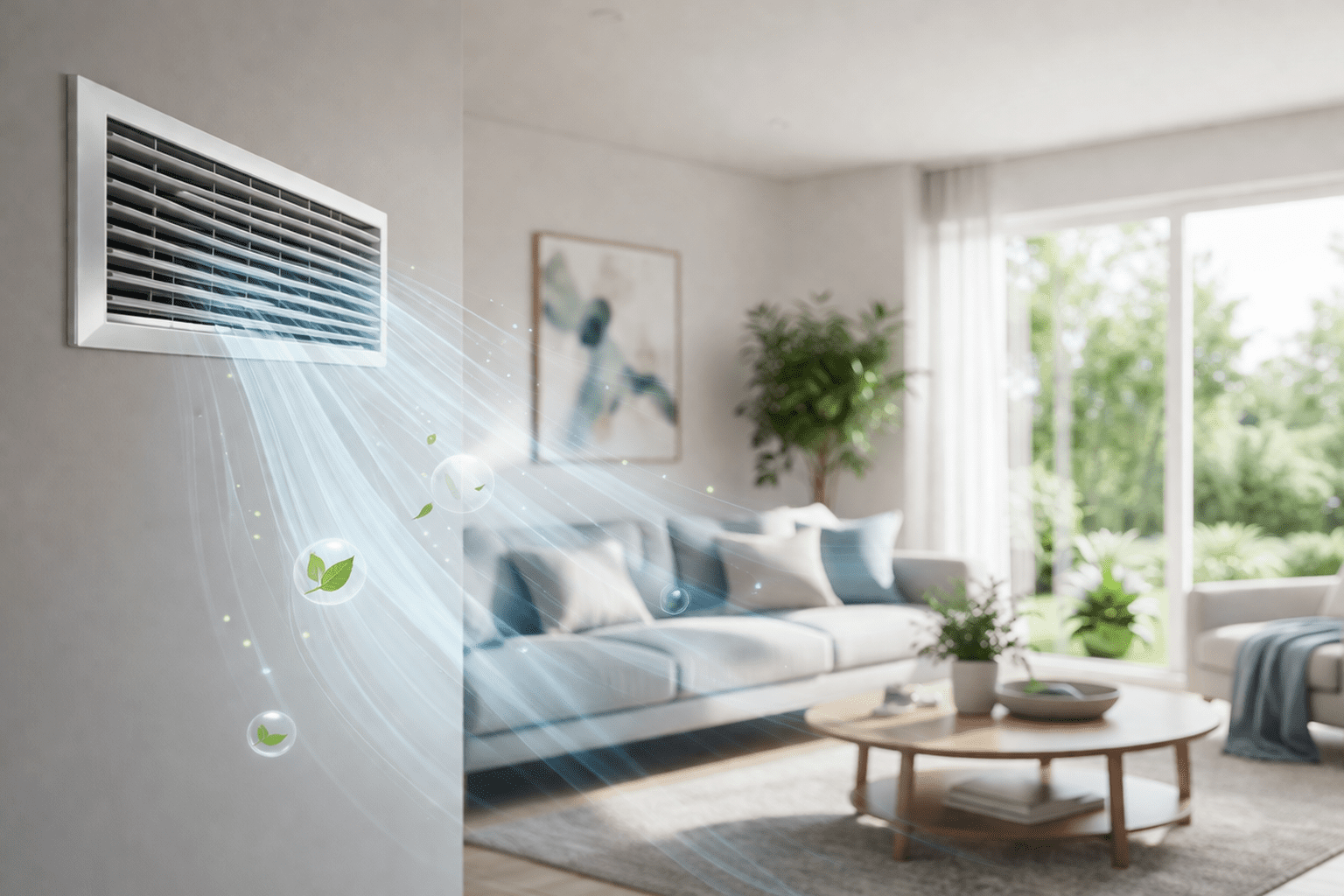
    Indoor Air Quality Starts Inside Your HVAC System

    Most people focus on surfaces when they think about cleanliness.

    But the real story?
    👉 Your air system is what defines your environment.

    Every time your HVAC system runs, it moves air through:

    • Ductwork
    • Coils
    • Filters
    • Vents

    If that system contains odor or contamination,
    👉 it distributes it—room by room, breath by breath.


    The Overlooked Source of Poor IAQ

    Indoor air quality (IAQ) issues often don’t come from what you can see.

    They come from what’s circulating.

    Inside HVAC systems, you’ll commonly find:

    • Dust and organic buildup
    • Moisture-prone areas
    • Residual odor compounds
    • Airborne particles that re-circulate continuously

    This creates a cycle:

    1. Contaminants build up inside the system
    2. Air moves through it
    3. Odors and particles spread
    4. The problem repeats

    Why Traditional Cleaning Isn’t Enough

    Fighting Allergens

    Standard HVAC maintenance is important—but incomplete.

    What it typically does:

    ✔ Removes visible debris
    ✔ Improves mechanical performance

    What it often misses:

    ❌ Embedded odor molecules
    ❌ Airborne contamination
    ❌ System-wide environmental issues

    Because IAQ problems aren’t just mechanical—
    👉 they’re environmental and molecular

    Also Read What Is Oxidation, and Why Does It Change Smells and Residue?


    How Chlorine Dioxide Changes the Approach

    Chlorine dioxide (ClO₂) isn’t a surface cleaner.

    It’s an environmental treatment technology.

    Here’s what makes it different:

    ✔ Moves Through the Entire HVAC System

    As a gas, it follows airflow pathways—reaching:

    • Ductwork
    • Coils
    • Hidden zones

    ✔ Targets Odor at the Source

    Instead of masking smells, it:

    • Interacts with odor-causing molecules
    • Breaks them down chemically
    • Eliminates the source of the problem

    ✔ Treats the Air, Not Just the Equipment

    It works within:

    • The airspace
    • The system
    • The environment as a whole


    Health, Comfort, and the Air You Breathe

    Let’s talk real-world impact.

    Poor IAQ isn’t just unpleasant—it affects:

    • Comfort
    • Perception of cleanliness
    • Breathing experience
    • Overall indoor environment quality

    When air carries odor or contamination:
    👉 people notice immediately—even if they can’t explain why

    Cleaner air means:
    ✔ More comfortable spaces
    ✔ Better perceived cleanliness
    ✔ Improved indoor experience


    Why IAQ Matters More Than Ever

    Modern buildings are:

    • More sealed
    • More energy-efficient
    • Less naturally ventilated

    That means:
    👉 Air stays inside longer—and so do contaminants

    At the same time:

    • Occupants are more aware of air quality
    • Property standards are rising
    • First impressions are instant

    A Smarter Approach to Indoor Air Quality

    infograph of how HVAC systems impact IAQ

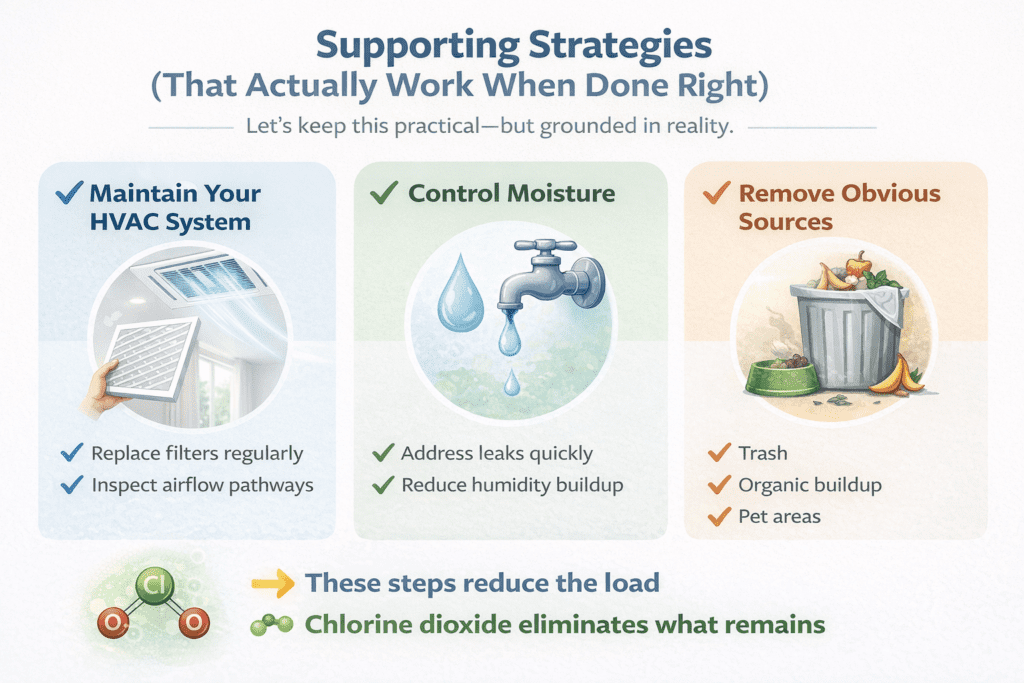
    Instead of relying only on:

    • Surface cleaning
    • Filters
    • Fragrance-based solutions

    The shift is toward:
    👉 system-level environmental treatment

    Because if the system is clean,
    the air becomes clean.


    Use-Case Scenario

    A homeowner notices:

    • A musty smell every time the AC turns on
    • Air feels “stale” despite cleaning

    The issue isn’t the room—it’s the system.

    After a chlorine dioxide treatment:

    • Odor source is neutralized
    • Air feels clean and neutral
    • The HVAC system stops reintroducing the problem

    Safe and Controlled Use

    Chlorine dioxide is highly effective—but must be used properly.

    Key considerations:

    • Follow product instructions carefully
    • Use correct dosage for space/system size
    • Ensure proper ventilation guidance is followed

    👉 Results come from controlled, intentional use—not overuse

    Also Read Clean Air Cure™ 90 – HVAC Air Distribution Sanitizing System (Up to 90 Days)


    Final Thoughts: Fix the System, Fix the Air

    If your indoor environment doesn’t feel clean,
    the issue may not be what you’re cleaning…

    👉 It’s what you’re breathing.

    Chlorine dioxide offers a way to:

    • Treat the HVAC system
    • Eliminate odor at the source
    • Support a cleaner indoor air environment

    Call to Action

    If you’re dealing with recurring odors or inconsistent indoor air quality, it may be time to move beyond surface-level solutions.

    Discover how chlorine dioxide tablets can help restore your air system and improve the environment you live and work in.

     (FAQs)

    1. How does chlorine dioxide improve indoor air quality?

    It works by breaking down odor-causing molecules within the air system, helping create a cleaner and more neutral indoor environment.


    2. Can chlorine dioxide be used in HVAC systems?

    Yes, it can be used as part of a controlled treatment process to address odors and environmental buildup within HVAC systems.


    3. Why does my HVAC system make my home smell?

    Odors often originate from buildup inside ductwork, coils, or airflow pathways and are distributed throughout the home when the system runs.


    4. Does chlorine dioxide replace HVAC cleaning?

    No, it complements traditional maintenance by addressing odor and environmental factors that cleaning alone may not eliminate.


    5. Can chlorine dioxide reach inside air ducts?

    Yes, as a gas, it travels through the system and reaches areas that are difficult to access with physical cleaning.


    6. Will this help with musty or stale air?

    Yes, it is commonly used to neutralize musty odors and improve the overall freshness of indoor air.


    7. Is chlorine dioxide safe for indoor use?

    When used according to product instructions and guidelines, it is designed for controlled environmental treatment.


    8. How long does it take to improve air quality?

    Results vary depending on the severity of the issue, but improvements are often noticeable within hours to days.


    9. Can it help with pet or smoke odors in HVAC systems?

    Yes, it can address odors from pets, smoke, and other organic sources embedded within the system.


    10. Why do indoor air problems keep coming back?

    Because the source of the issue often remains inside the HVAC system, continuing to circulate through the air.

  • ClO2 Tablets for HVAC Cleaning & Deodorizing

    ClO2 Tablets for HVAC Cleaning & Deodorizing

    Why Your HVAC System May Be the Source of Poor Air Quality

    Most people think of their HVAC system as a solution for comfort.

    But here’s the reality:
    👉 If it’s not properly maintained, your HVAC system can become a distribution system for odors and contaminants.

    Every time air cycles through:

    • Ductwork
    • Coils
    • Filters
    • Blower components

    …it can carry:

    • Musty smells
    • Pet-related odors
    • Smoke residue
    • Organic buildup

    And once those odors are embedded?
    They don’t just disappear—they circulate.


    The Hidden Problem Inside HVAC Systems

    Modern HVAC vent releasing clean air into a bright home interior, representing improved indoor air quality

    Unlike surfaces you can wipe down, HVAC systems are:

    • Enclosed
    • Complex
    • Lined with porous materials
    • Constantly exposed to moisture and airflow

    This creates the perfect environment for:

    • Odor buildup
    • Organic residue accumulation
    • Recurring “mystery smells”

    Common signs:

    • That “dirty sock” smell when the system kicks on
    • Musty air in certain rooms
    • Odors that return even after cleaning

    Why Traditional HVAC Cleaning Falls Short

    Let’s be honest—most approaches are incomplete.

    Typical methods:

    • Filter changes
    • Coil cleaning
    • Surface-level duct cleaning

    These are important… but they often:
    ❌ Miss embedded odor sources
    ❌ Don’t treat the full air system
    ❌ Provide short-term results

    Because again—this is a molecular problem, not just a visible one.


    How Chlorine Dioxide Works in HVAC Environments

    Chlorine dioxide (ClO₂) is a selective oxidizing gas that works differently than traditional cleaners.

    Instead of scrubbing surfaces, it:
    ✔ Moves through the entire air system
    ✔ Reaches ductwork, coils, and hidden spaces
    ✔ Interacts with odor-causing molecules
    ✔ Breaks them down at the chemical level

    This allows it to treat:

    • Airflow pathways
    • Porous materials
    • Hard-to-reach system components

    Odor Elimination vs. Odor Masking in HVAC Systems

    Here’s the key distinction:

    Masking Solutions:

    • Add fragrance to airflow
    • Temporarily cover odors
    • Require repeated use

    Chlorine Dioxide Approach:

    • Neutralizes odor molecules
    • Targets the source inside the system
    • Helps prevent recurring smells

    👉 If the HVAC smells bad, the entire building smells bad.
    Fix the system, and you fix the environment.

    infograph showing Chlorine dioxide impact on HVAC systems


    Operational Benefits Beyond Air Quality

    This is where it gets interesting for decision-makers:

    ✔ Improved Airflow Efficiency

    Cleaner systems allow air to move more freely.

    ✔ Reduced Recurring Odor Complaints

    Especially in:

    • Property management
    • Hospitality
    • Office environments

    ✔ Extended System Performance

    Less buildup = less strain on components.


    Use-Case Scenario (Real-World)

    A property manager prepares a unit for new tenants.

    The space has been cleaned—but once the HVAC turns on:
    👉 A musty odor fills the unit.

    Surface cleaning didn’t fix it… because the source was inside the system.

    After a controlled chlorine dioxide treatment:

    • Odors are neutralized
    • Air feels clean—not fragranced
    • The unit is ready for occupancy

    Safe Application: What You Need to Know

    Let’s keep this grounded and responsible.

    Chlorine dioxide is highly effective—but it must be used correctly.

    Best practices:

    • Follow product instructions exactly
    • Use appropriate dosing for system size
    • Ensure proper ventilation guidance is followed
    • Avoid direct handling without precautions

    👉 Like any professional-grade solution, results come from proper use—not shortcuts.


    Why Indoor Air Quality Matters More Than Ever

    A great threat to your family's health are dirty air ducts filled with bacteria

    Today’s buildings are:

    • More sealed
    • More energy-efficient
    • Less naturally ventilated

    Which means:
    👉 What’s in your air… stays in your air.

    At the same time:

    • Occupants are more sensitive to odor and air quality
    • Businesses are judged by environmental comfort
    • Buyers notice air immediately upon entering a space

    Why Chlorine Dioxide Tablets Stand Out for HVAC Treatment

    Most solutions treat parts of the system.

    Chlorine dioxide treats the environment as a whole system.

    The difference:

    • Not surface-level
    • Not temporary
    • Not fragrance-based

    👉 It’s a source-level environmental treatment


    Final Thoughts: Treat the System, Not Just the Symptoms

    If your HVAC system is contributing to poor air quality,
    you don’t just need cleaning—you need targeted treatment.

    Chlorine dioxide tablets offer a way to:

    • Reach hidden areas
    • Eliminate odor at the source
    • Support a cleaner, more breathable indoor environment

    Call to Action

    If you’re dealing with recurring HVAC odors or inconsistent indoor air quality, it may be time to go beyond traditional cleaning methods.

    Explore how chlorine dioxide tablets can help restore your air system and improve the environment you live or work in.


    (FAQs)

    1. Can chlorine dioxide be used in HVAC systems?

    Yes, chlorine dioxide can be used as part of a controlled environmental treatment process to address odors within HVAC systems when applied according to product guidelines.


    2. Does chlorine dioxide clean air ducts?

    It helps treat odor-causing compounds within ductwork by interacting with them at a molecular level, complementing physical cleaning methods.


    3. Will chlorine dioxide remove musty HVAC smells?

    Yes, it is commonly used to neutralize musty odors caused by moisture-related buildup within HVAC systems.


    4. Is chlorine dioxide safe for HVAC components?

    When used correctly and at proper concentrations, it is designed for controlled use without damaging system components.


    5. How does chlorine dioxide improve indoor air quality?

    By eliminating odor-causing molecules within the air system, it helps create a cleaner and more neutral indoor air environment.


    6. Can chlorine dioxide reach inside ductwork?

    Yes, as a gas, it disperses through the HVAC system and reaches areas that are difficult to access with traditional cleaning methods.


    7. How long does HVAC odor treatment take?

    Treatment duration depends on system size and odor severity but can range from several hours to a few days.


    8. Does this replace HVAC cleaning?

    No, it complements physical cleaning by addressing odor sources that cleaning alone may not fully eliminate.


    9. Can it help with pet or smoke odors in HVAC systems?

    Yes, chlorine dioxide is effective at neutralizing odors from pets, smoke, and other organic sources within air systems.


    10. Why do HVAC odors keep coming back?

    Because the source of the odor often remains inside the system, traditional cleaning methods may not fully eliminate it.