Tag: chlorine dioxide odor removal

  • How Chlorine Dioxide Neutralizes the Odor Compounds Created by Wet Summer Gear

    How Chlorine Dioxide Neutralizes the Odor Compounds Created by Wet Summer Gear

    The Smell Usually Starts Long Before You Notice It

    woman opens the back of the SUV to find sour summer gear in the back after a lake trip and forgotten towels and swimware

    You spend the day on the lake.

    The kids jump off the dock all afternoon. Towels get tossed into the back of the SUV. Life jackets dry in a pile beside the camper. Wet swimsuits end up hanging over folding chairs while everyone enjoys dinner around the campsite.

    Everything seems normal.

    A day or two later, however, something changes.

    The towels smell sour.

    The life jackets have a strange stale odor.

    The swimsuit that seemed perfectly clean suddenly smells like it has been sitting in a gym locker for weeks.

    Most people assume these odors are simply caused by moisture.

    But moisture is only part of the story.

    The real source of many summer odors is a complex mixture of bacterial activity, organic residue, and odor-producing compounds that develop as microorganisms begin breaking down organic material trapped within wet fabrics and porous surfaces.

    Understanding how those odor compounds form is the first step toward understanding why chlorine dioxide works so differently than traditional odor-control products.


    image of monsters depicting seat, body oil, bacteria and debris in fabric fibers that cause odors.

    What Actually Creates Summer Odors?

    Many summer odors begin when moisture combines with:

    • Sweat
    • Skin oils
    • Organic debris
    • Environmental contaminants
    • Bacteria naturally present on surfaces

    When these materials remain trapped inside damp fabrics or porous materials, microorganisms begin feeding on the available organic matter.

    As they do, they release byproducts known as volatile organic compounds (VOCs).

    These VOCs are what your nose detects as odor.

    Common examples include:

    • Sour towel smell
    • Locker room odor
    • Stale fabric odor
    • Wet life jacket smell
    • Musty gear odor

    In many cases, the odor is not the bacteria itself.

    The odor comes from the compounds produced by microbial activity.


    Why Odors Get Stronger in Summer

    Summer conditions accelerate odor formation.

    Higher temperatures increase microbial activity.

    Humidity slows drying.

    Enclosed vehicles, campers, storage compartments, and gear bags trap moisture longer.

    As temperatures rise, VOCs become more active and are released into the air more rapidly.

    This is why a towel that seemed fine yesterday can suddenly smell terrible after sitting in a hot vehicle for a few hours.

    The compounds were already present.

    The heat simply increased their release into the surrounding air.

    Also Read ☀️The Hidden Science of Mold and Odor Growth in Enclosed Spaces


    Why Traditional Odor Solutions Often Fail

    Many odor-control products focus on masking odor rather than eliminating it.

    Common approaches include:

    • Fragrances
    • Air fresheners
    • Scent boosters
    • Perfumed sprays

    While these products may temporarily improve the smell, they often leave the underlying odor compounds untouched.

    As the fragrance fades, the original odor returns.

    This cycle leads many people to repeatedly wash, spray, and deodorize the same items without ever addressing the source of the problem.


    How Chlorine Dioxide Works Differently

    Chlorine dioxide operates through oxidation.

    Unlike fragrances that attempt to cover odor, chlorine dioxide interacts directly with many odor-causing compounds.

    At the molecular level, chlorine dioxide helps alter and neutralize the chemical structures responsible for offensive odors.

    Instead of adding another scent to the environment, chlorine dioxide targets the compounds producing the smell.

    This distinction is important because odor molecules cannot continue producing the same odor once their molecular structure has been altered.


    Why Chlorine Dioxide Is Effective on Wet Gear Odors

    circular infograph showing the summer odor cycle with clo2.

    Check out this article over at FreshTent ☀️https://freshtent.com/how-to-stop-wet-towels-swimsuits-and-lake-gear-from-smelling/


    Wet gear creates the perfect environment for odor development because moisture allows microbial activity to continue deep within materials.

    Chlorine dioxide is particularly useful because it can move through airspaces and penetrate difficult-to-reach environments where odor compounds often remain trapped.

    Examples include:

    • Towels
    • Swimsuits
    • Life jackets
    • Camping gear
    • Storage totes
    • Athletic equipment
    • RV fabrics
    • Marine upholstery

    These materials often contain small fibers, pores, and airspaces that allow odors to persist long after surfaces appear dry.

    Also Read ☀️Why Campfire Smoke Odor Stays in Gear for Months


    The Science of Molecular Odor Neutralization
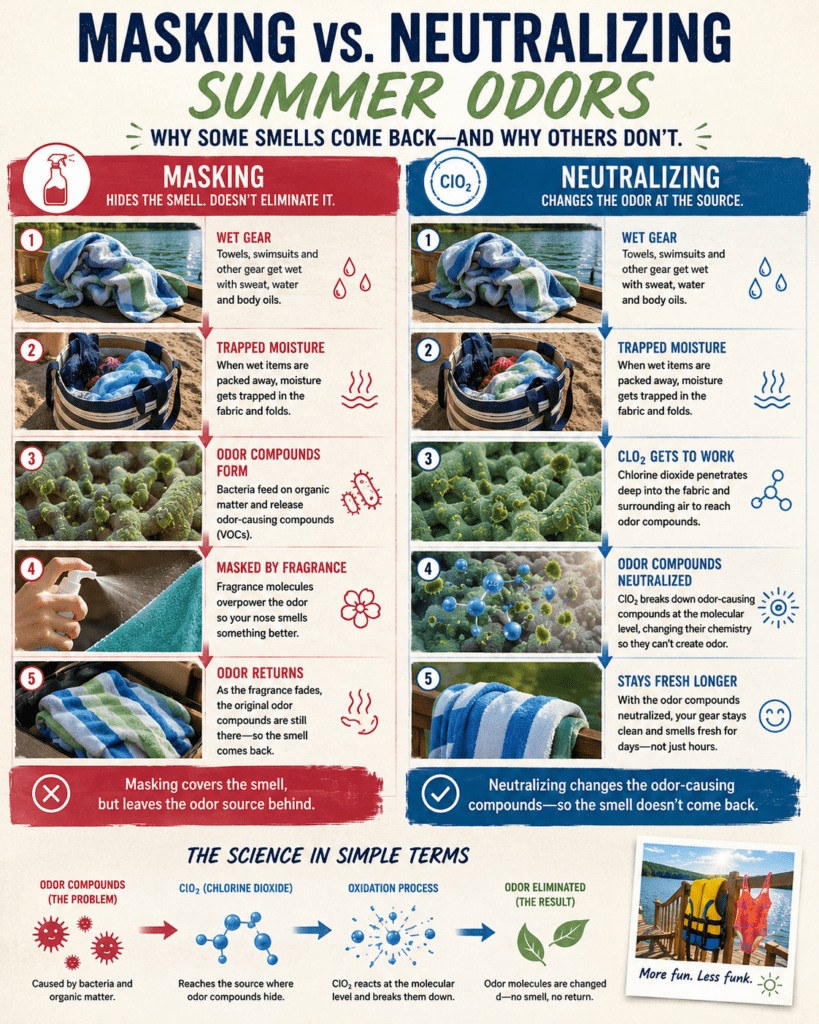
    infograph showing the science of masking odors vs actually removing odors on a molecular level.


    How This Helps Summer Activities

    Summer means:

    • Camping
    • Boating
    • Swimming
    • Fishing
    • Lake trips
    • RV travel
    • Outdoor recreation

    All of these activities create moisture.

    And moisture creates opportunities for odor development.

    The sooner odor compounds are addressed, the easier it becomes to prevent them from becoming deeply embedded within fabrics and porous materials.


    Wrapping Things Up…
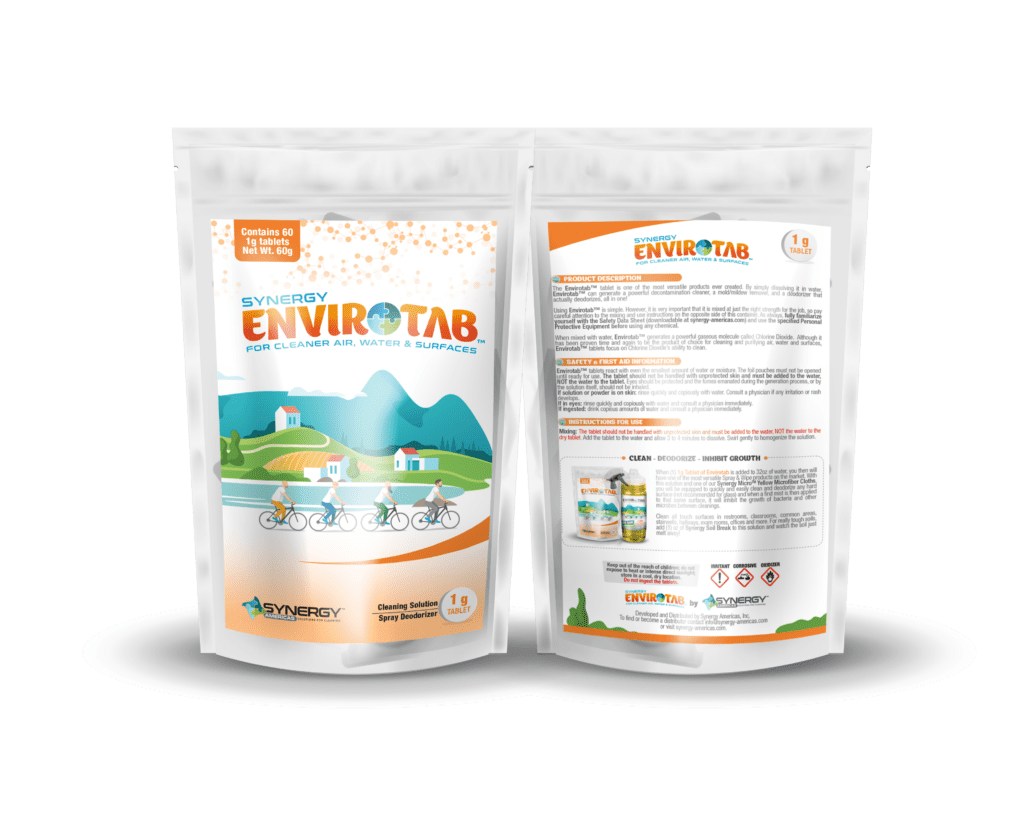
    1g Pouch

    Most summer odors begin long before anyone notices them.

    What starts as a damp towel, wet swimsuit, or moisture-filled life jacket quickly becomes a breeding ground for the chemical compounds responsible for unpleasant smells.

    While traditional fragrance products attempt to cover those odors temporarily, chlorine dioxide works differently.

    By helping neutralize odor-causing compounds at the molecular level, chlorine dioxide addresses the chemistry behind the smell itself rather than simply masking it.

    As summer activities increase and wet gear becomes part of everyday life, understanding the science behind odor formation can help explain why some odor-control approaches provide only temporary relief while others deliver more lasting results.

    Because the goal isn’t to make odors smell different.

    It’s to eliminate the compounds creating them in the first place.

    Also Read ☀️Why Odors Stay Trapped in Fabric, Foam, and Porous Materials

    Have More Questions?

    1. Why do wet towels develop a sour smell?

    Wet towels can develop a sour smell when moisture combines with sweat, skin oils, bacteria, and organic residue. As microorganisms break down these materials, they release odor-causing compounds that create unpleasant smells.


    2. What causes wet swimsuits to smell bad?

    Wet swimsuits often trap moisture, body oils, sunscreen residue, and bacteria. When left damp for extended periods, these materials can produce odor compounds that create stale or sour smells.
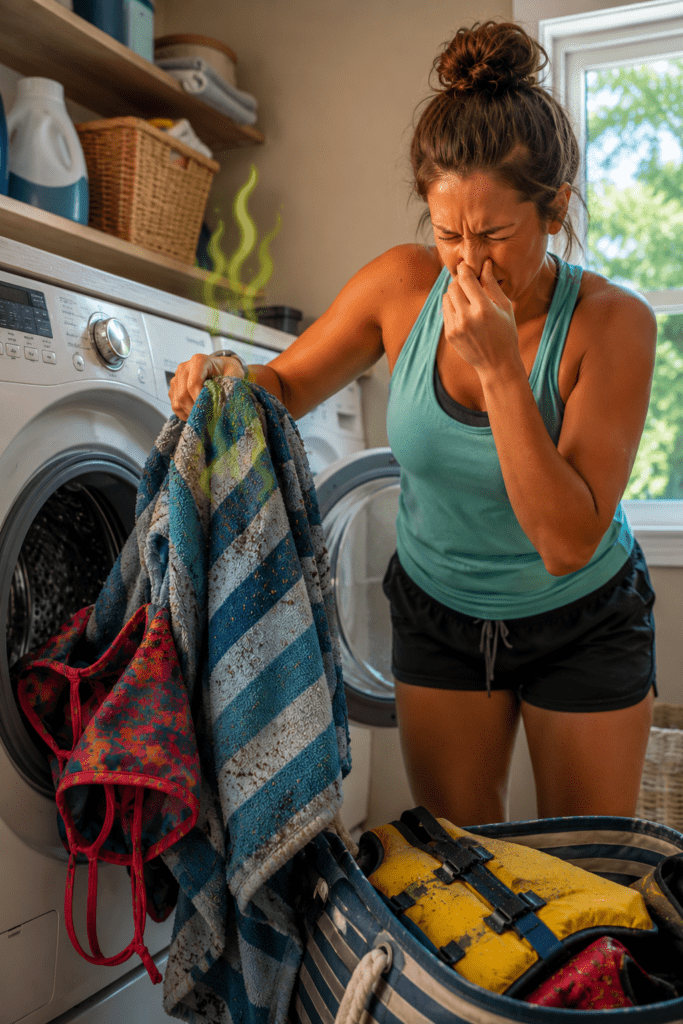

    a woman picking up a sour towel and putting it in the washing machine.

    3. Why do odors seem stronger during summer?

    Warm temperatures and humidity accelerate microbial activity and increase the release of volatile organic compounds (VOCs), making odors more noticeable during the summer months.


    4. What are VOCs and how do they create odors?

    Volatile Organic Compounds (VOCs) are molecules released by bacteria, mold, mildew, and decomposing organic matter. These compounds are often responsible for the odors people associate with damp fabrics, lockers, and wet gear.


    5. Why does odor return after washing?

    Odor can return when odor-causing compounds remain trapped inside porous materials or when moisture allows microbial activity to continue after washing.


    6. How is chlorine dioxide different from fragrance sprays?

    Fragrance sprays temporarily cover odors with stronger scents. Chlorine dioxide works differently by helping neutralize odor-causing compounds at the molecular level rather than simply masking them.


    7. Can chlorine dioxide help with locker room odors?

    Yes. Locker room odors are commonly caused by bacteria, sweat, and trapped moisture. Chlorine dioxide helps neutralize many of the compounds responsible for these persistent odors.


    8. Why do life jackets and water gear develop odors so quickly?

    Life jackets, wetsuits, and water gear often stay damp longer than expected. Trapped moisture combined with organic residue creates ideal conditions for odor-producing microorganisms.


    9. What types of summer gear commonly develop odor problems?

    Common items include:

    • Towels
    • Swimsuits
    • Life jackets
    • Water shoes
    • Gym bags
    • Camping gear
    • RV fabrics
    • Boat upholstery

    These materials frequently encounter moisture and limited airflow.


    10. How does chlorine dioxide neutralize odor compounds?

    Chlorine dioxide works through an oxidation process that helps alter odor-causing compounds at the molecular level. By changing the chemistry of these compounds, chlorine dioxide helps eliminate odors at their source rather than simply covering them up.

  • The Hidden Science of Mold and Odor Growth in Enclosed Spaces

    The Hidden Science of Mold and Odor Growth in Enclosed Spaces

    The Cooler Was Clean When You Put It Away… So What Happened?

    You spent the afternoon last fall doing everything right.

    The cooler was emptied, rinsed out, wiped down, and left open in the driveway to dry before you finally packed it away for the winter. The camping gear went into storage bins, the RV got covered, and another season of outdoor adventures came to an end.

    Fast forward to spring.

    The weather finally breaks, you start getting excited for that first camping trip of the year, and you pull the cooler back out of storage expecting it to be ready to go.

    Then you open the lid.

    Instead of fresh, clean air… you’re hit with that unmistakable sour, stale, musty smell. Maybe there are dark spots forming in the corners. Maybe the seals feel damp. Suddenly the cooler you cleaned so carefully months ago looks and smells like it sat forgotten in a swamp all winter.

    And that’s the frustrating part.

    Most campers, hikers, backpackers, and outdoor enthusiasts did clean their gear before putting it away. But odor and mold problems usually don’t happen overnight. They develop slowly inside enclosed spaces where trapped moisture, limited airflow, and microscopic organic buildup create the perfect environment for microbial growth.

    By the time you smell it in spring, the process has already been happening for months.

    And once it starts, surface cleaning alone usually isn’t enough to fully stop it.


    Why This Problem Gets Worse in Spring and Summer

    As temperatures rise and humidity increases, enclosed environments become even more active odor zones.

    Spring and early summer create:

    • Higher moisture levels
    • Faster microbial activity
    • More condensation in sealed spaces
    • Stronger odor compound release

    This is why people suddenly notice odor problems in:

    • Coolers
    • Storage bins
    • RVs
    • Boats
    • Seasonal equipment
    • Closets and garages

    👉 The problem may have started months ago—it just becomes noticeable now.


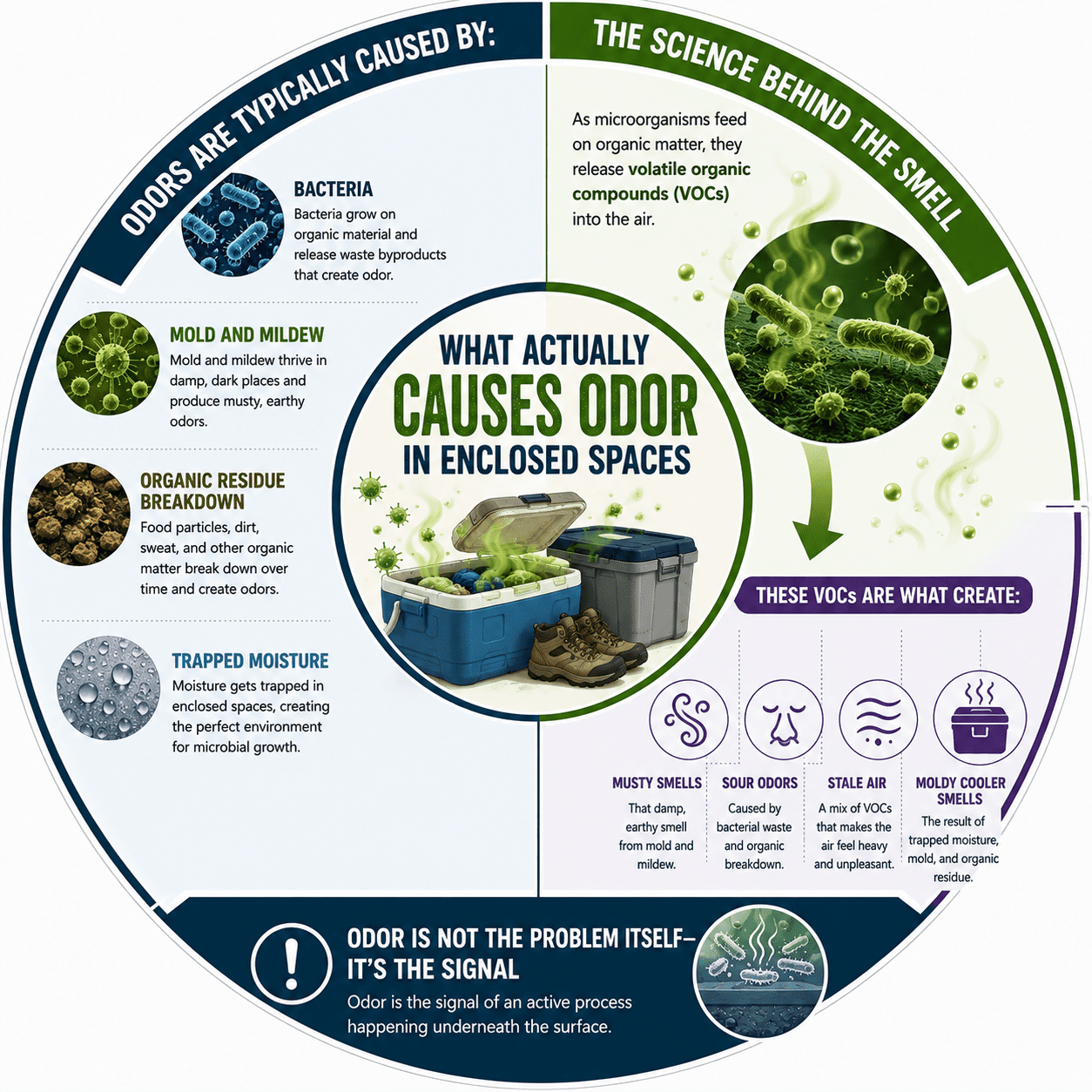
    circular infograph show what actually causes odors in closed in spaces.


    Why Enclosed Spaces Become Odor Traps

    Enclosed spaces are ideal environments for odor buildup because they combine:

    ✔ Limited airflow
    ✔ Trapped humidity
    ✔ Temperature fluctuation
    ✔ Porous materials
    ✔ Residual organic contamination

    Even small amounts of moisture can create a chain reaction over time.

    Also Read 📖Why Musty Odors Come Back Every Spring?


    Common Misconceptions About Odor Problems

    Let’s clear up a few common myths:

    ❌ “If I dry it out, the smell will disappear”
    → Odor compounds can remain deep inside materials

    ❌ “Bleach fixes mold smell”
    → Bleach may clean surfaces but doesn’t always neutralize embedded odor

    ❌ “Air fresheners solve the problem”
    → They only mask odor temporarily

    ❌ “If I can’t see mold, there’s no issue”
    → Odor-causing buildup often exists before visible growth appears


    Why Surface Cleaning Often Fails

    This is where many people get frustrated.

    They clean the surface…
    …and the smell still comes back.

    Why?

    Because:

    • Odor compounds remain trapped inside materials
    • Enclosed airspaces retain contamination
    • Sprays don’t penetrate deeply enough

    👉 If the source remains active, the odor cycle continues.


    Why Chlorine Dioxide Technology Works Differently

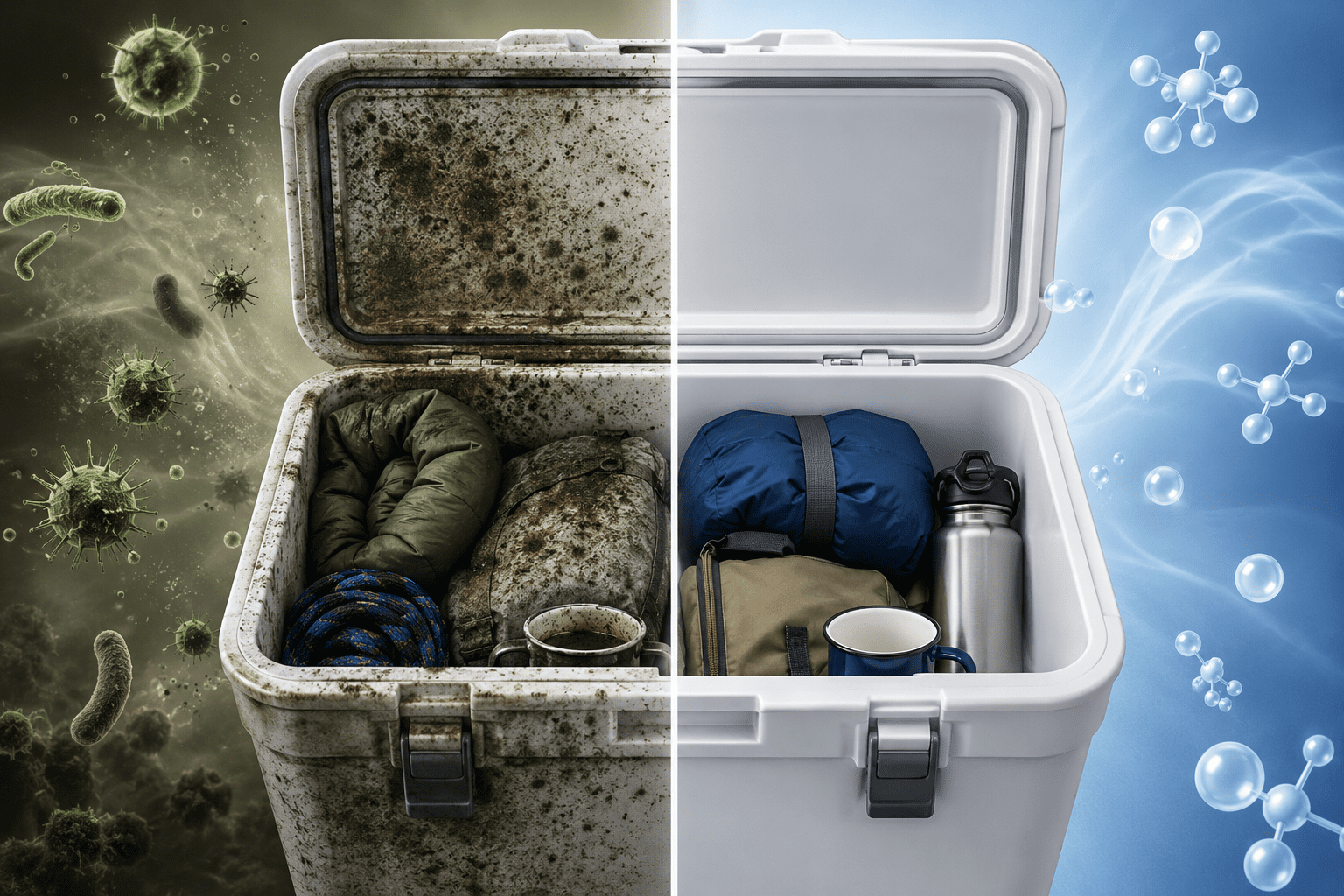
    image of a cooler, one side moldy from storage and the other clean and deodorized.

    Chlorine dioxide technology works through true odor neutralization, not masking.

    It:

    • Breaks down odor-causing compounds
    • Penetrates enclosed environments
    • Reaches into porous materials
    • Neutralizes odors at the molecular level

    Because chlorine dioxide can exist in a gas phase, it can travel into:

    • Fabric fibers
    • Foam materials
    • Hard-to-reach crevices
    • Sealed storage areas

    👉 This creates a more complete odor treatment process.

    👉https://freshtent.com/how-to-clean-a-moldy-cooler/


    Real-World Example

    A cooler put away after summer may seem “mostly dry.”

    But inside:

    • Small moisture pockets remain
    • Organic residue stays trapped
    • Enclosed conditions continue developing odor

    Months later, opening the lid releases the unmistakable smell of microbial buildup.

    For a practical step-by-step example of how this happens in camping coolers specifically, see:
    👉 How to clean a moldy cooler before your first trip


    Why This Matters More Than Ever

    People are becoming more aware of:

    • Indoor air quality
    • Environmental odor issues
    • Hidden contamination sources
    • Long-term storage conditions

    As awareness grows, odor treatment is shifting away from masking and toward:
    👉 Source-level neutralization


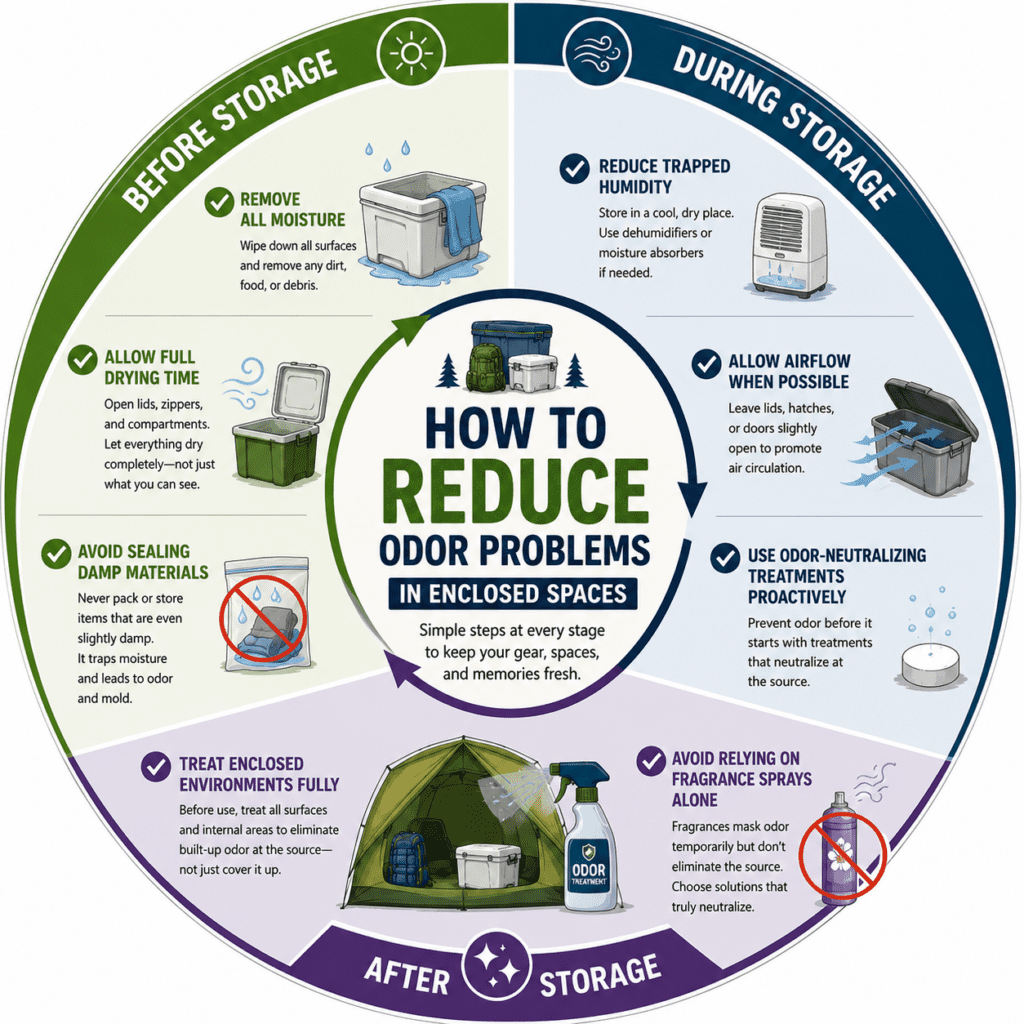
    infograph showing how to reduce mold in enclosed spaces.


    Conclusion 

    Odor problems in enclosed spaces don’t happen by accident.

    They develop through a predictable combination of moisture, microbial activity, and trapped air.

    And once odor compounds form, masking them isn’t enough.

    👉 Real odor control starts by neutralizing the source.


    ❓ FAQs (10)

    1. Why do enclosed spaces smell musty?

    Because trapped moisture and microbial activity create odor compounds over time.

    2. Why do coolers smell after storage?

    Residual moisture and organic buildup continue developing odor in enclosed conditions.

    3. What causes odor compounds?

    Bacteria, mildew, and organic breakdown release VOCs into the air.

    4. Why doesn’t surface cleaning remove odor?

    Because odor compounds remain embedded inside materials and enclosed airspaces.

    5. Can odor exist without visible mold?

    Yes, odor-causing microbial activity often starts before visible growth appears.

    6. Why does humidity make odors worse?

    Humidity accelerates microbial activity and VOC release.

    7. Do air fresheners eliminate odor?

    No, they only mask odor temporarily.

    8. Why are storage bins high-risk for odor?

    They trap moisture and limit airflow.

    9. How does chlorine dioxide neutralize odor?

    It breaks down odor-causing compounds at the molecular level.

    10. How do you prevent enclosed-space odor problems?

    Control moisture, improve drying, and neutralize odor sources before storage.

  • Why Musty Odors Come Back Every Spring?

    Why Musty Odors Come Back Every Spring?

    Every spring, the same thing happens.

    You open a storage bin, step into the garage, or pull out seasonal items—and that unmistakable musty smell hits you instantly.

    It’s not just unpleasant.
    It’s persistent.
    And no matter how many times you try to “freshen it up,” it keeps coming back.

    That’s because musty odors aren’t random—they’re predictable, seasonal, and driven by environmental conditions that reactivate odor at the source.


    What Actually Causes Musty Odors?

    Musty odors are not just “stale air.”

    They are the result of active microbial processes, primarily:

    • Bacteria
    • Mold and mildew
    • Organic residue breakdown

    These microorganisms feed on microscopic organic material and release volatile organic compounds (VOCs)—the compounds your nose detects as odor.

    👉 If you can smell it, something is actively producing it.


    Why Spring Triggers Odor Problems

    Spring creates the perfect conditions for odor to return:

    🌡️ Temperature Increase

    Warmer environments accelerate microbial activity

    💧 Rising Humidity

    Moisture fuels bacterial and mold growth

    🔒 Enclosed Storage Conditions

    Limited airflow traps odor compounds and allows buildup

    💤 Dormant-to-Active Shift

    Microorganisms that slowed during winter reactivate rapidly


    Where Musty Odors Commonly Develop

    This is why you notice odors in:

    • Storage bins and containers
    • Closets and basements
    • Vehicles and enclosed cabins
    • Upholstery and cushions
    • Seasonal gear and fabrics

    These environments combine moisture + limited airflow + porous materials, creating ideal conditions for odor formation.


    Why Most Odor Solutions Fail

    Most people try to fix the problem with:

    • Air fresheners
    • Fragrance sprays
    • Surface cleaners

    These approaches only address the symptom, not the source.

    ❌ They mask odor

    ❌ They don’t penetrate materials

    ❌ They don’t neutralize odor-causing compounds

    That’s why the smell returns—often stronger than before.

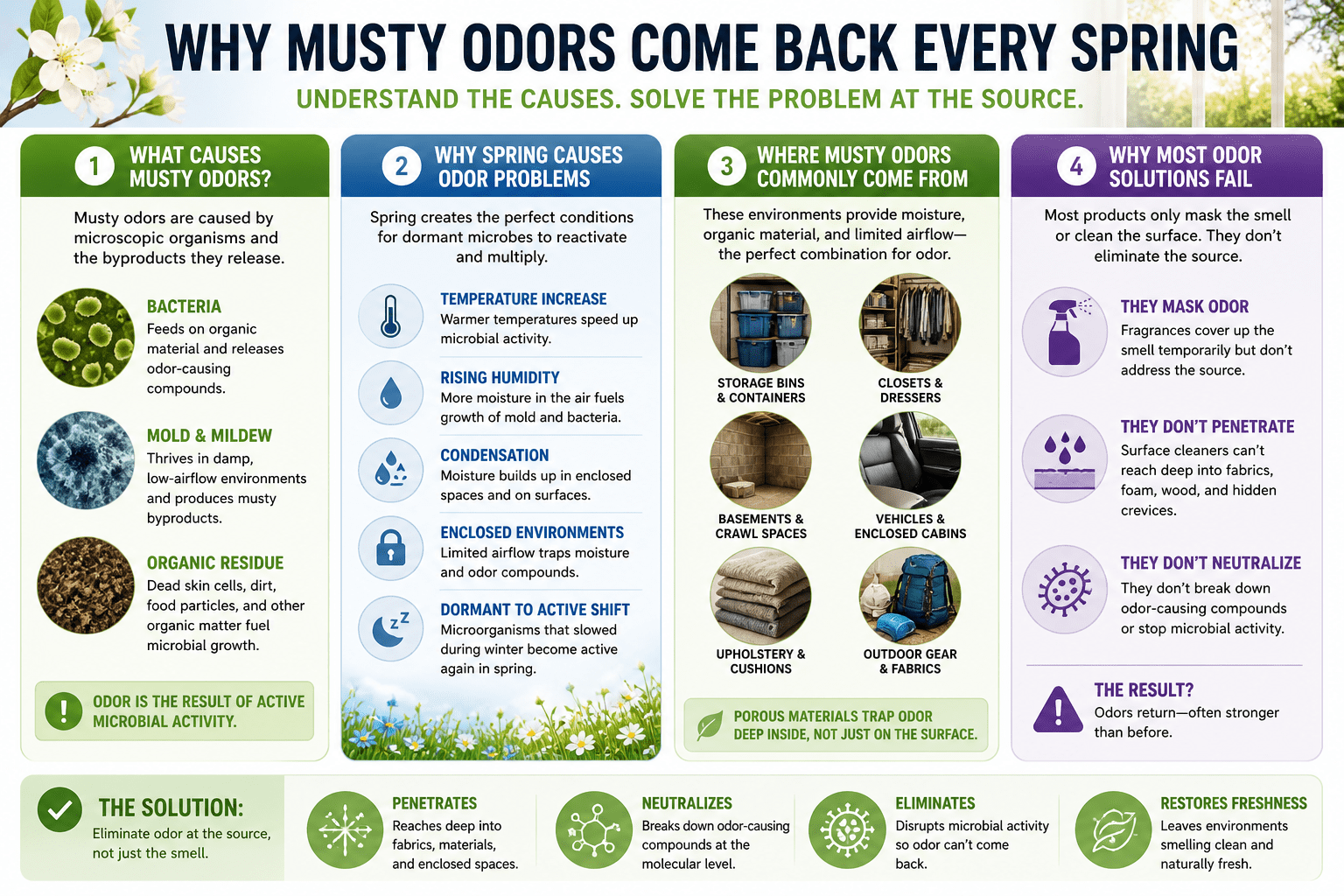
    infograph exolaining what causes musty odors and why they are worse in the spring.


    Why Odor Means Active Contamination

    This is where most people underestimate the problem.

    Odor is not just a nuisance—it’s a signal.

    It indicates:

    • Ongoing microbial activity
    • Active breakdown of organic material
    • Continued release of odor compounds

    👉 In other words, the problem isn’t gone—it’s growing.


    What It Takes to Actually Eliminate Odor

    To solve musty odors at the source, a solution must:

    ✔ Reach into porous materials (fabric, foam, wood)
    ✔ Neutralize odor-causing compounds at the molecular level
    ✔ Penetrate enclosed and hard-to-reach areas
    ✔ Address both air and surface contamination

    This is where chlorine dioxide (ClO₂) technology stands apart.

    Also Read 📖The Science of Safe Air | How ClO₂ Purifies Without Harm


    How Chlorine Dioxide Technology Works

    Chlorine dioxide works through a true neutralization process, not masking.

    It:

    • Breaks down odor-causing compounds
    • Disrupts microbial activity responsible for odor production
    • Penetrates areas that sprays and liquids cannot reach

    Because it can exist in a gas form, it moves through:

    • Airspace
    • Fabric fibers
    • Hidden crevices
    • Enclosed environments

    👉 This allows for whole-environment odor treatment, not just surface cleaning.

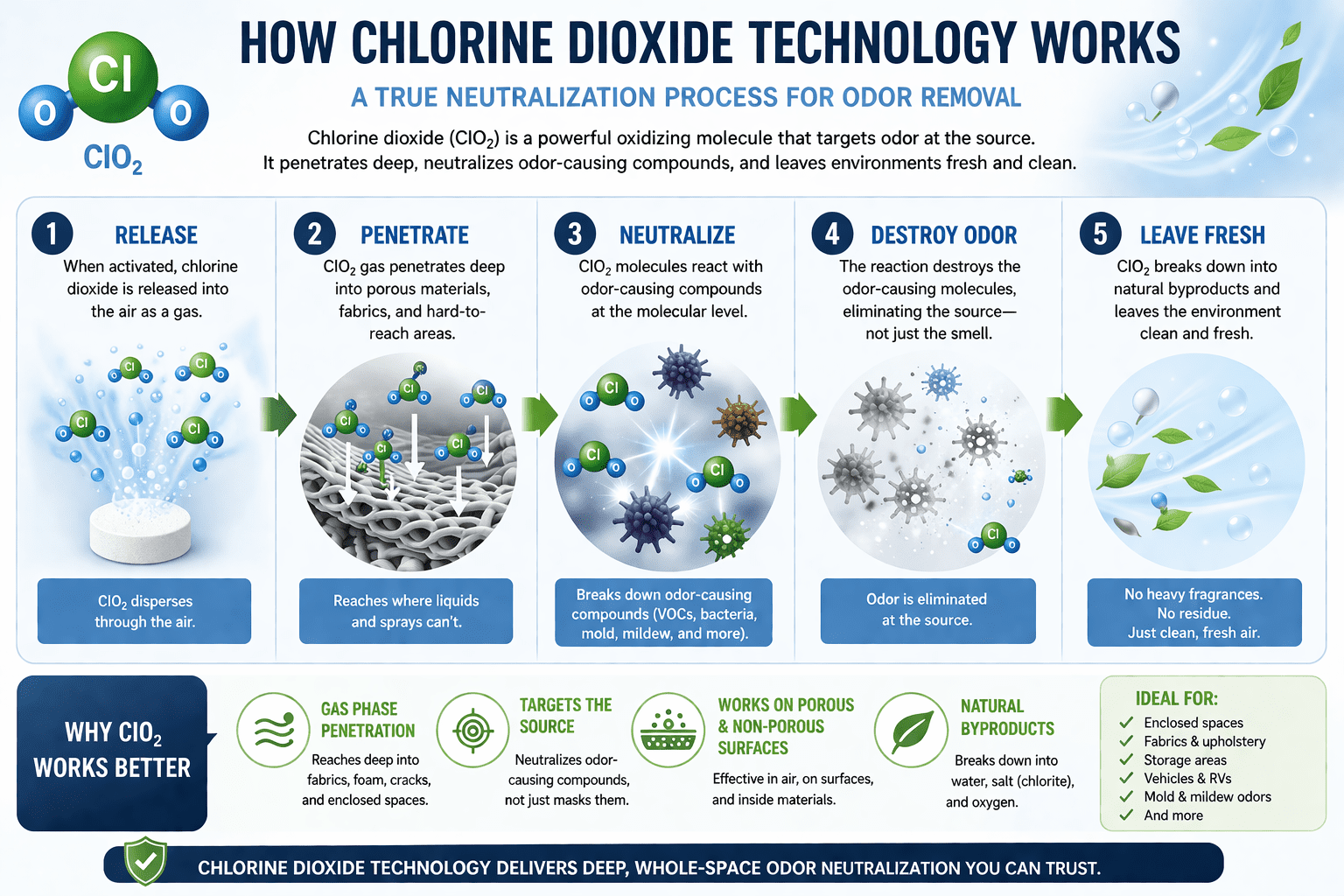
    Infographic explaining chlorine dioxide odor removal process, including gas penetration, molecular neutralization, and elimination of odor-causing bacteria and compounds


    Real-World Application Example

    Consider a storage bin sealed over winter.

    Even if items were “clean,” small amounts of moisture and organic residue remain.

    Over time:

    • Microbial activity continues slowly
    • Odor compounds build up
    • Enclosed space traps those compounds

    When spring arrives, conditions accelerate the process—and the odor becomes noticeable immediately.

    For a real-world example of how this affects outdoor gear specifically, see how this applies in camping environments here:


    👉 How to remove musty smell from camping gear (FreshTent Solutions)

    Why Does Camping Gear Smell Musty Every Year?


    How to Prevent Musty Odors from Returning

    Prevention is just as important as treatment.

    Before Storage:

    • Ensure items are completely dry
    • Avoid sealing in moisture
    • Treat enclosed environments before long-term storage

    After Storage:

    • Use a full odor-neutralizing treatment
    • Allow time for deep penetration
    • Avoid relying on fragrance-based solutions

    Why This Matters More Than Ever

    As awareness around indoor air quality and environmental conditions continues to grow, people are recognizing that odor is not just cosmetic—it’s environmental.

    Persistent odors can affect:

    • Comfort
    • Perceived cleanliness
    • Air quality
    • Long-term material condition

    👉 Eliminating odor at the source is no longer optional—it’s essential.

    Also read 📖Ways to Prevent Persistent Odors From Returning for Good In 2026


    Conclusion 

    Musty odors don’t just “come back”—they were never fully eliminated.

    They persist because the source remains active beneath the surface.

    If you want to break the cycle, the solution isn’t stronger fragrance—it’s true odor neutralization at the molecular level.

    👉 If you can smell it, it’s still there.
    👉 And if it’s still there, it can be eliminated the right way.


    ❓ FAQs

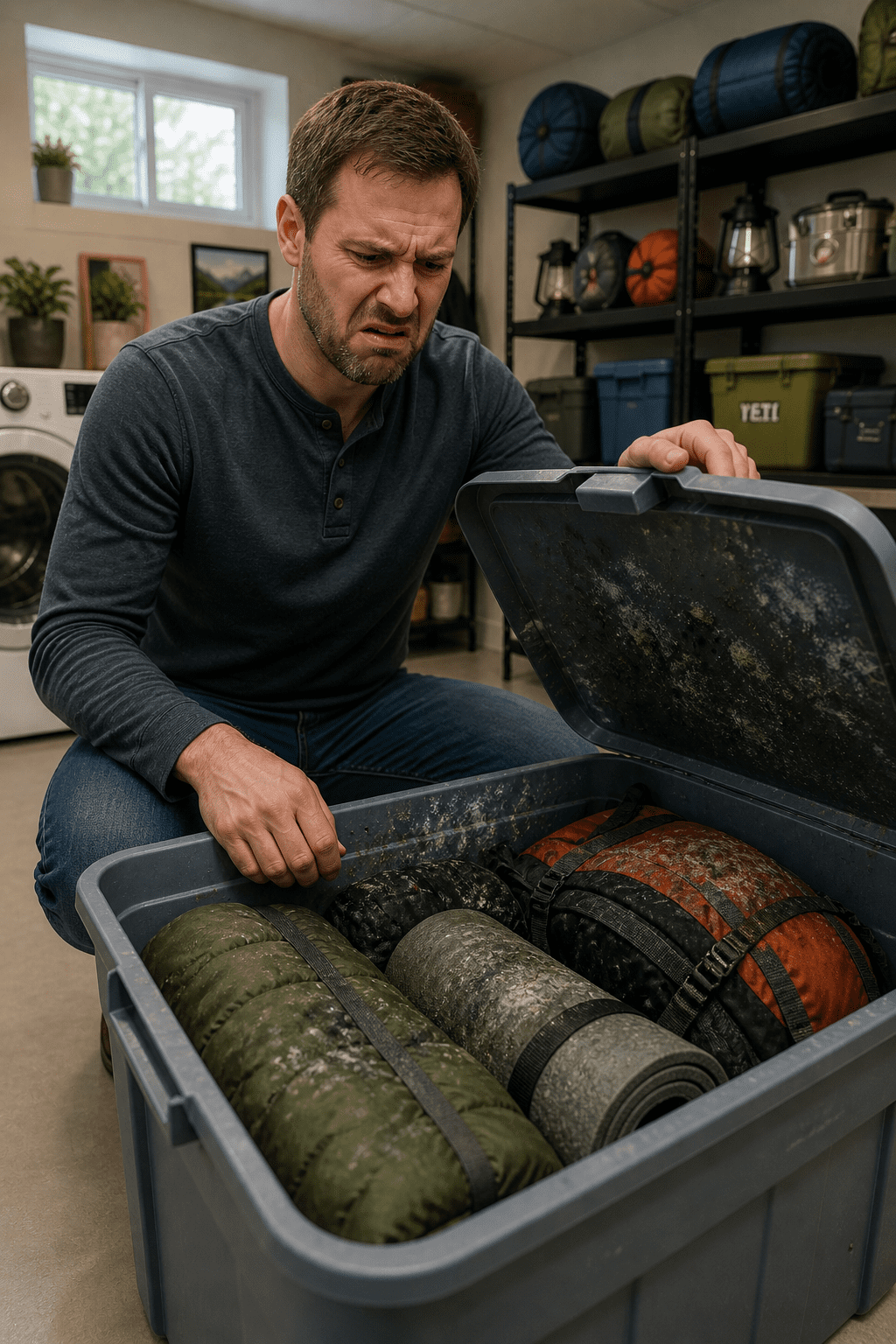
    Man opening a storage tote of camping gear and reacting to moldy, musty equipment in a basement storage area

    1. Why do things smell musty after winter?

    Because moisture and dormant bacteria reactivate in warmer, humid spring conditions.

    2. What causes musty odors?

    Microbial activity such as bacteria and mildew breaking down organic material.

    3. Why do odors come back after cleaning?

    Because most cleaning methods do not eliminate the source of odor.

    4. Is musty smell a sign of contamination?

    Yes, it indicates active odor-producing processes.

    5. Can odors live in fabric?

    Yes, porous materials trap odor-causing compounds deeply.

    6. Why don’t air fresheners work long-term?

    They mask odor instead of neutralizing it.

    7. What eliminates odor at the source?

    Treatments that break down odor-causing compounds at the molecular level.

    8. Does humidity make odors worse?

    Yes, moisture accelerates microbial activity.

    9. Can enclosed spaces trap odor?

    Yes, lack of airflow allows buildup of odor compounds.

    10. How do you prevent musty smells?

    Control moisture, treat enclosed areas, and eliminate odor sources before storage.

  • How to Prevent Odors from Returning: HVAC & Indoor Air Quality Solutions

    How to Prevent Odors from Returning: HVAC & Indoor Air Quality Solutions

    The Real Reason Odors Keep Coming Back

    You clean.
    You open windows.
    You use sprays or candles.

    And yet… the smell returns.

    That’s not a cleaning problem.
    👉 It’s a system problem.

    Most recurring odors don’t live on surfaces—they live in:

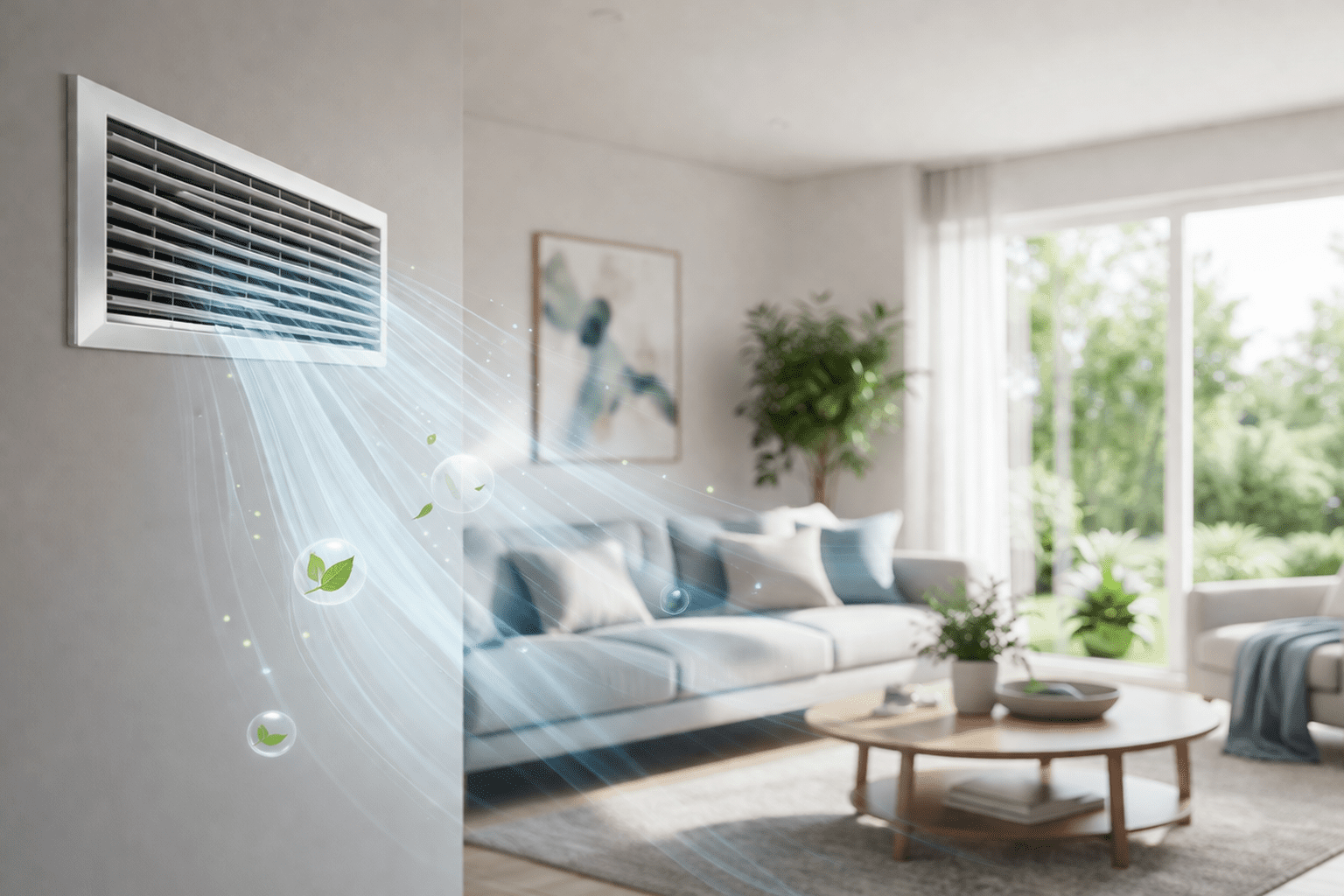
    • Air circulation pathways
    • HVAC systems
    • Porous materials

    Which means every time air moves…
    👉 the odor comes back with it.


    Why “Fresh Air” Isn’t a Long-Term Solution

    Opening windows feels like it works—and temporarily, it does.

    But here’s the catch:

    • It dilutes odors
    • It doesn’t eliminate them
    • It doesn’t address the source

    Once the windows close…
    👉 the environment resets to where it was.

    Also Read Winter IAQ Solutions: Stop Wood Smoke, Dry Air & Stale Indoor Odors


    Where Odors Actually Hide

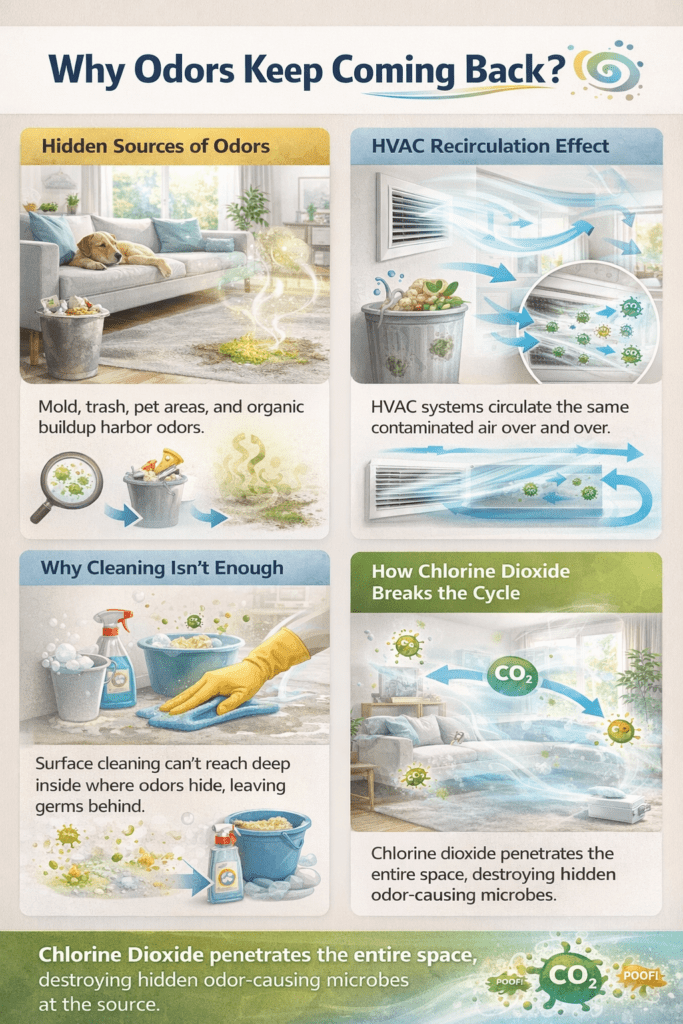
    infograph showing different areas that are missed when just surface cleaning is applied.

    To stop odors, you have to understand where they live.

    Primary Hidden Sources:

    • HVAC ductwork
    • Coils and condensation areas
    • Filters and airflow systems
    • Carpets and upholstery
    • Subflooring and wall materials

    These areas:
    ✔ Trap odor-causing compounds
    ✔ Protect them from surface cleaning
    ✔ Reintroduce them into the air continuously


    Why Surface Cleaning Alone Fails

    Let’s call it out clearly:

    Surface Cleaning:

    ✔ Removes visible dirt
    ✔ Improves appearance

    But it does NOT:

    ❌ Reach inside HVAC systems
    ❌ Eliminate airborne odor molecules
    ❌ Treat embedded contamination

    👉 That’s why odors return—even in “clean” spaces.


    The HVAC Connection: Your Hidden Odor Distributor


    Your HVAC system doesn’t just move air—it moves everything in it.

    If odor exists inside the system:

    • It spreads room to room
    • It recirculates continuously
    • It becomes part of the environment

    Common signs:

    • Smell when AC or heat turns on
    • Odors stronger in certain rooms
    • “Clean house” that still smells off

    The Shift: From Cleaning to Environmental Control

    If you want odors gone for good,
    you need to stop thinking in terms of cleaning…

    …and start thinking in terms of environmental treatment.


    How Chlorine Dioxide Prevents Odors from Returning

    Chlorine dioxide (ClO₂) works differently.

    It doesn’t:

    • Cover odors
    • Add fragrance
    • Rely on repeated application

    Instead, it:

    ✔ Targets Odor Molecules

    Breaks them down at a chemical level


    ✔ Moves Through the Entire Air System

    Reaches:

    • Ductwork
    • Coils
    • Hidden airflow zones

    ✔ Treats the Source

    Not just where you smell it—but where it originates


    Where It Makes the Biggest Difference

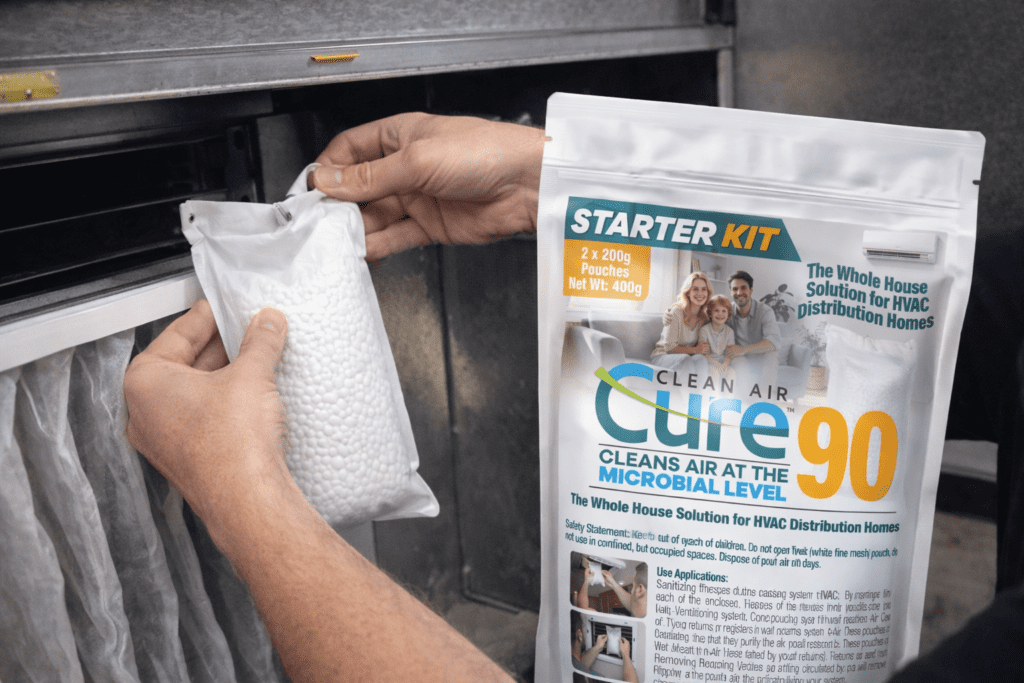
    1. HVAC Systems

    Stops odor recirculation at the source

    A new pouch is inserted into a HVAC unit


    2. Moisture-Prone Areas

    Prevents odor buildup in:

    • Basements
    • Bathrooms
    • Utility spaces

    3. Whole-Home Airspace

    Treats:

    • Air
    • Surfaces
    • Hidden zones

    4. Recurring Odor Environments

    Ideal for:

    • Pet-related odors
    • Smoke exposure
    • Rental turnovers
    • Stale or musty homes

    Also Read Will Professional Carpet Cleaning Remove Pet Odors?


    Air quality improvement strategies infographic


    Use-Case Scenario

    A homeowner:

    • Cleans regularly
    • Uses air purifiers
    • Opens windows

    But still notices:
    👉 A stale, musty smell when the system runs

    The issue?

    Not the room.
    👉 The HVAC system.

    After a chlorine dioxide treatment:

    • Odor source is neutralized
    • Air feels clean—not fragranced
    • The problem stops returning

    Health, Comfort, and Perception

    Always remember that CLO2 is highly affective if use properly.

    Air quality affects more than smell.

    It impacts:

    • Comfort
    • Breathing experience
    • Perception of cleanliness
    • Overall indoor environment quality

    When air is clean:
    ✔ Spaces feel better
    ✔ People stay longer
    ✔ Environments feel healthier

    Also Read Ways to Prevent Persistent Odors From Returning for Good In 2026


    Why This Matters More Today

    Modern environments are:

    • More sealed
    • More energy-efficient
    • Less ventilated

    Which means:
    👉 Odors and contaminants stay longer

    At the same time:

    • Expectations for air quality are rising
    • Occupants notice air instantly
    • First impressions matter more than ever

    Final Thoughts: Stop the Cycle

    If odors keep coming back,
    it’s not because you’re not cleaning enough.

    👉 It’s because the source hasn’t been eliminated.

    Chlorine dioxide offers a way to:

    • Treat the HVAC system
    • Eliminate odor at the molecular level
    • Prevent the cycle from repeating

    Call to Action

    If you’re ready to stop managing odors—and start eliminating them at the source—explore how chlorine dioxide tablets can help restore your indoor air environment.

    (FAQs)


    1. Why do odors keep coming back after cleaning?

    Because the source of the odor often remains in HVAC systems or embedded materials, continuing to circulate through the air.


    2. How can I stop odors from returning in my home?

    By addressing the source of the odor—especially within air systems—rather than relying only on surface cleaning or fragrance-based solutions.


    3. Can HVAC systems cause odors in a home?

    Yes, HVAC systems can circulate odors throughout a space if buildup exists within ductwork, coils, or airflow pathways.


    4. Does chlorine dioxide eliminate odors permanently?

    It neutralizes odor-causing molecules at the source, which can provide long-lasting results depending on the environment.


    5. Is opening windows enough to remove odors?

    No, it only temporarily dilutes odors and does not eliminate the source.


    6. Can chlorine dioxide reach hidden odor sources?

    Yes, as a gas, it disperses through air systems and reaches areas that are difficult to access with traditional cleaning.


    7. What causes musty smells in homes?

    Often moisture buildup combined with airflow systems that distribute odor throughout the space.


    8. Does this replace regular cleaning?

    No, it complements cleaning by addressing deeper environmental odor sources.


    9. How long does it take to eliminate odors?

    Results vary, but noticeable improvements can occur within hours to days.


    10. What makes chlorine dioxide different from air fresheners?

    It eliminates odor at the molecular level rather than masking it with fragrance.

  • Ways to Prevent Persistent Odors From Returning for Good In 2026

    Ways to Prevent Persistent Odors From Returning for Good In 2026

    Making Sure Odors Stay Away In 2026

    Your home is your sanctuary. It should smell clean, calm, and unmistakably healthy.
    Yet nothing breaks that illusion faster than conquering an odor—only to have it creep back days later like it never got the memo.

    Here’s the truth that still holds in 2026:

    The presence of an odor is the presence of a problem.

    Odor behaves like the check engine light of your home. You can ignore it. You can cover it up. But it will not turn off until the underlying issue is addressed. And just like your car, homes now require preventative maintenance, not emergency reactions.

    The good news? With modern IAQ (Indoor Air Quality) strategies, advanced chlorine dioxide technology, and smarter household habits, odors don’t have to be recurring guests.

    Below are the 2026-aligned, science-supported ways to stop odors from returning—permanently.


    1. Prioritize Continuous Air Circulation, Not Just “Fresh Scents”

    Fresh air is not a luxury—it’s a necessity for odor prevention.

    Opening windows and doors regularly allows stale, odor-laden air to escape and brings in oxygen-rich outdoor air. This simple habit dramatically reduces the concentration of airborne odor-causing compounds.

    For days when outdoor airflow isn’t practical, fans and modern air circulation systems keep air moving so odor molecules don’t stagnate and settle into fabrics, walls, and soft surfaces.

    Scented candles and air fresheners may provide temporary relief, but in 2026 they are widely recognized as masking agents—not solutions. Overuse can actually worsen indoor air quality by adding VOCs (volatile organic compounds) into the environment.

    Rule of thumb:
    If something needs to be covered up, it hasn’t been resolved.

    Also Read 👉🏼Winter IAQ Solutions: Stop Wood Smoke, Dry Air & Stale Indoor Odors

    a woman opening curtains with a smiling face.


    2. Build Daily Cleaning Into Your Odor-Prevention Strategy

    Odors don’t start as smells.
    They start as bacteria, mold spores, and organic residue.

    Daily cleaning routines—wiping surfaces, removing food debris, managing laundry—interrupt odor formation before it begins. Consistency matters more than intensity.

    Modern chlorine dioxide (ClO₂) cleaning solutions are particularly effective because they neutralize odor-causing microbes at the molecular level instead of simply disinfecting surfaces.

    Using microfiber cloths enhances this process by reaching microscopic surface imperfections where bacteria and mold love to hide.

    In 2026, the goal is no longer “clean enough to look good.”
    It’s clean enough to disrupt microbial ecosystems.


    3. Control Moisture to Eliminate Mold and Mildew Odors at the Source

    Moisture is the silent enabler of persistent odor problems.

    Mold and mildew thrive in damp environments—bathrooms, kitchens, basements, crawl spaces—and once established, they continuously emit musty odors even after visible growth is removed.

    Dehumidifiers help maintain optimal humidity levels, while prompt repairs of leaks, drips, and condensation prevent moisture accumulation in the first place.

    Targeted chlorine dioxide mold-remediation products go a step further by destroying mold spores and preventing regrowth, rather than simply cleaning visible residue.

    Dry air is hostile air—to mold.

    Also Read 👉🏼Mold Remediation in Crawl Spaces | Identify, Remediate & Protect with ClO₂


    4. Manage Pet Hygiene as an IAQ Issue, Not a Cosmetic One

    Pet odors are not “just part of having animals.”
    They are biological odors caused by bacteria, dander, oils, and moisture.

    Regular pet bathing, brushing, and bedding sanitation dramatically reduce odor load. In controlled concentrations, chlorine dioxide solutions (such as 100 ppm formulations) are safe and effective for neutralizing pet-related odors without masking or irritation.

    Cleaning pet bedding and toys with fragrance-free, biodegradable detergents prevents odor buildup while protecting sensitive respiratory systems—both human and animal.

    In 2026, pet-friendly homes are defined by odor neutrality, not perfume.


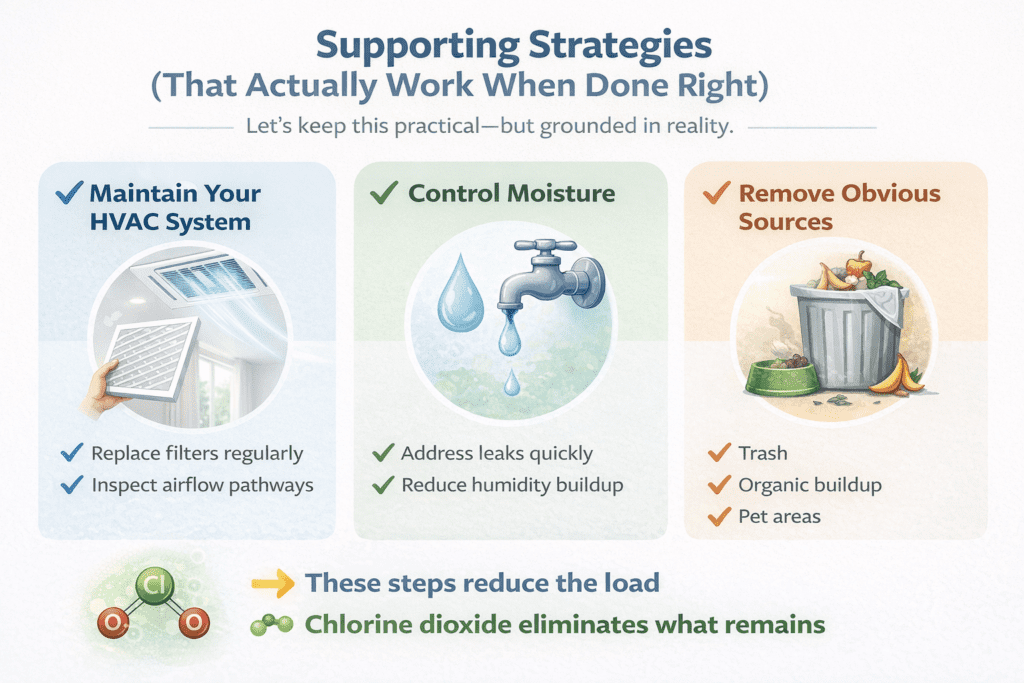
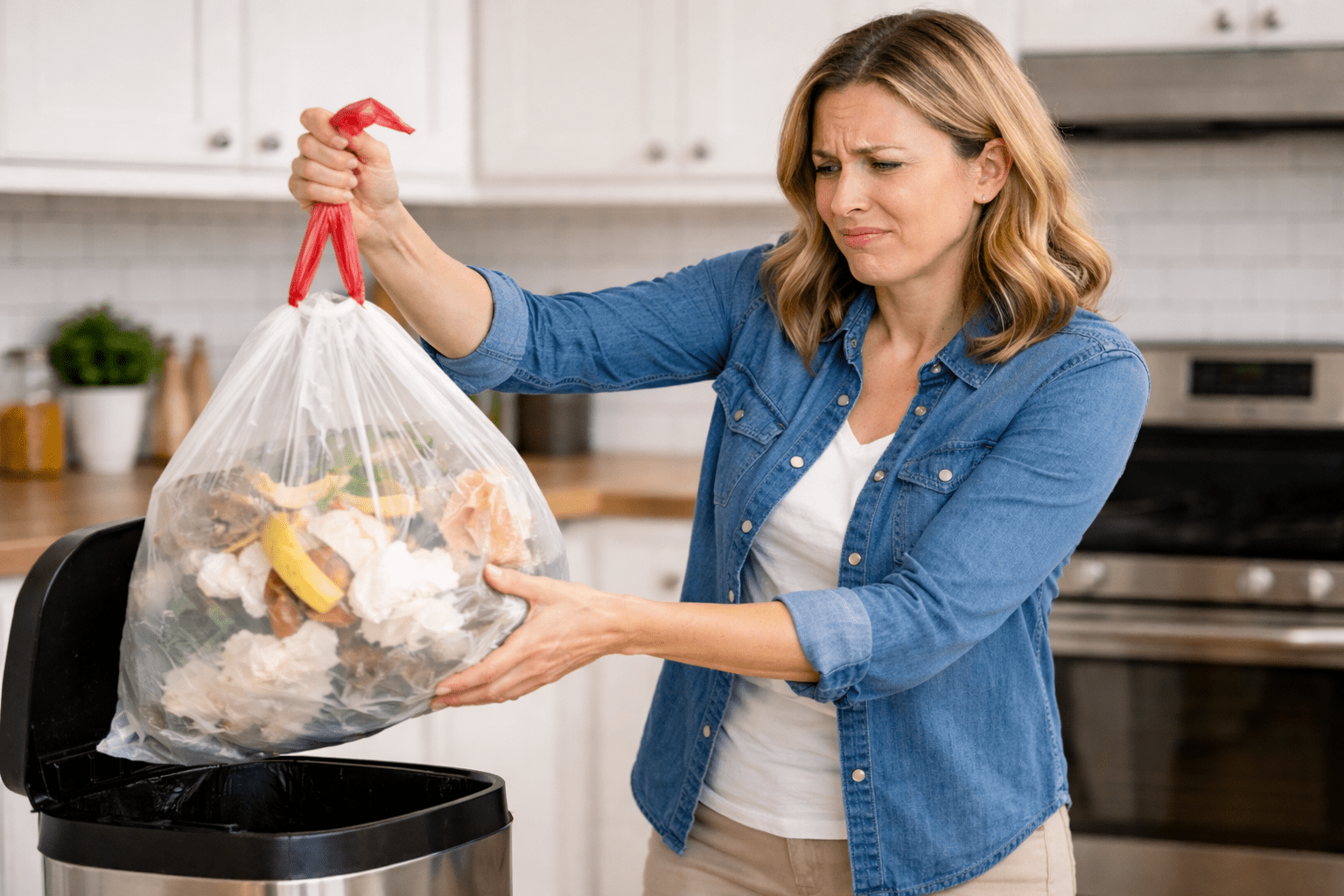
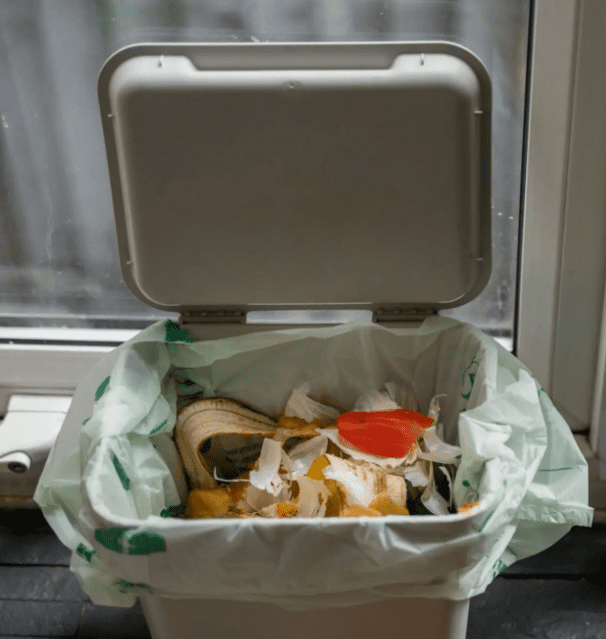
    5. Dispose of Garbage Strategically—Not Passively

    Using CLO2 on your trash can can not only kill the odor but also break down the biome that is creating the odor.

    Trash odors escalate quickly because decomposing organic matter produces sulfur compounds and microbial gases.

    Best practices include:

    • Prompt disposal after meals
    • Sealing trash bags before removal
    • Routine cleaning of trash cans and surrounding areas

    Chlorine dioxide tablets are especially effective here, as they eliminate odor-causing microbes rather than layering fragrance on top of decay.

    Odors ignored in waste areas rarely stay contained.


    6. Designate and Maintain Smoking Areas With Intentional Remediation

    Smoke and nicotine residues are notoriously persistent. They bond to walls, fabrics, ceilings, and ventilation systems.

    Designated smoking areas reduce cross-contamination, but only if those areas are actively cleaned and remediated. Chlorine dioxide products are uniquely effective at breaking down nicotine residues and smoke-related soils at the molecular level.

    In 2026, smoke odor management is about containment, neutralization, and prevention—not ventilation alone.

    Also Read 👉🏼Why Does My Leather Sofa Smell & How Do I Get Rid of It for Good?


    7. Use ClO₂ Tablets and Granules in High-Risk Odor Zones

    Certain areas act as odor reservoirs: closets, basements, storage rooms, trash areas, and utility spaces.

    Dissolving a 1-gram Envirotab tablet in water and allowing it to off-gas safely creates a powerful, residue-free deodorization environment that works without introducing new fragrances.

    Chlorine dioxide is effective precisely because it does not smell like a “cover-up.”
    It eliminates the problem rather than announcing its presence.


    8. Improve Whole-Home Air Quality With Modern Air Purification

    Air purifiers are no longer optional accessories—they are foundational IAQ tools.

    High-quality systems remove airborne particulates, allergens, microbial fragments, and odor molecules before they settle. Granule and powder deodorization technologies add another layer by absorbing persistent odors in larger spaces.

    Clean air smells like…nothing.
    That’s the goal.


    9. Schedule Periodic Inspections to Catch Hidden Odor Sources Early

    Some odor problems are invisible.

    Leaks behind walls, microbial growth in HVAC systems, or organic buildup in rarely accessed spaces can quietly sabotage your efforts. Periodic professional inspections—often using tools like UV or black-light detection—identify problems before odors become entrenched.

    Addressing issues early is always easier, healthier, and less expensive than reactive remediation.


    Take Back Your Home—And Keep It That Way

    A consistently fresh-smelling home isn’t achieved through one-time fixes.
    It’s built through systems, habits, and preventative strategies that work together to maintain healthy indoor air.

    In 2026, odor control is no longer about fighting smells.
    It’s about engineering an environment where odors can’t survive.

    When the source is addressed, the smell doesn’t return—and your sanctuary stays exactly that.

    FAQS

    1. Why do household odors keep coming back after cleaning?
    Household odors return when the underlying source—such as bacteria, mold, moisture, or trapped organic residue—was not fully eliminated. Cleaning alone removes surface soil but may not neutralize odor-causing microbes.

    2. What is the most effective way to prevent persistent odors?
    The most effective approach is source control combined with airflow management, moisture regulation, and microbial neutralization using technologies like chlorine dioxide.

    3. Are air fresheners effective for long-term odor control?
    No. Air fresheners only mask odors temporarily and can add VOCs to indoor air. Long-term odor control requires eliminating the odor source rather than covering it.

    4. How does moisture contribute to recurring odors?
    Excess moisture allows mold and bacteria to grow, which continuously release odor-causing compounds. Controlling humidity prevents these organisms from thriving.

    5. Can chlorine dioxide permanently remove odors?
    Yes. Chlorine dioxide neutralizes odor-causing microbes and organic compounds at the molecular level, preventing odors from returning when used correctly.

    6. Are pet odors preventable without strong fragrances?
    Yes. Regular pet hygiene, bedding sanitation, and microbial odor control eliminate pet odors without relying on perfumes or masking agents.

    7. How often should air purifiers be used to control odors?
    Air purifiers should run daily, especially in high-traffic or enclosed spaces, to continuously remove airborne odor particles before they settle.

    8. Why do trash areas smell even after the garbage is removed?
    Odors linger because bacteria and residue remain on trash cans and surrounding surfaces. These areas require cleaning and microbial neutralization, not just emptying.

    9. Do smoking odors require professional treatment?
    Often, yes. Smoke residues bond to surfaces and require targeted remediation using advanced deodorization methods such as chlorine dioxide for full removal.

    10. When should a professional odor inspection be considered?
    Professional inspections are recommended when odors persist despite cleaning, as hidden sources like leaks, HVAC contamination, or microbial growth may be present.


  • Benefits Of Using Chlorine Dioxide Tablets For Home Environment

    Benefits Of Using Chlorine Dioxide Tablets For Home Environment

    Can Chlorine Dioxide Tablets Transform Your Home Environment in 2026?

    Answer: When used properly and in the right concentrations, chlorine dioxide (ClO₂) tablets can significantly improve home sanitation, disinfect water, neutralize odors, and inhibit mold growth — all while minimizing harmful residues and environmental impact compared to many traditional cleaners. clo2tablets.com+1


    Why Chlorine Dioxide Matters in Today’s Clean­ing Landscape

    As cleaning science advances, homeowners are demanding solutions that balance powerful microbial control with environmental and occupant safety. Chlorine dioxide (ClO₂) is not just another “bleach alternative.” It’s a selective oxidizing agent — meaning it disrupts microbial cells through oxidation rather than by simple chlorination — and leaves minimal residues on treated surfaces and in water. clo2tablets.com


    What Chlorine Dioxide Tablets Are and How They Work

    Chlorine dioxide tablets are solid forms of a chemical precursor that, once dissolved in water, generate ClO₂. That gas dissolves into a disinfecting solution that:

    • Oxidizes and destroys bacteria, viruses, fungi, and spores.
    • Neutralizes volatile organic compounds (VOCs) and odors instead of just masking them.
    • Breaks down without forming hazardous chlorinated by-products common to bleach. clo2tablets.com

    This mechanism makes ClO₂ highly effective across multiple sanitation tasks while remaining gentle on materials and air quality when used as directed. clo2tablets.com


    Realistic, Science-Backed Benefits for Home Environments

    1. Broad-Spectrum Water Disinfection
    Chlorine dioxide is used worldwide in municipal water treatment due to its ability to kill a wide range of waterborne pathogens, including bacteria, viruses, and protozoa — often more reliably than simple chlorine alone.
    In homes with private wells or during travel/camping, tablets allow you to purify water on demand, making it safe to drink and use without heavy chemical odor or taste.

    2. Effective Odor Neutralization
    Unlike many fragrances or masking sprays, ClO₂ breaks down odor molecules at the chemical level. This means foul smells from trash bins, pet areas, or humidity don’t just disappear temporarily — they’re neutralized. clo2tablets.com

    3. Mold & Mildew Control
    Mold thrives in humidity and porous materials. ClO₂’s oxidative action reaches beyond surface dirt into spore structures, helping suppress mold growth and reducing associated allergens when used correctly. clo2tablets.com

    4. Versatility Across Cleaning Tasks
    From surface sanitation in kitchens and bathrooms to neutralizing air contaminants and deodorizing fabrics, ClO₂ tablets can tackle diverse home needs with one chemistry rather than dozens of different products. clo2tablets.com

    5. Cost-Effective & Eco-Friendly
    Tablets are lightweight, easy to store, and require minimal packaging. Because ClO₂ dissolves cleanly and degrades into salt and water after use — unlike many harsher disinfectants — its environmental footprint is smaller when responsibly applied. clo2tablets.com


    The best trend is to use natural cleaning products. Include ClO2 among that list.

    Safe Use: What Every Homeowner Should Know

    Chlorine dioxide is a powerful antimicrobial, but that power comes with responsibility:

    • Always follow manufacturer instructions on dilution and contact time.
    • Use in well-ventilated areas, especially when deploying solutions for air or surface sanitation.
    • Do not mix with other chemicals, which can inadvertently generate hazardous compounds.
    • Store tablets securely and dry to preserve potency and prevent accidental exposure. clo2tablets.com

    ClO₂’s safety is rooted in proper application, not in casual or unsupervised use — especially not ingestion. Regulatory agencies have warned against internal consumption of concentrated chlorine dioxide products, which can cause serious health effects if misused.


    Everyday Scenarios Where ClO₂ Tablets Shine

    Imagine you’re prepping for a summer BBQ and notice a musty basement smell from last winter’s leaks — a properly diluted ClO₂ solution can help break down airborne odor molecules. Or you’re filling your emergency water supply: tablets give you broad-spectrum disinfection without a heavy chemical taste. These are practical, scientifically grounded use cases that make ClO₂ a modern home sanitation tool rather than a gimmick. clo2tablets.com+1


    Bottom Line for 2026 Homeowners

    Chlorine dioxide tablets offer real, measurable benefits for home sanitation when used intelligently and safely. They bring together wide-range microbial control, odor neutralization, mold mitigation, and environmental care in a compact, cost-effective format. For anyone serious about a cleaner, healthier home — without heavy chemistry or harsh fumes — ClO₂ tablets deserve a spot on your cleaning shelf. clo2tablets.com

    woman standing in akimbo posture, she has one chlorine dioxide tablet spray in a spray bottle in her hand and a cleaning cloth in her second hand.

    FAQs

    1. What are chlorine dioxide tablets used for in homes?
    Chlorine dioxide tablets are used to disinfect water, sanitize surfaces, neutralize odors, and help control mold and mildew in residential environments when diluted and applied according to instructions.

    2. Are chlorine dioxide tablets safe to use indoors?
    Yes, when used at proper concentrations and with adequate ventilation, chlorine dioxide solutions are considered safe for indoor use and leave minimal chemical residue.

    3. How do chlorine dioxide tablets differ from bleach?
    Chlorine dioxide disinfects through oxidation rather than chlorination, making it effective at lower concentrations and less likely to form harmful by-products compared to bleach.

    4. Can chlorine dioxide tablets kill viruses and bacteria?
    Yes. Chlorine dioxide is effective against a wide range of bacteria, viruses, fungi, and spores, which is why it is used in municipal water treatment and healthcare settings.

    5. Do chlorine dioxide tablets remove odors or just mask them?
    They remove odors at the molecular level by breaking down odor-causing compounds rather than masking smells with fragrances.

    6. Are chlorine dioxide tablets effective against mold?
    Chlorine dioxide can inhibit mold growth and neutralize mold odors by oxidizing mold spores and organic material when used properly.

    7. Can chlorine dioxide tablets be used for drinking water?
    Yes, when used specifically for water purification and following manufacturer dosage instructions, they can disinfect drinking water in homes, wells, and emergency situations.

    8. Is chlorine dioxide environmentally friendly?
    When used responsibly, chlorine dioxide breaks down into salt and water, making it more environmentally friendly than many persistent chemical disinfectants.

    9. Do chlorine dioxide tablets leave residue on surfaces?
    No significant residue is left when properly diluted, making them suitable for kitchens, bathrooms, and frequently touched surfaces.

    10. Who should use chlorine dioxide tablets at home?
    Homeowners looking for effective sanitation, odor control, mold management, or water purification — especially those seeking alternatives to harsher chemical cleaners — can benefit from chlorine dioxide tablets.

  • How Do You Eliminate Odors Safely & Effectively With CLO2?

    How Do You Eliminate Odors Safely & Effectively With CLO2?

    Chlorine Dioxide for Odor Removal — The Complete Guide to Eliminating Odors at the Molecular Level

    Some odors don’t just linger — they fight back. Pet urine, mildew, smoke, body odors, musty basements, mold, trash rooms, and vehicles often smell bad because the odor molecules are trapped inside porous materials or protected by microbial biofilms. Traditional cleaners mask these smells. Chlorine dioxide (ClO₂) tablets eliminate odors at the molecular level. This guide breaks down how ClO₂ works, what odors it can remove, how to use it safely indoors, and why it outperforms conventional odor products.


    Why Chlorine Dioxide Is the Gold Standard in Odor Removal

    Chlorine dioxide is a selective oxidizer recognized by the EPA for disinfection and used in water treatment, hospitals, food-processing facilities, and large-scale odor remediation projects. Unlike enzyme cleaners, perfumes, ozone machines, baking soda, or bleach, ClO₂ targets the odor at the chemical structure.

    ClO₂ doesn’t mask. It doesn’t cover.
    It oxidizes odor-causing molecules and neutralizes them completely.

    This makes it highly effective for homes, businesses, kennels, HVAC systems, storage units, rental properties, vehicles, and more.

    Also Read 👉🏻ClO₂ Tablets Uses: Water, Mold, Surface Cleaning, Odor & More | Full Guide


    What exactly is a biofilm? A structured microbial community encased in a self-produced matrix of polymers, adhering to surfaces.How Chlorine Dioxide Actually Removes Odors
    Odors come from volatile organic compounds (VOCs) — molecules released by bacteria, mold, smoke, and organic material.
    ClO₂ works through selective oxidation:

    • It penetrates organic residues
    • Oxidizes odor-causing molecules
    • Breaks their chemical bonds
    • Neutralizes bacterial and fungal sources
    • Penetrates biofilm layers (where microbes and odors hide)

    Because ClO₂ is non-chlorinating, it doesn’t produce harmful chlorinated byproducts or leave chemical residue. Once the reaction is complete, ClO₂ breaks down into salts and oxygen-related compounds.


    What Types of Odors Can ClO₂ Remove?

    ClO₂ is one of the few odor solutions effective across all major odor categories:

    Removing odors from laundry has never been easier with CLO2. ✔ Pet Odors

    • Cat urine
    • Dog accidents
    • Kennel smells
    • Pet bedding odors

    ✔ Smoke Odors

    • Cigarette
    • Cigar
    • Cannabis
    • Fire damage residue

    ✔ Musty & Moldy Odors

    • Mildew in bathrooms
    • Damp basements
    • Flooded areas
    • Crawlspaces
    • Storage units
    • Laundry Odors

    ✔ Food & Organic Odors

    • Rotten food
    • Trash cans
    • Fridge/freezer odors
    • Compost smells

    ✔ Body & Lifestyle Odors

    • Gym bags
    • Shoes
    • Sports equipment
    • Sweat odors

    ✔ Vehicle & RV Odors

    • Cars
    • Trucks
    • Boats
    • RVs
    • Campers

    ✔ Commercial Odors

    Restaurants, gyms, hospitals, hotels, kennels, rental homes, apartments — anywhere persistent odors arise.

    Also Read 👉🏻Is CLO2 Safer Sanitation for The Food & Beverage Industry?


    Why ClO₂ Works Better Than Traditional Odor Products

    Odor Product How It Works Why It Fails ClO₂ Advantage
    Perfumes / Air Fresheners Mask smells Odor returns; VOCs unchanged ClO₂ eliminates VOCs
    Enzyme Cleaners Break down organic material Slow; doesn’t kill microbes fully ClO₂ penetrates biofilm quickly
    Bleach Chlorinates surfaces Doesn’t neutralize odor molecules; strong fumes ClO₂ oxidizes odors without residue
    Activated Charcoal / Baking Soda Absorb odors Limited range ClO₂ neutralizes odors at source
    Ozone Generators Oxidize air-borne odors Dangerous, must be used with evacuation ClO₂ works safely at lower concentrations

    ClO₂ is the only method that:
    ✔ Neutralizes odors chemically
    ✔ Penetrates hidden sources
    ✔ Kills microbes that generate odors
    ✔ Works safely in occupied buildings (at correct ppm)


    How to Use Chlorine Dioxide for Odor Removal

    ClO₂ can be used in three primary ways depending on odor severity.


    Method 1 — Light-to-Moderate Odors (Surface Deodorizing)

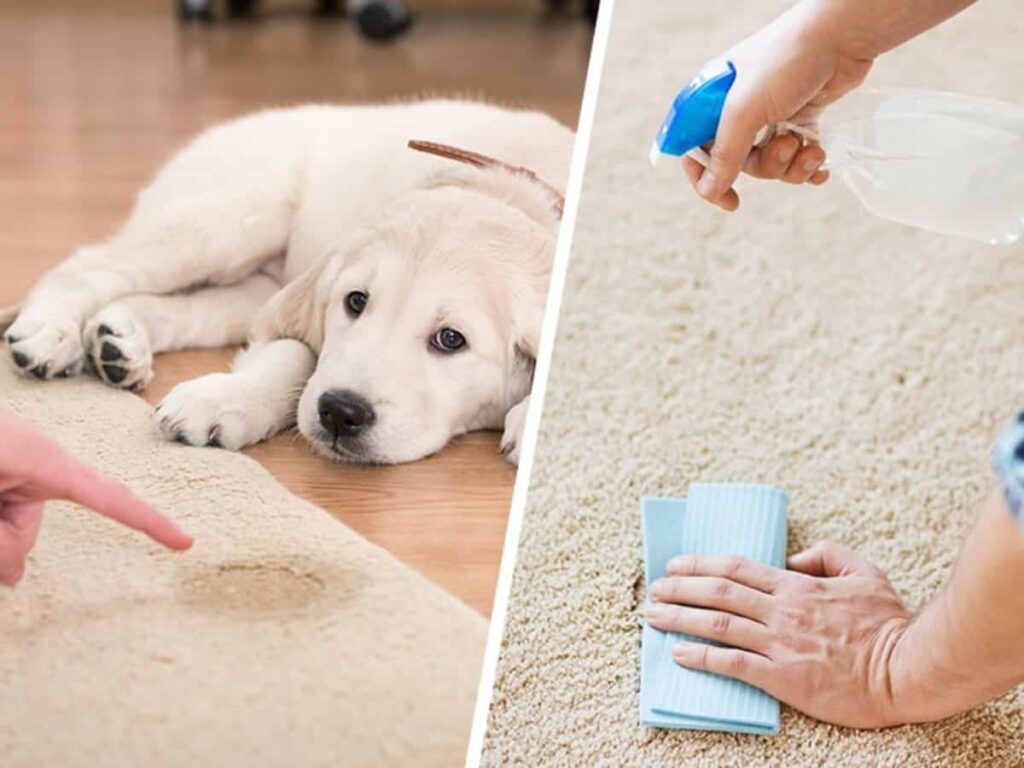
    two parts of picture, on the left side, a urine stain on carpet and a dog sitting sad and a hand pointing finger to the urine stain and on the right side, a close shot of hands with a cloth and spraying on urine stain.Use concentration: 50–200 ppm
    Ideal for:

    • Pet accidents
    • Bathroom smells
    • Small odor patches
    • Kitchen surfaces

    How to Apply:

    • Mix tablet to correct ppm
    • Allow full activation (solution turns amber/yellow)
    • Spray directly on odor source
    • Let sit 5–10 minutes
    • Rinse if needed (food surfaces)

    Also Read 👉🏻Deodorizing Pet Bedding with ClO2


    Method 2 — Deep Odor Penetration (Heavy Surfaces & Porous Materials)

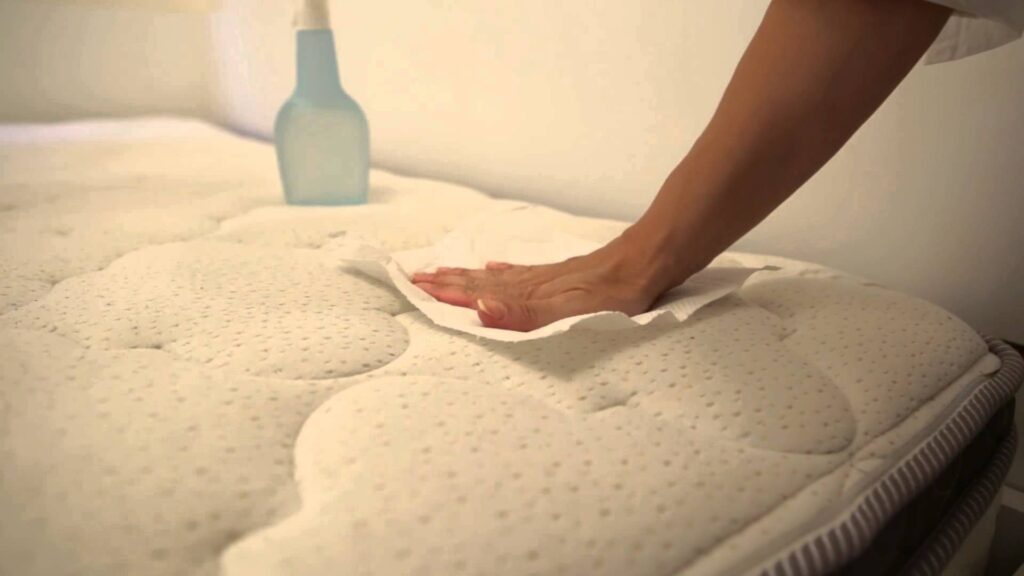
    sanitizing-mattress-with-sanitizer.Use concentration: 500 ppm
    Ideal for:

    • Carpets (spot treatment)
    • Mattresses
    • Gym gear
    • Pet bedding
    • Moldy areas
    • Trash cans

    How to Apply:

    • Spray or wipe affected area
    • Allow 10–30 minutes dwell time
    • Repeat if needed
    • Allow drying & ventilation

    Also Read 👉🏻 How to Sanitize Your Mattress After the Flu | Envirotab ClO₂ Solutions


    Method 3 — Room Shock Treatment (Severe Odor Remediation)

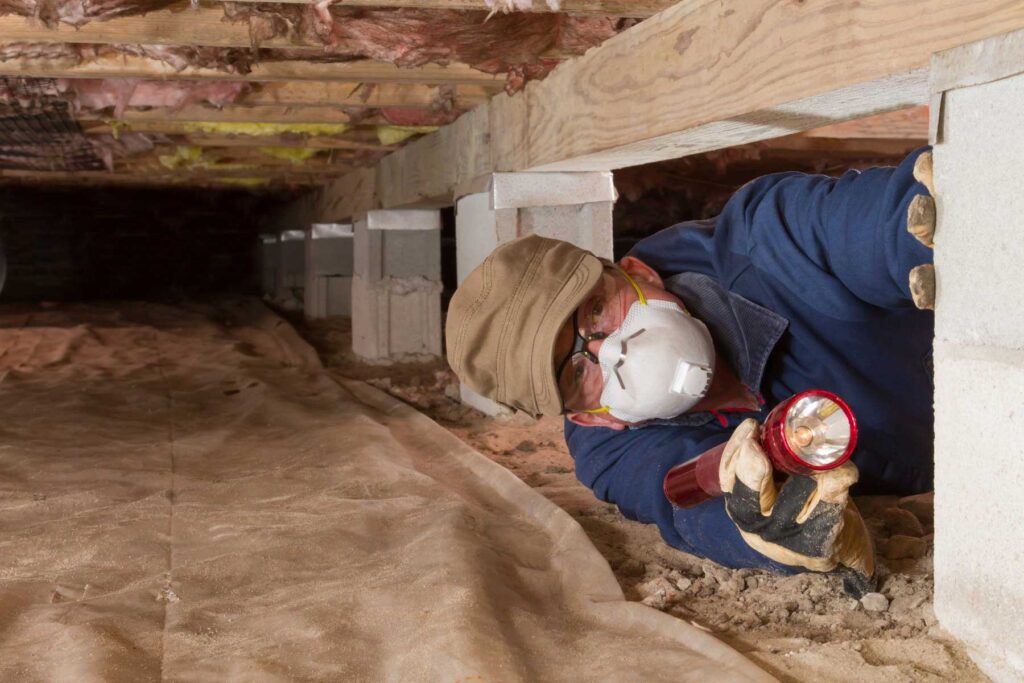
    mold inspector looking for mold in a crawl space and a torch in his hand.Use concentration: Based on tablet type
    Ideal for:

    • Smoke-damaged rooms
    • Musty basements
    • Vacant rentals
    • Storage units
    • Cars & RVs

    How Shock Treatment Works:
    ClO₂ slowly releases vapor into the air in a controlled way — safe when done properly.

    Procedure:

    • Place activated solution in a bowl or container
    • Seal room or vehicle
    • Leave 2–6 hours depending on intensity
    • Ventilate space for 10–20 minutes before re-entry

    NEVER:
    – Perform shock treatments in occupied rooms
    – Use ClO₂ gas aggressively without ventilation
    – Combine shock concentrations with ozone

    Also Read 👉🏻Airbnb & Short-Term Rental Cleaning | Odor Removal & Sanitizing With ClO₂


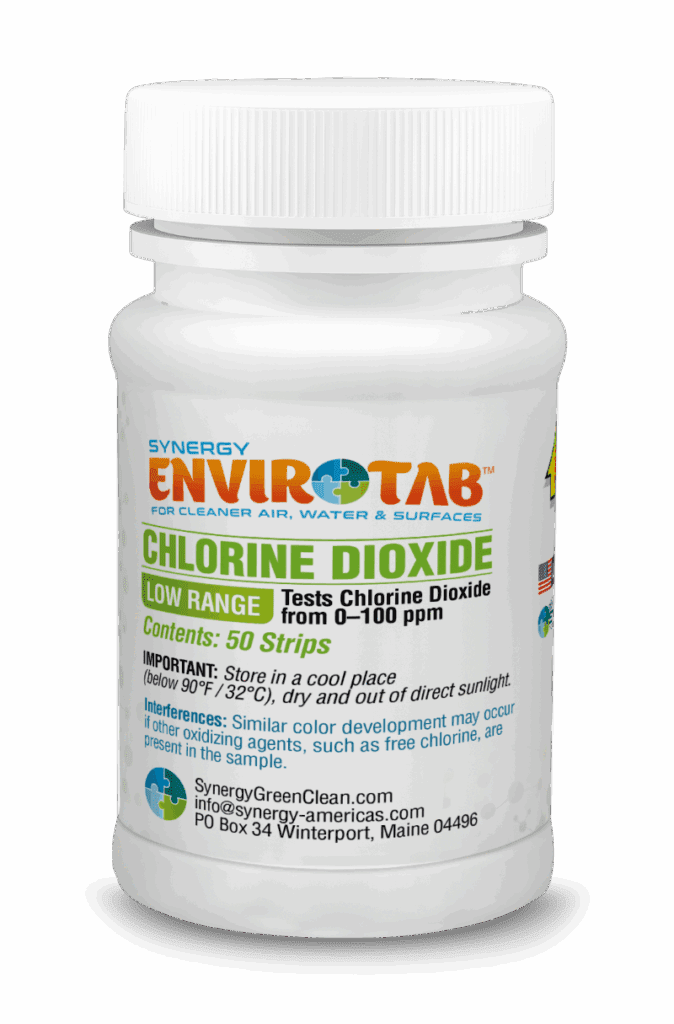
    Low Range Test Strip BottleSafety Guidelines for Indoor Odor Removal
    ClO₂ is safe indoors when:

    ✔ Used at correct ppm
    ✔ Basic ventilation is provided
    ✔ Room is unoccupied during shock treatments
    ✔ Pets and children avoid wet solution
    ✔ Solutions are not mixed with other chemicals
    ✔ Activation containers are not sealed tightly

    ClO₂ is less irritating than bleach and produces minimal fumes at cleaning levels.

    Order CLO2 Test strips here 👉🏻https://clo2tablets.com/clo2-test-strips-low-range-0-100ppm-50-bottle/

    Also Read 👉🏻How Safe Is Chlorine Dioxide for Indoor Use Around People and Pets?


    When NOT to Use ClO₂ for Odor Removal

    ClO₂ is not suitable for:

    • Diffusers
    • Devices that aerosolize chemicals
    • Fully enclosed, unventilated spaces
    • Highly porous materials (very old carpets, insulation) without testing
    • Removing non-organic chemical odors (solvents, gasoline)
    • Using concentrations above recommended levels in occupied spaces


    Always remember that CLO2 is highly affective if use properly.Quick Summary Box — Odor Removal With ClO₂

    • ClO₂ neutralizes odors at the molecular level through selective oxidation
    • Safe for indoor use when diluted properly
    • Effective on pet, smoke, mold, mildew, food, and musty odors
    • Works on surfaces, fabrics (spot treatment), and in enclosed shock treatments
    • Requires ventilation for stronger applications
    • Far safer and more versatile than ozone or bleach for odor remediation

    Ready to eliminate stubborn odors safely and effectively? Discover professional-grade chlorine dioxide tablets at Clo2Tablets.com and restore freshness to any space — without harsh chemicals.

    Order Here 👉🏻http://Clo2Tablets.com


    Frequently Asked Questions

    1. Does chlorine dioxide remove cat urine smell?

    Yes — ClO₂ oxidizes the uric acid crystals responsible for cat urine odor.

    2. Is ClO₂ safe for pets during odor removal?

    Yes, once surfaces are dry; keep pets away from wet applications.

    3. Can ClO₂ remove smoke smell from walls?

    Yes — both surface cleaning and shock treatments work well.

    4. How long does it take to remove odors?

    Anywhere from a few minutes (surface odors) to several hours (room shock).

    5. Will ClO₂ discolor fabrics?

    No — it is non-chlorinating and does not bleach fabrics at proper ppm.

    6. Can it remove moldy or musty smells?

    Yes — ClO₂ destroys both mold spores and musty VOCs.

    7. Is ClO₂ better than ozone for odor removal?

    Yes — because it is effective at lower concentrations and safer indoors.

    8. Does ClO₂ leave any after-smell?

    No — once dry, no chemical odor remains.

    9. Can I use ClO₂ in my car?

    Yes — both surface cleaning and vehicle cabin shock treatments work well.

    10. Can I spray ClO₂ on furniture?

    Yes, on non-porous surfaces. Test fabrics first.


  • Why DIY Mold Remedies Like Baking Soda, Vinegar & Oils Fail!

    Why DIY Mold Remedies Like Baking Soda, Vinegar & Oils Fail!

    DIY Mold Remedies vs. Science: Why Vinegar & Baking Soda Don’t Work

    🍋 The Myth of the Magic Pantry Fix

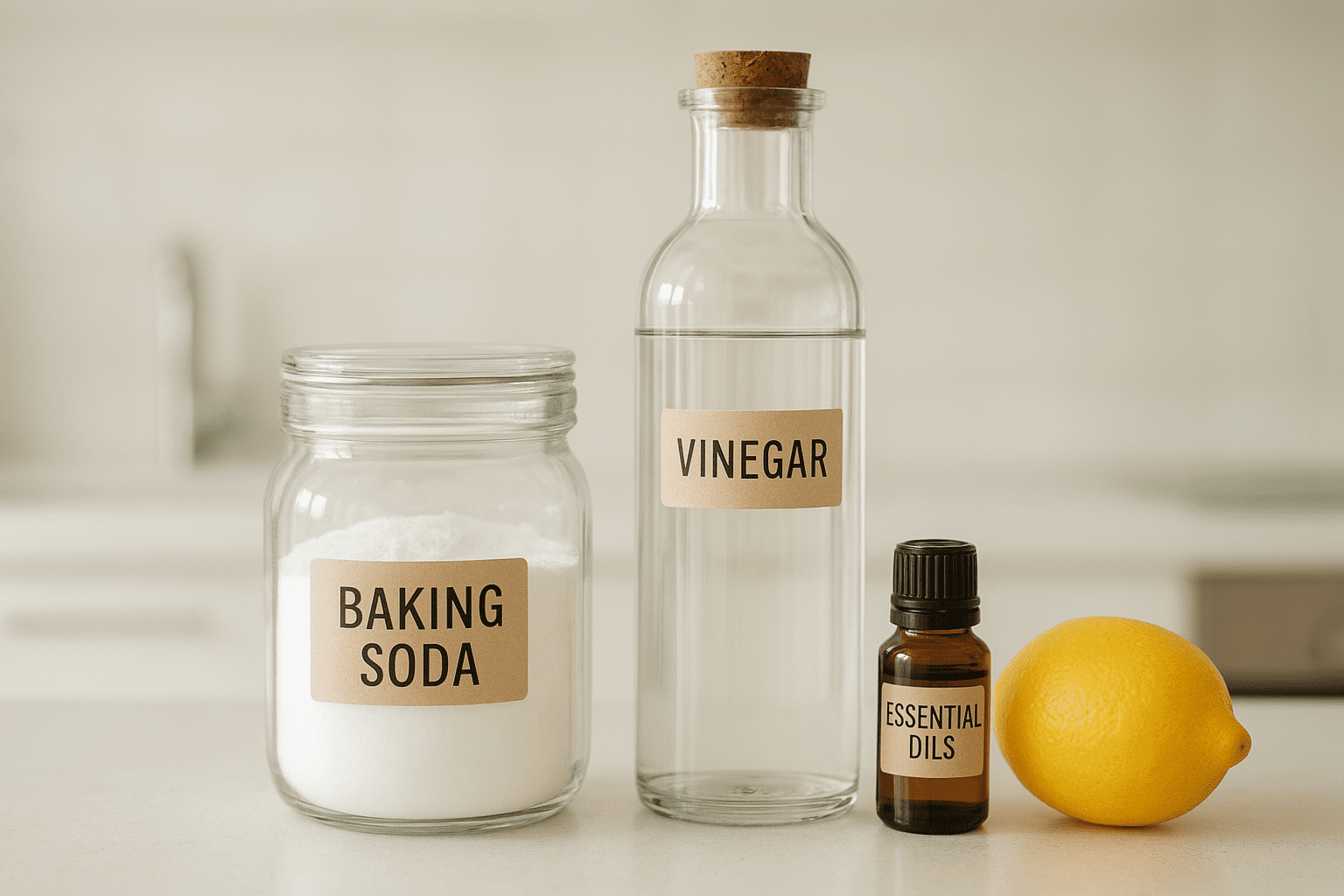
    It’s the rainy season, and you notice that all-too-familiar musty smell in the basement. You do what many homeowners do: grab a box of baking soda, a jug of vinegar, or maybe a bottle of essential oils. After all, Grandma swore by vinegar for everything, and Pinterest promises that a few drops of tea tree oil will keep mold away forever.

    It feels good, right? A quick fix you already have in your kitchen. You sprinkle, you spray, you dab, and for a moment—it smells fresh again.

    But here’s the truth: that’s surface-level comfort. Beneath the smell, the mold spores are still alive, active, and ready to spread.


    Backing soda is a great rubbing compound and excellent tooth polish but has no benefits to removing mold.🧂 Baking Soda – The Odor Absorber, Not the Mold Slayer
    Baking soda has a reputation for being a cure-all. People use it in refrigerators, laundry, even as toothpaste. When it comes to mold, though, baking soda is more of a band-aid than a cure.

    • Why people believe it works: Baking soda absorbs odors and creates a less hospitable environment for some microbes.

    • The science: While it can temporarily reduce musty smells, it doesn’t kill mold spores or penetrate porous surfaces. Mold isn’t just on the surface—it roots deep into wood, drywall, fabric, and insulation.

    • What is it good for: While not all is lost, Baking soda is good for making a paste with water to scrub sinks, tubs, or stovetops, Combine with vinegar to help clear minor clogs, Adds extra cleaning power to regular laundry, and makes for a great natural toothpaste powder.

    Bottom line: baking soda can freshen your fridge, but it won’t stop mold colonies from growing behind your walls.


    Vinegar is excellent for removing grease and gives a great shine to surfaces but won't cut to the core to remove bacteria and mold that makes you sick.🧴 Vinegar – The Half-Truth Cleaner

    Vinegar is the most popular DIY mold solution floating around the internet. “Just spray vinegar, and the mold dies!” sounds convincing.

    • Why people believe it works: Vinegar is acidic, and in some lab conditions, it can slow down certain types of mold.

    • The science: Vinegar can reduce surface-level mold but doesn’t neutralize all strains, especially the tougher, allergenic, or toxic molds. Plus, vinegar doesn’t stop spore regrowth. Think of it like mowing the lawn—the blades look gone, but the roots are still there, ready to return.

    • What is it good for: Mix with water for streak-free shine on glass and mirrors, Cuts grease and grime (avoid natural stone like marble) on countertops and sinks,  Steam vinegar to loosen gunk in your microwave, and add it to your laundry as it naturally softens without chemicals.

    That’s why a week after your vinegar spray-down, the same black spots creep back on the bathroom ceiling.


    🌿 Essential Oils – The Feel-Good Fix

    Who doesn’t love the smell of eucalyptus or tea tree oil? They make a house smell spa-like and clean. But when it comes to mold? The benefits are more myth than reality.

    • Why people believe it works: Essential oils have antimicrobial properties in controlled conditions and lab tests. Plus, they smell amazing, so we associate them with cleanliness.

    • The science: Oils might mask musty odors and offer some temporary inhibition, but they cannot reach deep-rooted mold colonies. Mold spores also thrive in places oils can’t reach—inside drywall, insulation, vents, or carpets.

    • What is it good for: Create a calming or uplifting home atmosphere, Combine oils with water in a spray bottle for a natural room spray. Add a few drops to laundry or dryer balls for a pleasant scent. and adding lavender or cedar oils in drawers are an excellent Natural moth repellant.

    At best, oils are mood-lifters, not mold-busters.

    essential oils smell good, promote inner balance and are just expensive!


    🧪 The Reality: Mold is Tougher Than Your Pantry

    Here’s the truth that often gets lost in the DIY advice cycle: mold spores are microscopic, resilient, and thrive in damp, hidden places. To truly eliminate mold, you need something that can:

    ✔ Penetrate porous surfaces
    ✔ Kill spores at their source
    ✔ Prevent regrowth

    That’s why baking soda, vinegar, and essential oils just don’t measure up. They may give you peace of mind for a day or two, but they don’t deliver long-term safety for your family’s health.


    🌊 The Science-Backed Solution: Chlorine Dioxide

    Unlike DIY hacks, chlorine dioxide (ClO₂) is scientifically proven to destroy mold spores at the molecular level. It works differently than bleach or vinegar—it penetrates, oxidizes, and eliminates mold without leaving harmful residues.

    • Safe for homes, basements, HVAC systems, and storage areas

    • Breaks down into salt and water, leaving no toxic leftovers

    • Effective against hidden mold growth and lingering odors

    When mold becomes a household guest, you don’t just want to cover up the smell—you want to show it the door for good.

    CLO2 is a healthy alternative to Bleach and other chemical household cleaners


    ⚖️ The Final Reality Check

    DIY remedies are comforting, but comfort doesn’t equal safety.
    The musty smell returning week after week isn’t just annoying—it’s a warning sign.

    Reality in one sentence: Vinegar, baking soda, and oils can make your home smell better, but only chlorine dioxide makes your home healthier.

    👉 Ready to ditch DIY myths and tackle mold at the source? Discover our eco-friendly chlorine dioxide tablets today.

    ❓ FAQ: Home Remedies vs. Real Protection

    Q: Do vinegar and baking soda really disinfect my home?
    👉 They can help clean surfaces, but they don’t fully kill bacteria, mold, or viruses. Vinegar can cut grease and reduce odors, and baking soda is great for scrubbing—but together, they’re more about shine than true sanitation.


    Q: What about lemon juice—doesn’t its acidity kill germs?
    🍋 Lemon juice has some antibacterial properties, but it’s not strong enough to eliminate pathogens that cause illness. It’s better at deodorizing and leaving a fresh scent than providing full protection.


    Q: Can essential oils replace disinfectants?
    🌿 Essential oils like tea tree, eucalyptus, or lavender smell wonderful and may inhibit some microbes in lab settings. But in real-world home use, they’re not broad-spectrum killers of viruses, mold spores, or dangerous bacteria.


    Q: Why should I be cautious about DIY remedies?
    ⚠️ Many DIY “green cleaning hacks” leave behind a false sense of security. Your counters may look and smell clean, but microscopic threats can still linger—and those are the ones that affect your family’s health.


    Q: So, what’s the safer alternative?
    ✅ For true peace of mind, use a proven solution like Chlorine Dioxide (ClO₂). It’s scientifically backed, eco-friendly, and powerful enough to handle the germs, odors, and mold that vinegar or lemons simply can’t touch.

    Other articles to check out!

    How Can I Kill Mold and Eliminate Musty Odors at Home

    https://clo2tablets.com/%f0%9f%a7%aa-how-safe-is-chlorine-dioxide-for-indoor-use-around-people-and-pets/

  • Is Chlorine Dioxide the Best Cleaning Solution for Schools?

    Is Chlorine Dioxide the Best Cleaning Solution for Schools?

    ✨ Why ClO2 Tablets Are a Smart Cleaning Choice for Schools, Homes & Public Spaces

    🧰 What Makes Chlorine Dioxide Tablets So Effective?

    Chlorine dioxide (ClO2) tablets are a game changer in the world of cleaning. When dissolved in water, they release chlorine dioxide gas—a powerful disinfectant that:

    • ❌ Kills bacteria, viruses, and fungi on contact
    • 🚫 Breaks down biofilm and germs at the cellular level
    • ✅ Works on surfaces like desks, floors, bathrooms, and cafeterias
    • ✨ Leaves no toxic residue

    This makes them a perfect choice for maintaining safe, sanitized environments—especially in high-touch areas like schools and shared housing.


    🚑 Disinfection Power That Schools Can Trust

    ClO2 tablets destroy germs by breaking down their cell walls. That means fewer illnesses spreading through classrooms, cafeterias, and restrooms. Use them on:

    • 💻 Desks
    • 🛋 Chairs
    • 🛏 Doorknobs
    • ♿ Toilet handles
    • 🛁 Sinks

    The best part? They’re safe to use around kids when applied properly, making them ideal for daily classroom sanitization.


    🍃 Eco-Conscious Cleaning You Can Feel Good About

    Unlike harsh chemical cleaners, ClO2 is non-toxic, biodegradable, and doesn’t pollute the air or leave harmful residues. It’s a win-win for:

    • 🚗 School systems
    • 🏠 Homeowners
    • 🏡 Landlords
    • 🏢 Commercial property managers

    Use them with peace of mind knowing you’re protecting both your people and the planet. 🙌


    💩 Say Goodbye to Lingering Odors

    ClO2 tablets don’t just cover up smells—they eliminate them by breaking down the actual odor-causing molecules. Whether it’s:

    • 🚻 Gym bag funk
    • 🚽 Bathroom smells
    • 🍽 ✨ Cafeteria spills

    Spray or fog the solution in affected areas and enjoy a truly fresh, clean scent.


    🏦 Cafeteria & Bathroom Cleaning Made Easy

    These high-traffic areas are breeding grounds for bacteria. ClO2 tablets make it easy to:

    • 🥚 Sanitize food-prep surfaces
    • 🧻 Disinfect sinks, floors, toilets
    • ⚡ Remove foul odors
    • 🚮 Prevent mold and mildew

    💲 Budget-Friendly & Efficient

    Each ClO2 tablet goes a long way.

    • 📊 Clean large spaces with a single tablet
    • ✉️ Store easily and use as needed
    • 💼 Replace multiple cleaning products with one versatile solution

    Perfect for schools and landlords looking to cut costs without compromising safety. 📅


    ✅ Safe Use Tips for Schools & Families

    To use ClO2 tablets effectively:

    1. 📚 Read the package instructions
    2. 🚧 Wear gloves
    3. 🌪‟ Work in well-ventilated spaces
    4. ☑️ Apply to approved surfaces only
    5. ⏳ Let surfaces dry before use
    6. 🌚 Store tablets away from children

    🏡 ClO2 Tablets: Your All-in-One Cleaning Ally

    Whether you’re a school admin, homeowner, or property manager, ClO2 tablets offer an unbeatable combination of:

    • 🌍 Environmental safety
    • 🤒 Disinfection strength
    • 😎 Odor removal
    • 🚌 Surface versatility
    • 💰 Cost-efficiency

    👉 Ready to clean smarter, not harder? Shop chlorine dioxide tablets at clo2tablets.com and start creating safer spaces today!


  • How do I Use CLO₂ Tablets for Cleaning, Odor Removal & Mold?

    How do I Use CLO₂ Tablets for Cleaning, Odor Removal & Mold?

    💥 From Air Quality to Mold Removal: Discover How CLO₂ Tablets Transform Your Home, Gear & Workspace

    🧪 What Are CLO₂ Tablets?

    CLO₂ tablets—also known as chlorine dioxide tablets—release chlorine dioxide gas when dissolved in water. This gas is a powerful, selective oxidizer that kills bacteria, viruses, mold, and odors without leaving harmful residues.

    They’re ideal for:
    ✅ Water purification
    ✅ Surface disinfection
    ✅ Air quality improvement
    ✅ Odor elimination
    ✅ Mold & mildew remediation
    ✅ Medical & industrial sanitation

    👉 Buy Professional-Grade CLO₂ Tablets Here


    ✅ How to Use CLO₂ Tablets Properly

    ✔️ Read the package instructions. Dosage varies by task.
    ✔️ Dissolve in the correct volume of water.
    ✔️ Work in a ventilated area—CLO₂ gas can be strong.
    ✔️ Wear gloves when handling the solution.
    ✔️ Store tablets in a cool, dry place—away from kids and pets.


    💧 Water Purification with CLO₂

    Perfect for camping, travel, or emergencies. These tablets kill waterborne bacteria, viruses, and parasites—without altering taste.

    🟢 Drop 1 tablet into 1 liter of water
    🟢 Wait 30 minutes before drinking
    🟢 Ensure your container is clean

    👉 Related: How To Remove Urine Odor From Hard Wood Floors?


    🧼 Disinfecting Surfaces Safely

    Ideal for high-touch surfaces: countertops, doorknobs, bathrooms, and more.

    1. Mix CLO₂ tablets with water
    2. Apply with cloth or spray bottle
    3. Let sit for 10 minutes
    4. Wipe dry with a clean cloth

    👉 Pro Tip: Always wear gloves.


    🌬️ Eliminating Bad Odors

    CLO₂ doesn’t mask—it neutralizes odors at the molecular level.

    • Mix solution and place in an open container for air treatment
    • Mist areas like cars, closets, and pet zones
    • Ventilate afterward for best results

    👉 Related: How To Eliminate Bad Odor From Refrigerator?


    🏥 Treating Medical Equipment

    Keep tools clean—without harsh, corrosive chemicals.

    • Prepare solution per instructions
    • Soak or wipe down equipment
    • Let sit for 10 minutes
    • Rinse and dry if required

    Great for stethoscopes, thermometers, and non-electric tools.


    🥦 Preserving Fresh Produce

    Disinfect fruits and vegetables to extend shelf life naturally.

    • Soak produce in CLO₂ solution for a few minutes
    • Rinse with clean water
    • Let air-dry before storage

    👉 Related: Benefits Of CLO₂ Tablets In Food Processing Sector


    🧽 Removing Mold and Mildew

    Target mold in bathrooms, basements, or crawl spaces.

    • Spray affected areas with CLO₂ solution
    • Let sit for 10–15 minutes
    • Scrub and wipe clean
    • Ventilate area afterward

    👉 Related: How To Remediate Mold In Crawl Spaces?


    🏭 Industrial Cleaning Applications

    Trusted by:
    ✅ Food processing plants (surfaces, tools, packaging lines)
    ✅ Hospitals (room disinfection, medical sanitation)
    ✅ Water treatment facilities (biofilm & microbial control)

    👉 Related: How Can CLO2 Tablets Improve Factory Cleaning Efficiency?


    🌱 Enhance the Air You Breathe

    Drop a tablet in water to release a deodorizing, germ-killing gas. Ideal for:
    🐾 Pet odors
    🔥 Smoke smells
    🏚️ Moldy basements

    ✅ Fast. ✅ Fresh. ✅ Effective.

    👉 Order Now: 1g CLO₂ Tablets for Cleaning, Deodorizing, and Sanitizing


    ✨ Final Thoughts

    CLO₂ tablets are more than just a cleaning hack—they’re a smart, eco-conscious solution for modern sanitation. When used correctly, they safely eliminate contaminants in water, air, and on surfaces.

    ✅ Ready to clean smarter, not harder?
    Visit 👉 clo2tablets.com and get the same powerful, professional-grade CLO₂ used in hospitals, farms, and industrial facilities.